Blog

Viewing Report 19th March 2022

20:00 – 23:00

So after a successful day at The Practical Astronomy show it was time to head on out to play with my new toys. In this case a new 31mm Nagler Type 5 2″ eyepiece that I purchased from Owen Brazzel.

31mm Nagler

The other aim tonight was to setup the Argo Navis computer to allow me to find objects in the night sky on the 22″. Owen had said to me at the show that this is a must else I would find it difficult to star hop from one object to another without it, which was proved out the last time Bob and I ventured out.

Argo Navis

So I went to the Workshop where the Dob is stored and took it out onto the observing space and started to put it together. It only takes about 15-20 mins and then I set about collimating quickly with the laser collimator.

Laser colimator

Once done I fitted the Paracorr optical corrector followed by the 2″ eyepiece. I then set about putting the cables in for the Argo Navis computer and clipping it onto the side of the 22″.

It took me over an hour to finally setup the computer, in the main I did not RTFM and finally succumbed like all good blokes to reading the manual. It was them extremely straight forward. I had a good look through the menus to familiarise myself, but really the only thing to do was to identify 2 stars. The process for this must be followed for it to work correctly.

So I selected Mode Align Star option form the menu clicking the Enter key, then selected a star using the Dial, in this case BETELGEUSE came up. Now DO NOT PRESS ENTER!! Put the star in the centre of the eyepiece and then press the Enter button. Then WARP= +0.00 (1) should appear briefly meaning 1 star is aligned. Now using the Dial select another star (in this case SIRIUS) and repeat. Once you select ENTER then you see WARP= +0.00 (A) which means aligned. Now you are good to go and use the catalogue to tour the night sky.

I then selected some objects including M42, which looked lovely but low, the double double which really allowed the eyepiece quality to show off its abilities. I went round few other objects and Luke came out too, In fact to be fair he helped me get the computer working and then we shared the views in the scope. It was a good evening. We then between us took the scope apart and put it back in it’s home.

Obsession in use with the light on for the photo of course πŸ™‚

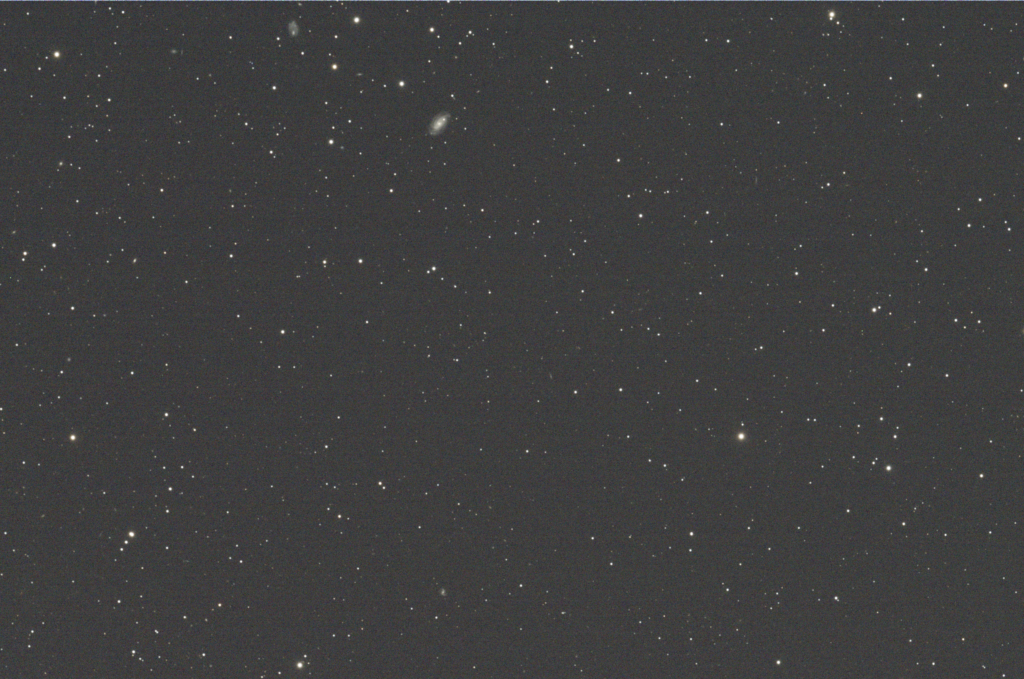
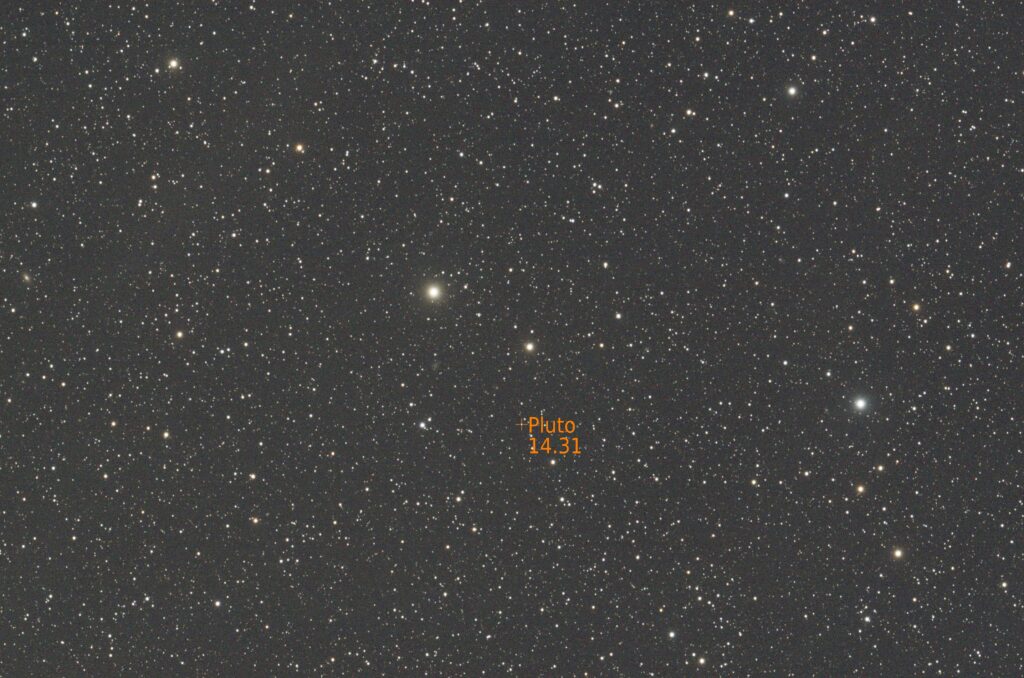
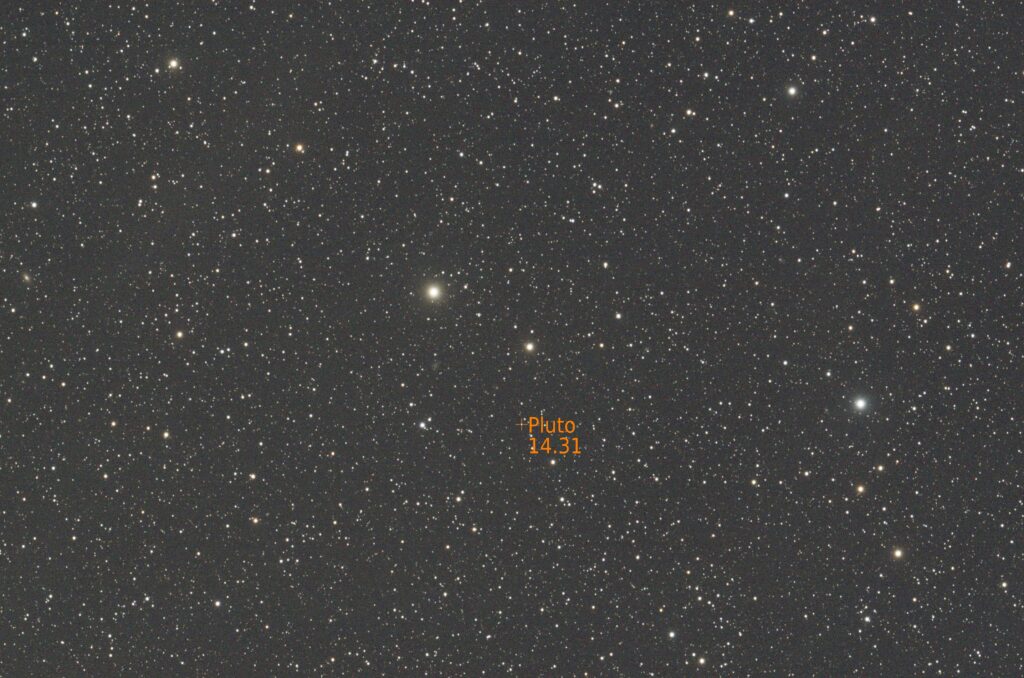
Exoplanet HAT-P-66b (25/2/2022) – IMT3Β + Visual with 22″ Dob!

21:24 – 03:00

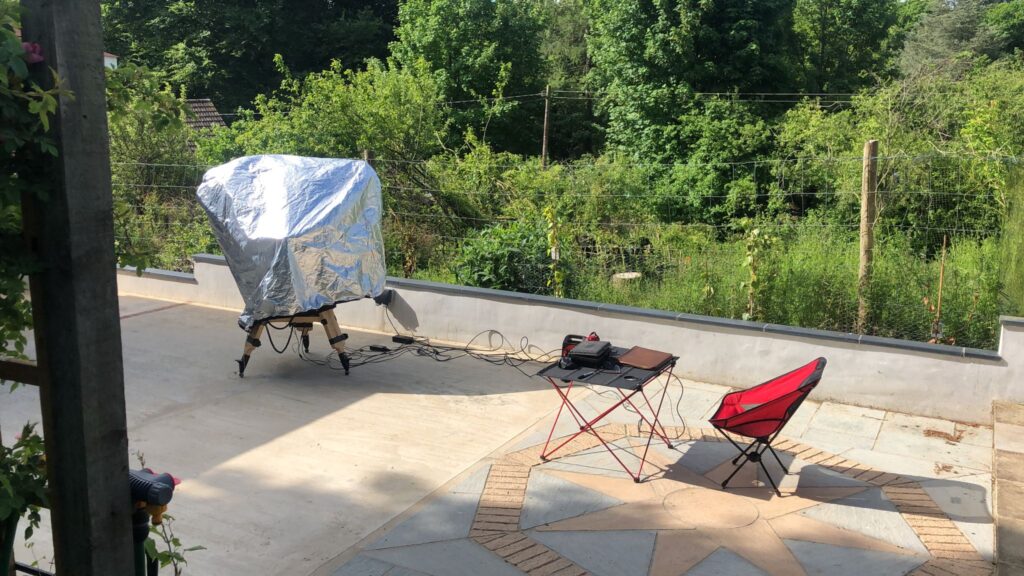
So for the first time in a while the observatory is back up and running and it’s Friday and it’s clear! So Bob came over and we set about imaging an exoplanet and getting the 22″ Obsession dob out of the warmroom where it had been sitting since November, and moving it down to the observing plateau by the IMT3b observatory.

A few nights back, during the week I had managed to get the 12″ in the dome balanced with my original 2004, 5″ Skywatcher 130 reflector as a guide scope and the Skywatcher Esprit 120 ED on the other side. The 5″ now guides, however the QHY camera on the 120 is not currently connecting so I need to investigate. Also the MEII hand controller is sending erroneous signals to the mount so I needed to disconnect as it kept saying ‘joysticking’ and moving the mount. Unfortunately the 5″ was pointing at the dowel so I used off-axis guiding instead.

Blue 5″ scope pointing at the dome

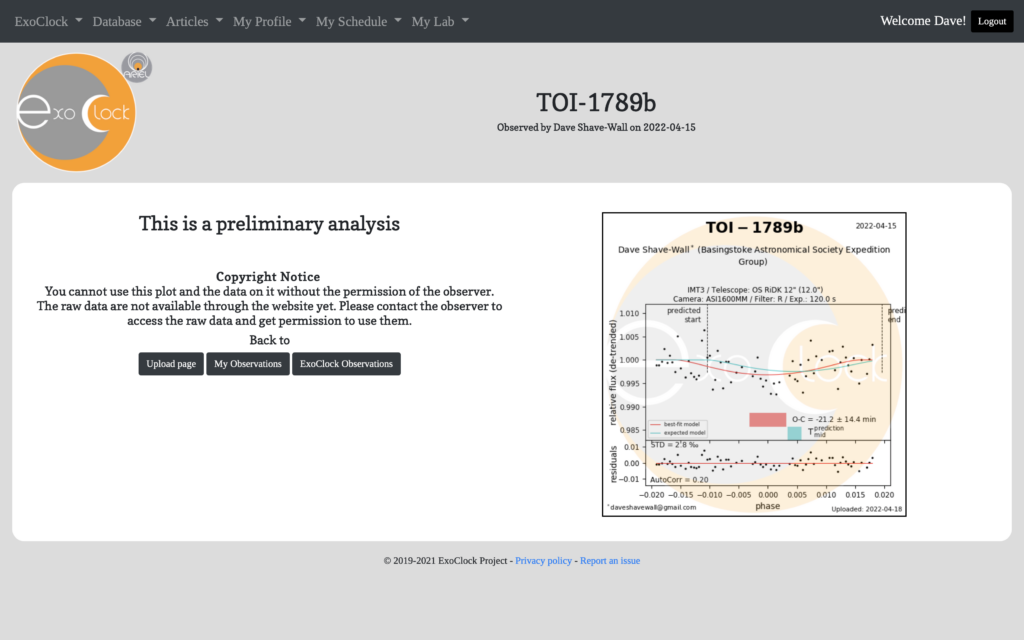
I selected an exoplanet on the Exoclock website, and set about imaging. Unfortunately due to my profile on exoclock being set to UTC +1 and me not noticing I started 45 mins into the transit! I will now use this as a test run and process the data and submit.

Exoplanet schedule

So first up was moving the 22″ down to the plateau so it could cool down. I had planned on taking it back up to the Warmroom, however it is so heavy I have decided to keep it in the workshop. I will make sure I connect the electric up for the workshop this weekend thus allowing for the new dehumidifier to be switched on and operational.

22″ UC Obsession telescope

Whilst the 22″ cooled down, we went back indoors and setup the 12″ in the observatory to image the transit. The focus point was 25,000 and I made sure I selected the Red filter. I slewed and aligned on the exoplanets host star and then settled on a 5min exposure due to the low brightness. I started imaging at 9:24pm, the transit start was 8:45pm πŸ™

HAT-P-66 b

Whilst imaging continued we went outside and set about setting up the 22″. Things I learnt from this first public outing were;

  1. Remember to put the shroud on
  2. Remember to pub the secondary shield on
  3. Remember to collimate the secondary first
  4. Remember to fit the Telrad dew heater
  5. Remember to find a 40mm eyepiece
  6. Remember to download and print the Parracor chart
  7. Remember to set the Parracor to the correct setting
  8. Remember to buy a 12v battery powered hair dryer
  9. Remember to buy a secondary dew heater

We collimated the scope and then went on to look at M42 which with the 24mm Panoptic looked great. We then slewed to M45 the Pleiades but of course the open cluster is too wide for the for I was using. Then we tried find M81 and M82 but I found this difficult due to the lack of bright stars in the area. So instead we went to the Trio in Leo.

M65 and M66 looked fairly bright and you could make out the dark dust lane in M65. NGC 3628 was visible with direct vision, however with adverted vision it was much easier. It appeared very long and thin.

We had to use s hairdryer on the secondary a lot. The Telrad also dewed up as did the eyepiece. The primary mirror was fine, although with direct headtorch light looked like it was dewed, but upon inspection this was not the case.

At midnight it was time to pack up before I had to do a meridian flip. Bob helped my dismantle the 22″ dob and then place inside the workshop. I could not move it into the room without dismantling which was a shame. It is far too tall.

Once done, Bob headed off home for a well deserved rest and to warm up due to it being 0℃. I headed indoors and performed the meridian flip at 0:23am.

I then left the observatory running until 2:30am whilst I wrote this blog, had a glass of wine and ate an easter egg πŸ™‚ I also went back out to the workshop to tidy up the telescope eyepieces etc that I had not put away.

At 3pm I went on to take luminance for M85 that I needed to complement the RGB data I had processed. I let this running and went to bed.

M85 Lum 300s

I took flats and dark flats in the morning, although I had to increase the exposure to get the required level for the flats. This is strange as they should be the same. I am now concerned the camera my be playing up and causing an issue. I will investigate.

Viewing Report – Kielder Water (18-20/02/2022)

So with short notice a couple of my friends booked a cottage just outside the Kielder Water park boundary in Northumberland. This was booked for same weekend that Storm Eunice and Storm Dudley hammered the UK, the drive from the South of England to the North was very gusty and interesting at times.

Suffice to say that during my short stay in a farm cottage I saw more of Pubs such as the local warm, very friendly and welcoming Star Inn and comfortable cottage fireplaces than I did clear nights.

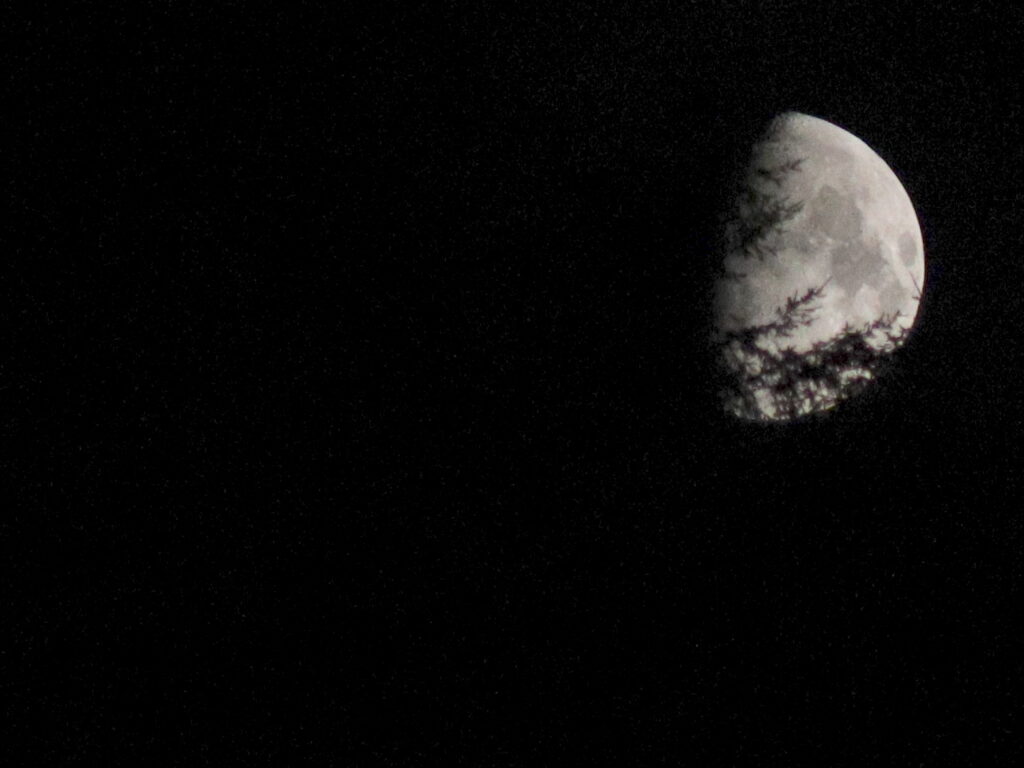
On the first evening it was broken fast moving cloud so we settled on taking in the various views of the 17 day old moon (94.2%). Although it was very bright being just after full moon, we scoured the edge of the disc looking at the shadowed craters. The first evening’s session was cut short by the cloud and rain, which seemed to set the mood for the week.

On the next few cloudy nights, I spent the time upgrading to ASCOM 6.6, the latest NINA beta and SGPro 64bit. Of course this required me to make sure I had the latest 64bit drivers installed. Once done, I began testing the various bits of hardware within the applications.

Very welcoming when it is wet, windy and foul outside

However on my final evening whilst nestling a Talisker Single Malt in front of the fire. I just happened to peer outside and it was clear, breezy and cold but clear. So since the weather report said it would cloud up I grabbed the Baby Dob (SkyWatcher Heritage 150) and headed outside for a quick sky tour.

With Laurence and Laura we finally saw why astronomers come to the Northumberland National Park. The Milky Way was so obvious stretching from Orion in the South, through Perseus and Cassiopeia and the sheer number of stars was breath taking.

We started looking in Orion, the Orion Nebula (M42) which the 150P does not do it justice and really a 200P and decent eyepiece would be needed to show the wispy cloud structures. We looked at the stars Betelgeuse and Sirius (Canis Major) just to show the colours of these giants before moving along to view the Pleiades (M45) and the star clusters in the constellation of Auriga.

The Double Cluster (NGC 889/NGC 884) in Perseus in the 25mm wide field eye-piece was beautiful. From the Perseus/Cassiopeia border we moved through the milky way and across to Canes Venatici hunting down The Whirlpool Galaxy (M51) which we saw as two misty patches, one smaller fainter patch and a larger patch with a faint core.

Moving southwards we hunted for the globular cluster M3 which was low on the horizon and effectively in the trees but we managed to locate it. Again it was a misty patch and looked like a comet. Switching to the 10mm eye-piece I tried to resolve the patch as stars but I was unable to, maybe due to it’s low altitude but Laura was able to do so with averted vision.

Of course I also forgot that objects I can see from The South Of England are higher up in the sky compared to The North Of England by almost 4 degrees altitude.

Not long after we headed in doors to warm up, the clouds rolled in, the wind picked and the snow started falling as a precursor to the incoming Storm Franklin. Such is life but at least I got a few hours under dark skies even if it was visual and not deep sky imaging.

Viewing Report 5th January 2022

17:00 – 02:15

went out and put ZWO ASI120MC on the back of the ST80 guide scope. Refitted the Lodestar to the off axis guider. I then setup the FoV indicator on TSX and also got the guider to focus.

Took a bunch of M78 frames LRGB to start with. Then tried a 600s Ha but that showed very little.

Then joined by Bob joined and he reminded me to image JWST.

Then around 12:30am I started imaging M78 again on the other side of the meridian. I must sort out imaging with a frame so that it is easier to get the object inside the FoV and lined up as it took me quite some time this evening. Plate solving was also not working again within SGP so I need to look at that on the next night out.

Detecting pressure waves from the Tonga Eruption (2022/01/15)

On January 15th 2022 at 15:10 AEDT (04:10 GMT) theΒ Hunga Tonga Hunga Ha’apai underwater volcano near Tonga erupted. Hunga Tonga-Hunga Ha’apai is 1.8 kilometres tall and 20 kilometres wide, but most of it is underwater, with the top 100 metres visible above sea level. The pressure wave generated by the explosion blasted through the atmosphere atΒ more than 1000 kilometres per hour.

Dave mentioned to me that the people had registered a pressure increase on their monitoring devices due to the pressure wave and checking the internet the Met Office has issued a nice graph on Twitter.

On the observatory Grafana dashboard I could indeed see two pressure waves at the correct time. We only record the pressure every 60 seconds because for astronomy that’s all we need so we do not have the resolution of others but the height of the two events are in the correct range compared to the graph above.

Double pressure wave

The first pressure wave arrived (19:13-19:24) we was 2hPa increase as we have lost some resolution due to sampling period and the Met Office is ~2.5 hPa. We could change the sampling to be lower (15 or 30 secs) as storage is not an issue and then we would have caught a nice defined peak. The second pressure wave (2022/1/16 01:55-2:14) and we measured ~1hPa drop and again was lower than the Met Office due to our sampling period.

Our auxiliary pressure monitoring install was down during this period as the box appeared to have been restarted/rebooted and the ASCOM Alpaca instance was not running which was unfortunate πŸ™

The Night Sky Observer Guide Series

When I started attending the Practical Astronomy Show held at Kettering I picked up my first copy of “The Night Sky Observers Guide Volume 4 – The Glories Of The Milky Way to -54Β°” written by George Robert Kepple and published by Willmann-Bell inc. These were sold at the Kettering show by the very helpful and knowledgeable staff of The Webb Deep-Sky Society for around Β£20.

Then in December 2019 ‘The Global Human Malware’ happened and the world went nuts, the Astronomy shows were cancelled year on year and I forgot to complete acquiring the rest of the series. Then suddenly in late 2020 it was announced that the publishers Willmann-Bell had closed and their entire portfolio went out of print.

Unfortunately I did not see the announcement until late Jan 2021, however I managed to obtain a copy of “Volume 2 – Spring & Summer” (ISBN 0-943396-60-3 (V2)) from Zoltan at 356 Astronomy but he told me he was out of stock for the rest of the series.

I contacted the Webb Deep-Sky Society to see if they had any available copies in stock. The president of the society Owen Brazell very promptly replied but informed me that they had sold their remaining stock just days before. He was extremely helpful in trying to help me source any remaining stock but eventually to no avail ! I recommend any avid astronomer should consider subscribing to the Webb Deep-Sky Society here …… I just did πŸ™‚

Example of Webb Deep Sky Society Digital Issue

Fast forward to 16th August 2021 and it was announced that the American Astronomical Society would acquire the inventory and related assets of Willmann-Bell. Luckily by January 2022 I noticed that FLO (First Light Optics) in the UK had managed to obtain a few copies and I promptly ordered a copy of “Volume 1 – Autumn & Winter” (ISBN 0-943396-58-1 (V1)) for Β£35.

Well, it arrived this morning and I apologised to my regular postman for having to carry it around by hand all morning.

As with the other volumes the information, maps, diagrams and descriptions are very useful for planning imaging or observing sessions.

The King of the Northern Winter Constellations – Orion
The fantastic Perseus Galaxy Cluster

I now have only Volume 4 “The Southern Skies” left to purchase but as that would only be a reference for objects I can’t see from the UK it would go mostly underused unless I start using my remote telescope account or travel around or below the equator.

I would like to thank Owen Brazell for all his time and for the ongoing activities of the Webb Deep Sky Society and hopefully we will see them at the next Practical Astronomy Show in March 2022 …. fingers crossed !

Viewing Report 4th January 2022

17:53 – 02:34

Clear night! So I’m going to setup and let the dome run all night if it stays clear which is the forecast as I have work tomorrow.

All Sky Camera

I have run the guiding assistant on PHD2 so that I can hopefully better track objects. The drift in frames from the last time out whilst using the ST80 as a guide scope was less than ideal. I have now put al the new settings suggested into the PHD setup and have swung round to do a focus run on a star near to M32.

PHD2 new settings

After successfully running autofocus in SGP at 23,560 on Luminance I have now slewed to M32 to gather more data that is desperately needed to resolve the outer spiral arms of the companion giant galaxy M31.

SGP Focus Run
M32

So it is now just gone 9pm and whilst the guiding is managing to stop trailing of stars, the image is moving between frames, enough to loose the object over the course of 4-8 hours. This is clearly not good enough and it does look like the focal length of the ST80 is simply not long enough.

To get around the problem this evening I have turned guiding off, as the exposures are short (3 minutes) the trailing of stars is not an issue. At midnight I took flats for M32. I then centred on M78 for the rest of the night. Before starting I performed another focus run as the focus point had changed over the night with the temperature drop.
Auto Focus

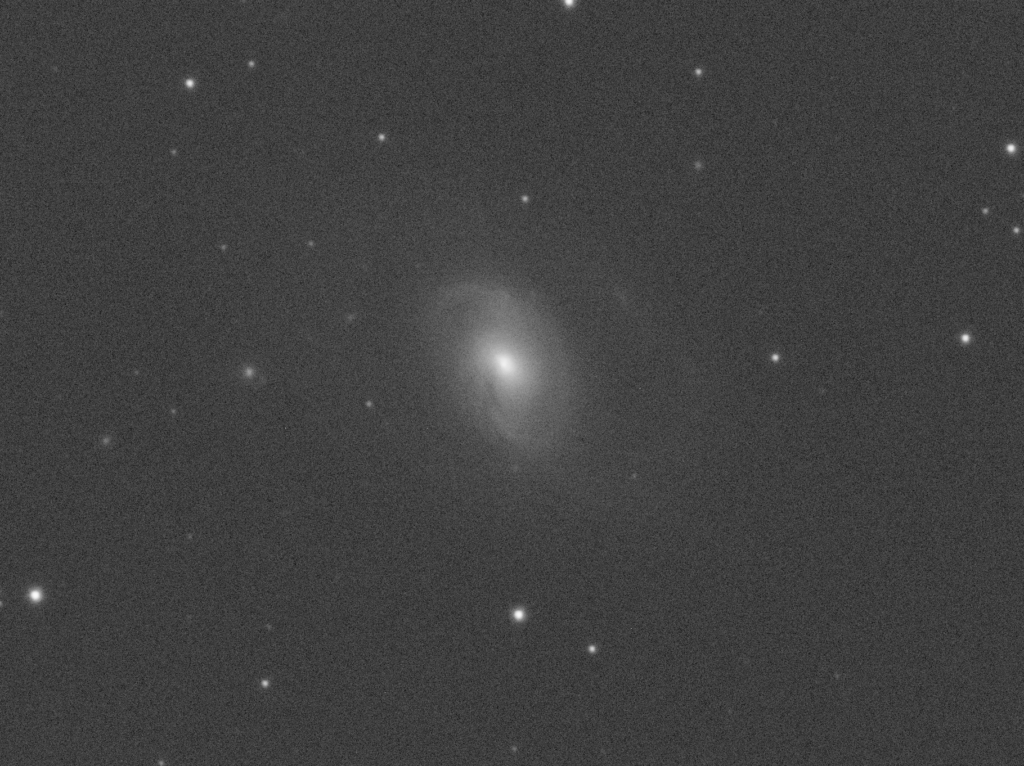
I choose the same exposure settings and Gain 139 and Offset 21 settings as for M32. -25C was the temperature but this time I rotated the camera by 90 degrees to also fit in NGC 27309.

M78 & NGC 27309 and a satellite trail

So I left the scope running and it completed at around 2:30am with 40 frames taken across 4 filters giving me 30 minutes per channel. This will be enough to get started and if clear tonight I will setup for another run at M78 and hopefully improve the guiding.

Update. On reviewing the files this morning it looks like I forgot to select the filter in SGPro which means all my M32 and M78 images from this evening are in fact luminance only! Which is ok for M32 but for M78 I need some colour. Below is the weather data for last night.
Viewing Report 2nd January 2022

19:26 – 01:30

I started with M76 Ha as I need some frame for this object. I already have many hours in OIII. However after starting to image I realised the guiding, which is currently being tested through Dave Boddington’s ST80 was not pointing through the slit correctly as M76 was near the zenith. This means I have suffered from trailing as the guider was trying to guide on long stars due to diffraction.

M76 – 1 x 600s Ha

I swapped to a different object, this time M32 as I have not imaged this directly before, just as a happenstance of imaging M31. I have chosen 180s exposures using Gain 139 Offset 21 to keep the saturation of the core down. At 300s the core was blown out.

M32 – 1 x 300s Lum

M31 can be seen to the left and lower left of the small galaxy. M31 covers a large part of this image! So how well was my guiding doing?

Guiding with the ST80 guider

The guiding looked fine. 0.52 arcsecs total error which I am happy with. I stayed up until just before midnight and then left the observatory running. In the morning I noticed the dome shut around 1:30pm due to the images after that looking like flats.

I also noticed this morning that the images were drifting so the guiding is not quite right as the image drifts. I will next time out run the guiding assistant and see if that helps.

Update the image scrubbed up fairly well but I lost a lot of frames to drift and trailed stars and then the dome closing. Resulting image around 3 hours 12 minutes exposure of which 48 mins was Luminance but there was cloud affecting many frames.

M32 – 3 hours

Below is a copy of the nights weather data.

Cloud cover

Temperature

PixInsight – Load Default Project/Process Icons

So whilst Dave was processing our M45 QHY268C data, he mentioned how it is frustrating that he has to reload his process icons for his workflow every single time.

After finishing the communications/process diagram for IMT I decided to have a quick look if it was possible. Watching PixInsight startup I noticed access to a few files – banner and startup.scp. For me these were located in the C:\Program Files\PixInsight\etc\startup directory.

Looking through the documentation it seemed possible to add statements to the file which was possible once I had modified it as Administrator.

Method 1 – Load Process Icons

This will load just the process icons into the current workspace on startup. Add the line below to the bottom of C:\Program Files\PixInsight\etc\startup\startup.scp :

open "C:\Users\gingergeek\Pixinsight\Pixinsight DSW Process Icons V10.1.6.xpsm"

Save the file and restart pixinsight.
Method 2 – Load An Empty Project With Process Icons

Another method (preferred) is to create a new project (Empty-process-icons.pxiproject), load in the process icons. Save the project and then change the properties to make it read-only so you can’t accidentally overwrite it later on.

Add the line below to the bottom of C:\Program Files\PixInsight\etc\startup\startup.scp :

open "C:\Users\gingergeek\Pixinsight\Empty-process-icons.pxiproject"

Save the file and restart pixinsight.
I also modified the banner file (in the same directory as startup.scp) so it would show the IMT3b designation. I generator the ASCII art from one of the many online sites, if I can remember which one I will link it here.

\x1b[1;38;2;255;000;000mβ–ˆβ–ˆβ•—β–ˆβ–ˆβ–ˆβ•— β–ˆβ–ˆβ–ˆβ•—β–ˆβ–ˆβ–ˆβ–ˆβ–ˆβ–ˆβ–ˆβ–ˆβ•—β–ˆβ–ˆβ–ˆβ–ˆβ–ˆβ–ˆβ•— β–ˆβ–ˆβ•—\x1b[39;21m
\x1b[1;38;2;230;000;000mβ–ˆβ–ˆβ•‘β–ˆβ–ˆβ–ˆβ–ˆβ•— β–ˆβ–ˆβ–ˆβ–ˆβ•‘β•šβ•β•β–ˆβ–ˆβ•”β•β•β•β•šβ•β•β•β•β–ˆβ–ˆβ•—β–ˆβ–ˆβ•‘\x1b[39;21m
\x1b[1;38;2;204;000;102mβ–ˆβ–ˆβ•‘β–ˆβ–ˆβ•”β–ˆβ–ˆβ–ˆβ–ˆβ•”β–ˆβ–ˆβ•‘ β–ˆβ–ˆβ•‘ β–ˆβ–ˆβ–ˆβ–ˆβ–ˆβ•”β•β–ˆβ–ˆβ–ˆβ–ˆβ–ˆβ–ˆβ•—\x1b[39;21m
\x1b[1;38;2;179;000;153mβ–ˆβ–ˆβ•‘β–ˆβ–ˆβ•‘β•šβ–ˆβ–ˆβ•”β•β–ˆβ–ˆβ•‘ β–ˆβ–ˆβ•‘ β•šβ•β•β•β–ˆβ–ˆβ•—β–ˆβ–ˆβ•”β•β•β–ˆβ–ˆβ•—\x1b[39;21m
\x1b[1;38;2;153;000;204mβ–ˆβ–ˆβ•‘β–ˆβ–ˆβ•‘ β•šβ•β• β–ˆβ–ˆβ•‘ β–ˆβ–ˆβ•‘ β–ˆβ–ˆβ–ˆβ–ˆβ–ˆβ–ˆβ•”β•β–ˆβ–ˆβ–ˆβ–ˆβ–ˆβ–ˆβ•”β•\x1b[39;21m
\x1b[1;38;2;128;000;255mβ•šβ•β•β•šβ•β• β•šβ•β• β•šβ•β• β•šβ•β•β•β•β•β• β•šβ•β•β•β•β•β•\x1b[39;21m
Our new PixInsight default project with process icons

Thoughts

The downside to both these methods is that if PixInsight is upgraded/reinstalled then you will lose the settings – not a disaster to be honest as they are easy to put back into place.

Processed Image (M45)

So visiting Dave one evening as we have not met for a while whilst I was updating software Dave processed the QHY268C data we took of M45.

M45 – PixInsight Processed Image

So I’m disappointed that although the image is a good first start I forgot to change the change setting on the gain which in SGPro is in the event settings and not in the top level sequence display πŸ™

Dave ran the image through the annotate function of PixInsight. The galaxy PGC13696 near the bottom of the image is actually 232 million light years away.
M45 – PixInsight Annotated Image

Viewing Report 10/11th December 2021

Unusually it was a clear Friday evening. I did plan to be ready to go as soon at the pole star was visible but my imaging PC insisted on updates and the local hard disk was running at 10MB/s (replacement SSD on the way).

By the time I was ready, mount setup, polar aligned and balanced it was already late. I decided not to use the latest SGPro or NINA beta but just use the existing SGPro version. I was delayed starting as I was having issues with SGPro hanging when it couldn’t talk to the SQM (ASCOM Conditions Observing Hub) on a previous COM port, I need to report this back to the devs as a bug.

At this point Peg-Leg Dave joined me on a video call and we discussed imaging M45 in different modes on the QHY268C OSC. So we moved the scope to Alp Ari and proceeded to plate solve in SGPro, sync’d the scope Cartes Du Ciel and calibrated OpenPHD2.

Using the SGPro framing and mosaic wizard to decide on the framing for the target sequence I wanted as much of the reflection nebula as possible rather than being dead center.

M45 – SGPro Framing Wizard (FSQ85/QHY268C)

I’ve used the multi-star guiding in OpenPHD2 since it was first released in an earlier beta and I know Dave is looking forward to using it when he moves from using an OAG on his 12-inch RC to a 90mm guide scope to make it easier to get more guide stars or even one star.

Multi-Star Guiding in OpenPHD2

Whilst trying some mode/exposure tests the guiding started acting up in RA, so parking the mount and disengaging the clutches I redid the balance of the scope. It was only marginally off but it was enough to cause issues for the CEM60 …. it is not forgiving !

We decided to increase the Gain/Offset to 15/75 and use the Extended Full-Well mode (#2) of the QHY268C, testing the star brightness levels of various exposure times we opted for 180 seconds as that was under the maximum brightness level.

As I currently have no IP camera outside I like to see the mount position using GSPoint3D as I like to view where it is especially during meridian flips. NINA has this built-in now in the recent version 2.0 betas. As SGPro lacks this functionality I can use the view via this is standalone version that connects to the ASCOM mount.
Mount/Telescope virtual view
M45 – Pre Meridian Flip

SGPro paused the guiding just prior to the meridian flip. Following the automated flip, the guider and the imaging sequence automatically restarted after a plate solve and auto centering were performed.
Inverted shot of M45 (180s) – Post Meridian Flip

It gradually got cloudier just after midnight and the quality of the subs declined so I decided to stop acquiring data even though we really wanted over 4 hours of exposure.

I proceeded to take calibration frames. Using a target ADU of ~23,000 the SGPro flat wizard on the Pegasus FlatMaster (100%) gave an exposure time of 9.68s for the Optolong L-Pro filter, 25 flat-frames were taken followed by 25 dark-flat frames of the same exposure time and finally 25 dark frames of 180 seconds.

It was at this point that I realised that the FITs header showed a gain level of 0 and not 15, the offset was correct but I can’t be sure if the EFW mode was used as it’s not in the FITs headers. Only when using the native driver in NINA can you set the mode within the sequence, in SGPro the mode is set in the external ASCOM driver when the camera is not active in SGPro even though though it’s in the ASCOM API as the Camera.ReadoutModes property.

Also for some reason the default setting in the QHY driver is to NOT disable the overscan area which means I have black borders on my images which will make processing the data in Pixinsight a challenge !

I actually got to bed after 3am even though I had planned to stay up until the dawn. Next morning I noticed that my counter-weight had slipped and rotated on the bar. This may have also caused some of the issues with the guiding so I need to set-up earlier and check things more thoroughly in future to avoid these mistakes.

So although it’s not the data we planned it will be worth processing over a wine. The evening was a really a useful experiment and hopefully lessons will be learned …. if I remember the next time.

Viewing Report 10th December 2021 – IMT3

04:00 – 06:53

Comet C/2021 A1 Leonard. The last day to get this lovely little comet. Dave Boddington had captured a wonderful image yesterday through his 6″ and 4″ refractors. I was was never going to be able to do that with my 5″ refractor due to my broken foot and not being able to move it from the Warm room to the verge on the other side of the lane at the front of my property.

Space boot πŸ™‚

So instead I settled for the good old Canon 6D on a tripod. I had slowly gone up and retrieved the kit the day before in the light and now at 4am set off out the front, crutches in hand, camera on tripod strapped round my neck, in the dark at 1℃.

After getting comfortable standing on the verge, I extended the tripod legs balancing on 1 foot and set the camera on Arcturus to focus at 100mm. I had chosen the 100-300mm lens for maximum flexibility. After achieving focus by hand and by using the zoom function on the camera screen, I placed the camera roughly in the direction of where the comet should appear just below Corona Borealis in the faint constellation of Serpens. This is the shot I got.

Comet C2021 A1 Leonard

I then changed focal length going to 300mm on the zoom lens, switched back to Arcturus to focus and then, after a few attempts, actually some 20 minutes, I managed to get the comet back on the chip. Result!

Comet C2021 A1 Leonard – 300mm

I packed up the tripod, hung it round my neck and headed slowly and gingerly across the lane and back up the drive to the house. When I had removed my one shoe, cleaned my boot and my crutches I looked at the camera lens and was not surprised to see a lens full of dew πŸ™„

Dew on the lens

I then set about opening the dome of the observatory as the comet would have now cleared the tree line. However it would not open 😳 On closer inspection, meaning I went back out in the cold and up the garden, I found the shutter would not operate. Some time spent investigating led me to believe the battery in the shutter box was dead πŸ₯Ί so I removed and took back to the house for further investigation later today. That meant no comet photo through the 12″, however I was pleased with my results given the challenge.

Battery box for shutter

Viewing Report 2nd November 2021 – IMT3

20:00 – 21:30

IC5067 Pelican in OIII and SII, rotated to new angle to allow guide star on West side of the mount. 10 x each channel at 600s and Gain 139 Offset 21, left running and dome shut later in the morning.

Rotation angle 218 from SGPro plate solve, 171.750 from TSX

Flats done the following day 3rd Nov.

Flats darks and darks still to be done

Viewing Report 8th October 2021 – IMT3

22:30 – 03:57

Tonight I am at Kelling Heath star party with Shane and Mark Radice. After a fantastic board game with Mark, Shane and Shane’s wife we then headed back to camp and I started to look through there binoculars using the NSOG (????) book as my guide. Whilst I realised I could have got away with bringing the Milkway edition, instead I brought along the Autumn/Winter version.

I had packed my 100mm Altair Astro binos so it was going to a visual night with some rudimentary drawing. I looked around and set my gaze on Pegasus and turned to the pages in the guide to set me off.

First on the list was M15. It appeared relatively close to

m15 – seen

peg 1 – seen

3 peg – seen

53 peg major seen not companion 

ngc 7217 – not seen

ngc 7331 – seen with averted vision

ngc 7332 – not seen

ngc 7814 – not seen

M39 seen

M42 seen

veil eastern seen

North American seen

tried UHC filter baader from Mark in 1 eyepiece in binos abs made nebula stand out

bed at 3:52am due to fog and 9deg c

looked at M81 and M82 through Keith’s 18”

could not see horse head 

M42 WOW!! and M43 both through 13m Ethos 100 deg and then 21m Ethos

Viewing Report 5th October 2021 – IMT3

19:21 – 21:00

NGC 6765

Focus 18,406

imaged for 1hour 36 mins and then the safety went off and it stopped imaging, no idea if the dome closed at that point or if it just lost a guide star but that was it, despite it being clear all night. So I need to not set the Boltwood OK to image setting in SGPro and I need to find a way of time stamping the dome closure

Viewing Report 1st October 2021 – IMT3

20:55-00:11

Kelt 16b

Focus 20,329, taken with Luminance filter rather than red

GAIN 75 OFFSET 12 -25℃

Rotator Angle 29.420

Dome stopped at 582 images so need to see how many good ones I got

Clarity got worse from 1:18am until 3:52am when it clouded over, imaging is no good just before 1:15am so mid transit

Kelt-16b
Observ. Priority: LOW
Total obs. (Recent): 35 (5)
O-C minutes: 0.6Β±0.21
RA/DEC
J2000
20:57:04.4386
+31:39:39.629
MagR
mag
11.601
DepthR
mmag
14.77
Duration
hours
2.49
2021/10/01
22:36
Alt: 65Β°
Azi: 228Β° (SW)
1h Before
Ingress
2021/10/01
23:36
Alt: 57Β°
Azi: 249Β° (W)
Transit
Start
2021/10/02
00:51
Alt: 45Β°
Azi: 266Β° (W)
Mid
Transit
2021/10/02
02:05
Alt: 34Β°
Azi: 280Β° (W)
Transit
End
2021/10/02
03:05
Alt: 25Β°
Azi: 291Β° (W)
Max counts increase during observationR:0% V:0%
Moon illumination: 22.5%, Moon distance: 126.5Β°
Observing times [ UTC+1.0 ] and target position
Kelt 16b FoV

Viewing Report 11th September 2021 – IMT3

22:35 – 23:45

Focus position 18464

Temp -25℃

Gain 139 Offset 21

OIII LRGB 20 x each, 600s on OIII and L and then 300s on RGB

Rotation angle 29.420

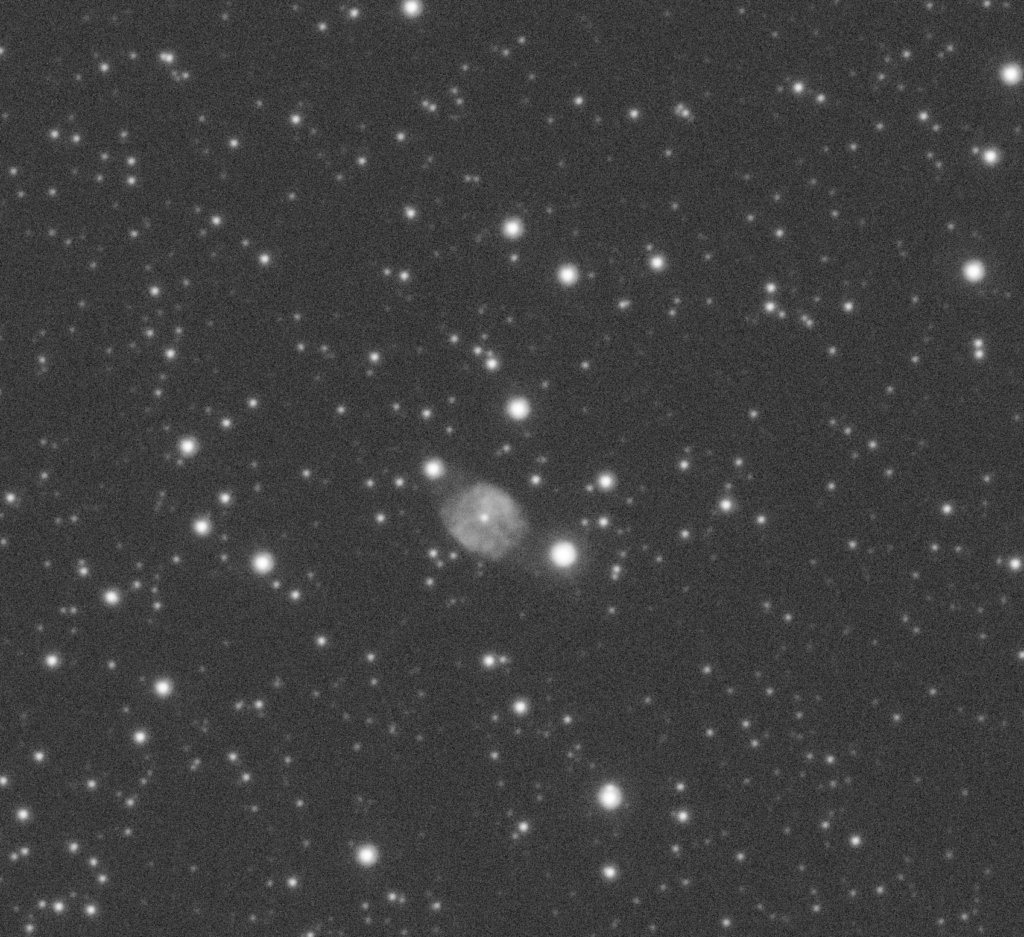
NGC 6765 planetary nebula in Lyra

Everything up until 23:45 is Luminance as the filter wheel was not connected correctly in SGPro and it thought it was moving but did not…..

Went to bed

Looks like it clouded over around midnight so a few images only. I also now seem to have a mark on the Luminance filter at the bottom which is a pain, not sure how that got there on a closed system. Also the scope must have moved during the imaging as a few of the images are of a different FoV.