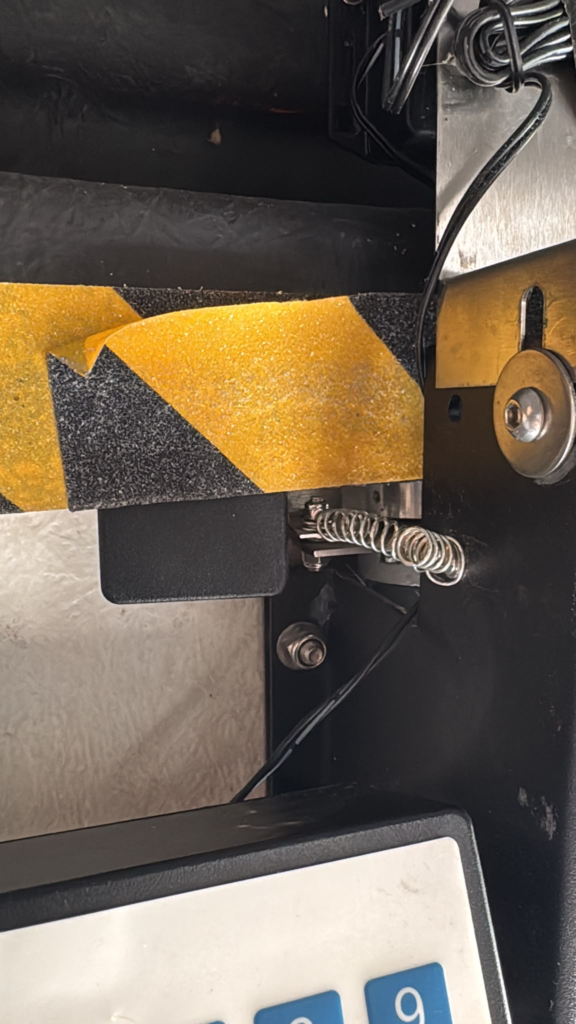
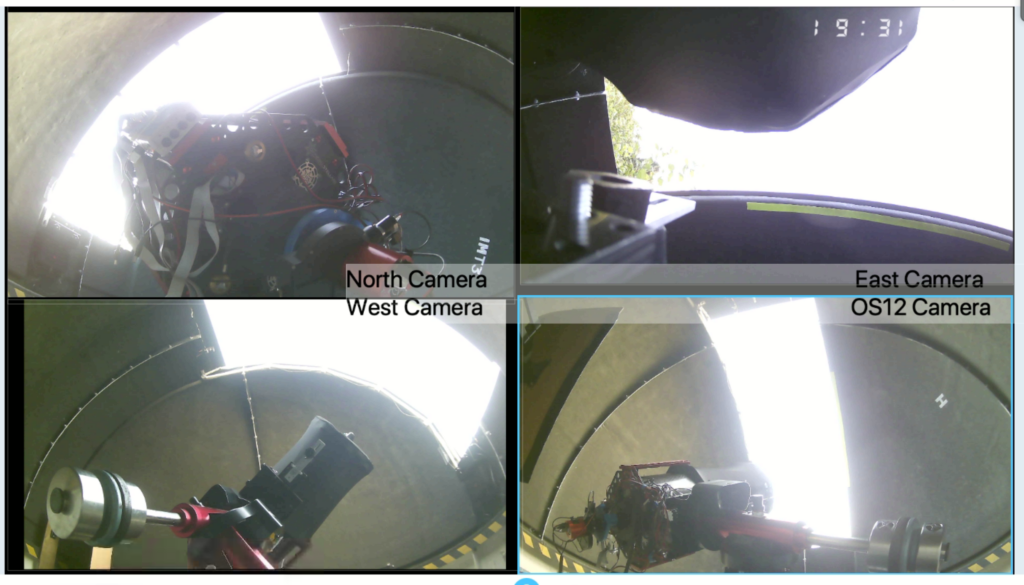
So today I decided to take a look at the Pulsar dome and its rotation problem. It transpired that the spring had stretched and was unusable that pulls the encoder wheel against the dome. I had to buy a 7mm spanner and I found a replacement spring in my workshop and fitted to fix the issue.
New spring on the encoder wheel
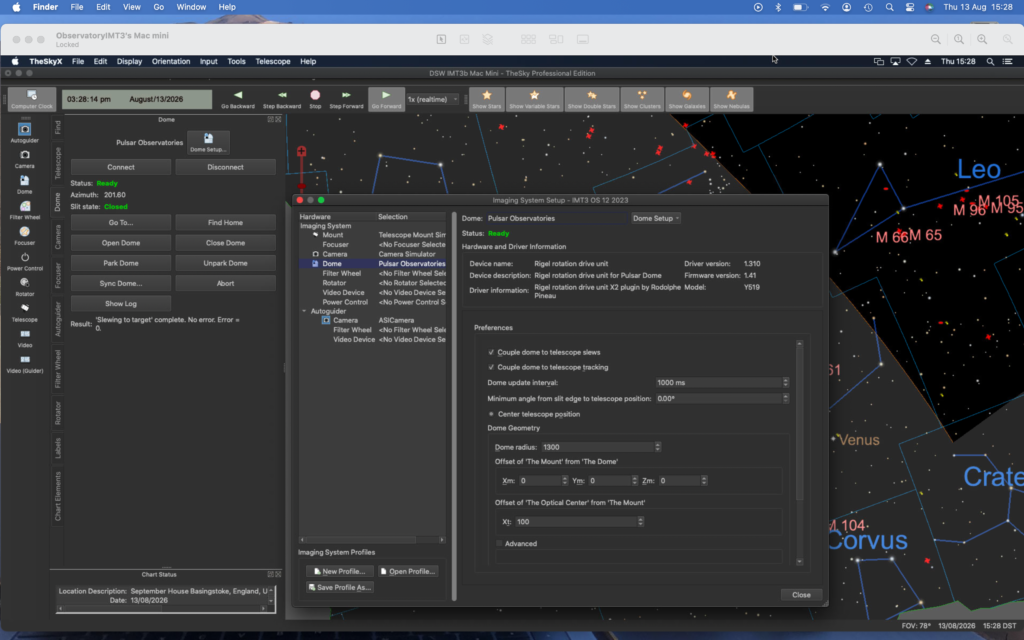
I then set about setting up the dome within TheSkyX (TSX)that I am now going to use only to run the dome. The way I have arranged this, as TSX does not have any connection to the ASIAIR, is that TSX connect to a simulator telescope and then to the dome. I then point the simulated telescope to the same object I am imaging with the ASIAIR and then the dome slews to the correct Azimuth. My home parked position is an Azimuth of 124º.
Dome geometry set in TSX
I set the dome geometry removing the settings I use to have for the 12″ scope Paramount MEII that use to be in the dome, replacing with the single figure that was needed for the AM7 with the Esprit 150, which was much simpler. A figure of 100, mm in my case. for the Xt value showing the offset from the centre of the AM7 axis to the optical centre. This seems to give me a good rotation so far. Over the coming nights I will test the accuracy and tweak if needed.
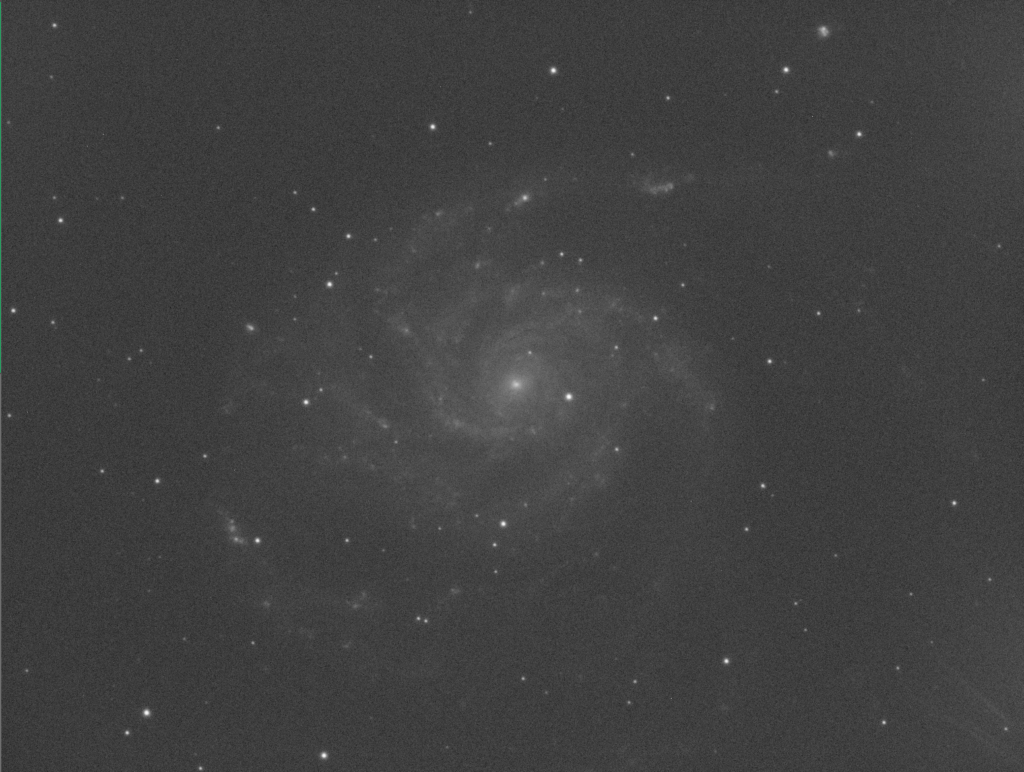
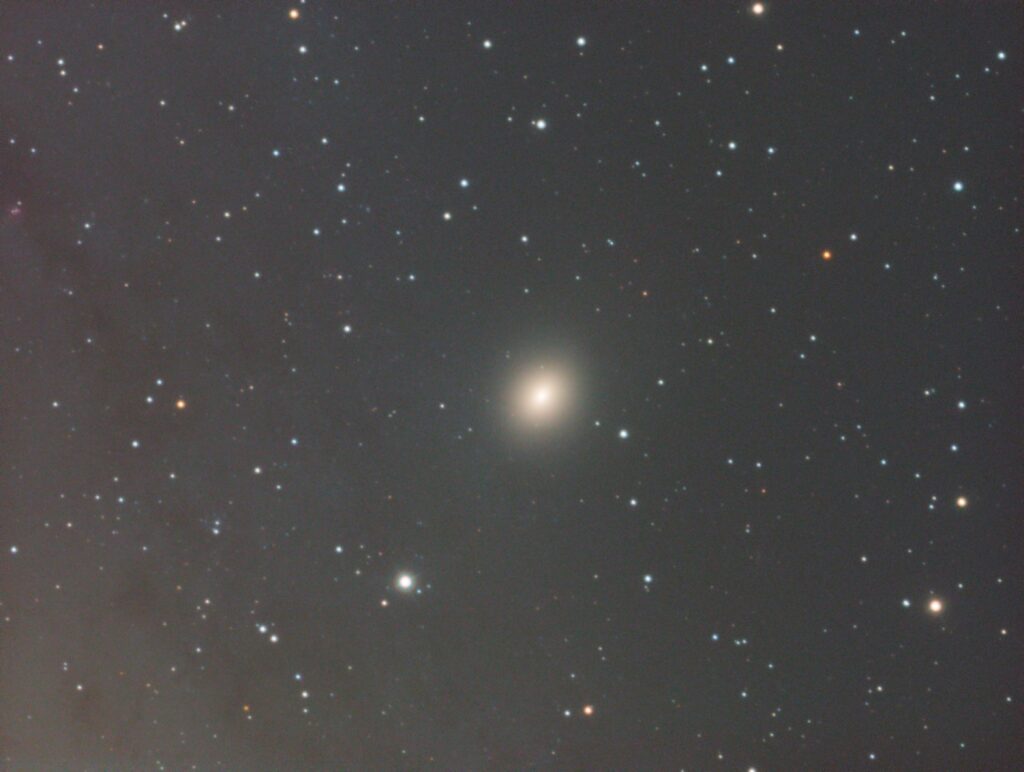
Out imaging M101 in Luminance again to gather more data before I move onto RGB. I already have some Ha which to be honest is probably not all that useful due to poor signal.
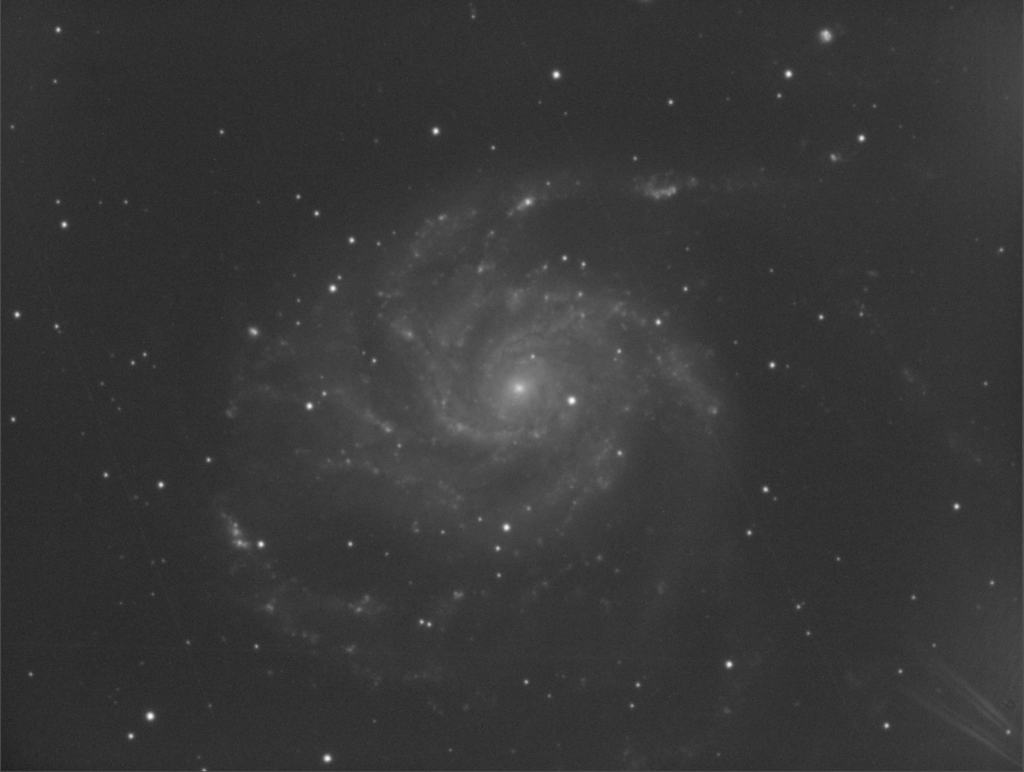
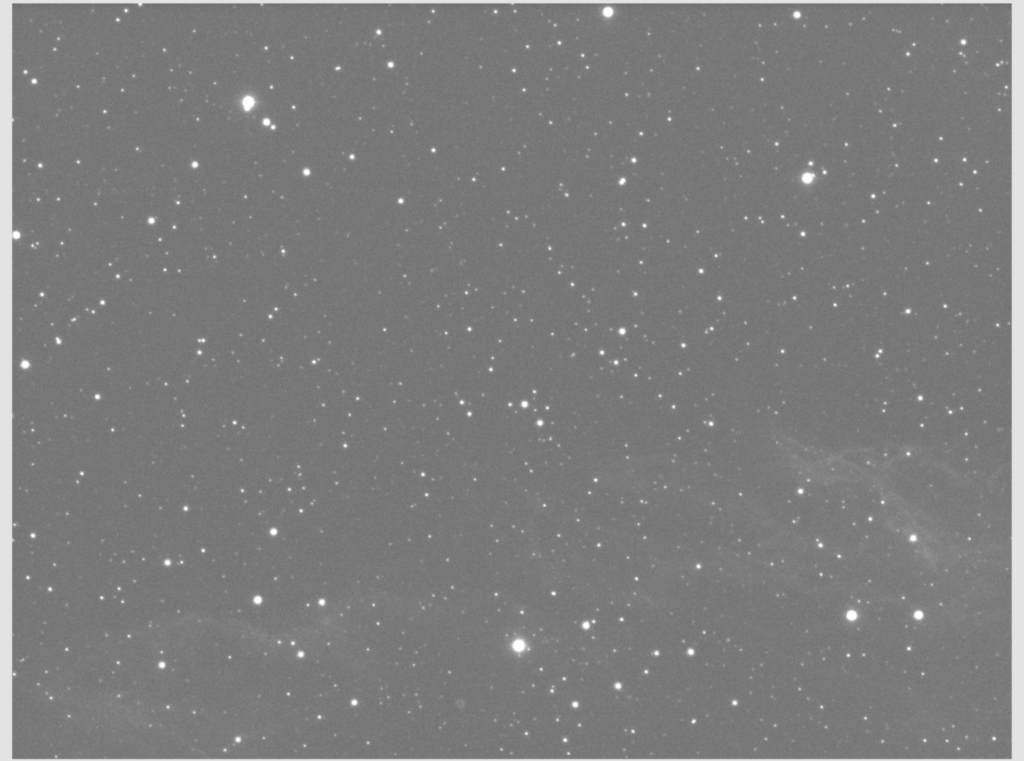
5 mins exposure of M101 uncalibrated
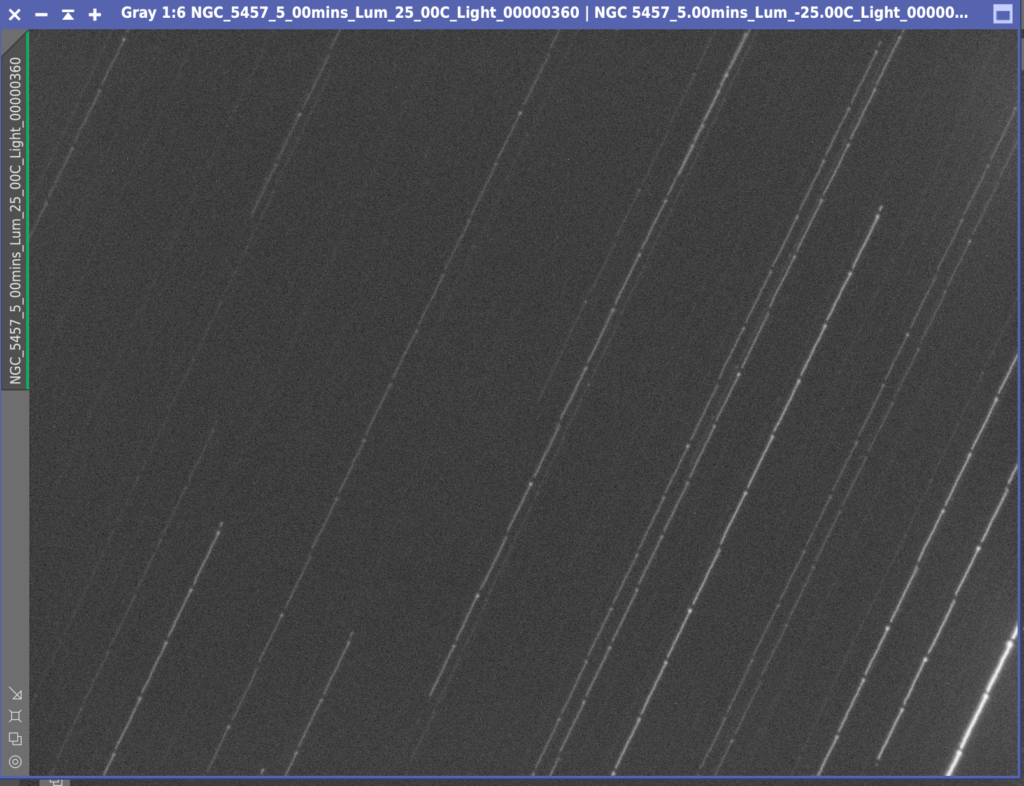
So admittedly the biggest challenge tonight was not having sorted automating a meridian flip, falling asleep and waking up after 1 hour to find I had 50 mins of star trails as the mount had come to a perfectly safe rest and stopped tracking. A quick manual flip and I was back in action
Not tracking at the meridian
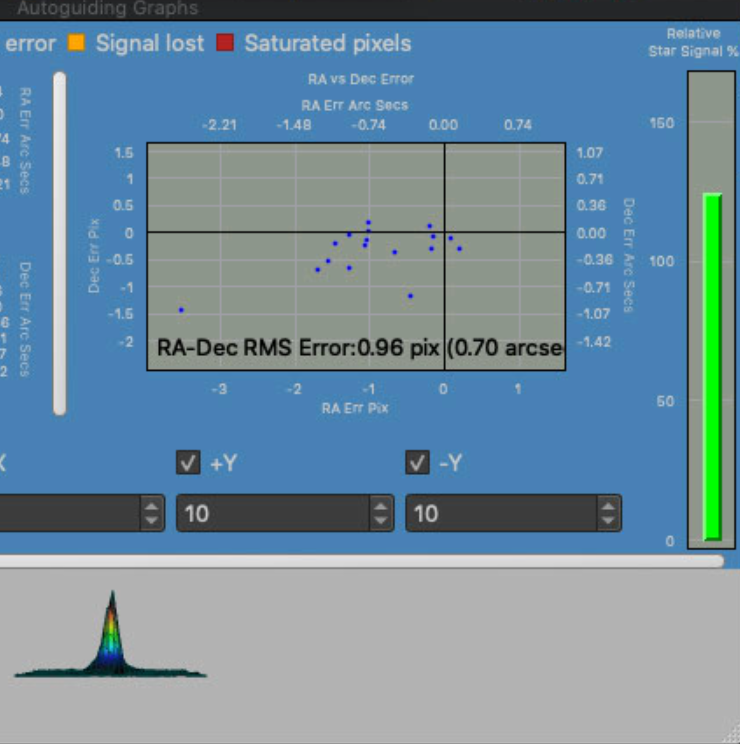
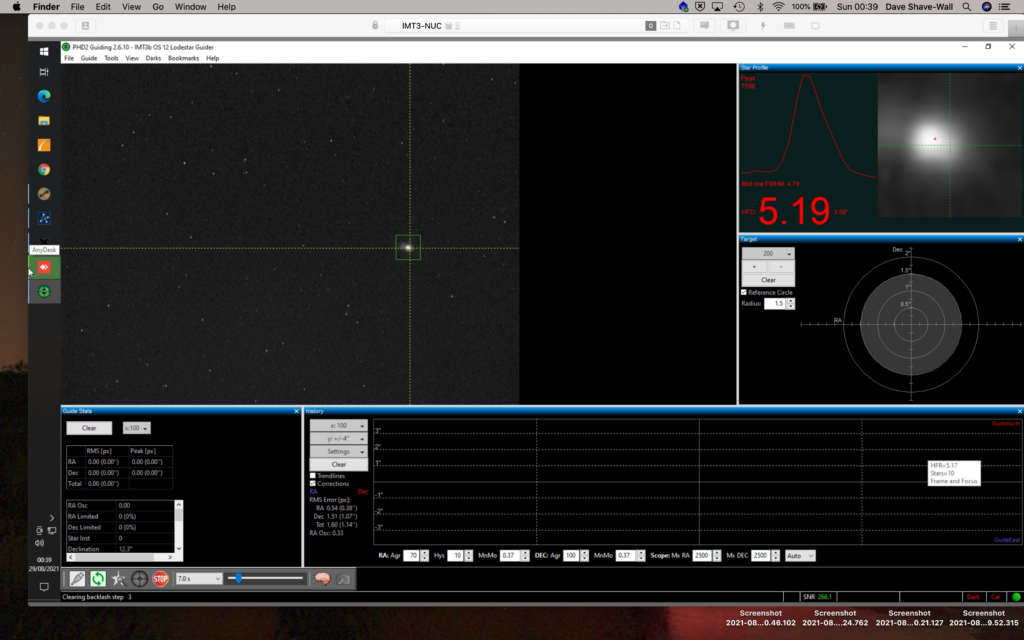
Another problem I had, especially on the West side of the meridian was a jump every now and then in the autoguider causing the resulting image to have a jump in it. I eventually suspected the star brightness of the guid star being the issue so I increased the exposure from 7s to 12s. This resulted in an increase in the Relative Star Brightness as shown on the Autoguider Graph increasing from 40 to over 100. It also seems to have resolved the issue.
Relative Star Brightness increased with increased exposure 7s to 12s
The last problem I had tonight was the camera was set to GAIN 139 OFFSET 10 rather than OFFSET 21. This seems to reset in TSX every time I reconnect the camera. So from now on I will make it part of my startup process to set the OFFSET correctly. The impact is slightly dimmer pixels as it is not adding the additional 11 to each one and thus the times for Flats I have need to be increased.
In total tonight I managed to grab around 4 hours 15 mins of good data once I removed problematic frames so 51 x 300s subs. I also took calibration frames, darks, flats and flat darks.
Opened the dome and setup the 22″ Obsessions telescope for visual.
I have gone with a recommendation of Mark Radice this evening andI will both image and perform visual on M46 including the planetary nebula Herschel H39-4 that resides within it.
So with the 120 Esprit inside the dome imaging away on M46, now that it is to the East of the Meridian, I connected the Argo Navis to the 22″ and set about aligning the scope. After a few minutes and with the alignment complete, I pushed to M46.
M46 Observing Notes
31mm Nagler 75x Mag. M46 Open Cluster fills the view. Apparent instantly is the planetary nebula Herschel H39-4 towards the 5 o’clock position. A small ring can be seen with direct vision and with averted vision the contrast increases. I am not using any filter yet.I can resolve many stars. With the 13mm Ethos 180 x Mag H39-4 becomes much larger and you can resolve easily the star within the centre of the ring. Now only several handfuls of stars can be resolved.
M42 Observing Notes
31mm Nagler 75 x Mag. M42 steller nursary and hydrogen nebula is very bright with the wings sweeping outward. The trapezium is clearly seen. With averted vision much more gas is forthcoming around the area within the FoV. Moving to the 13 Ethos 180 x Mag the trapezium is resolved pleasantly into a much wider set of 4 stars. The hydrogen gas now takes on structure and lingering on this one can make out dark features within it give the nebula a 3 dimensional feel. Now you experience a warm glow within the eyepiece that seems to draw your eye towards the gas in which the trapezium stars sit.
At this point I cam back into there Warmroom to write up my notes and review the images being taken in the observatory. I have now taken 21 x 300s of M46. Now switching to M48.
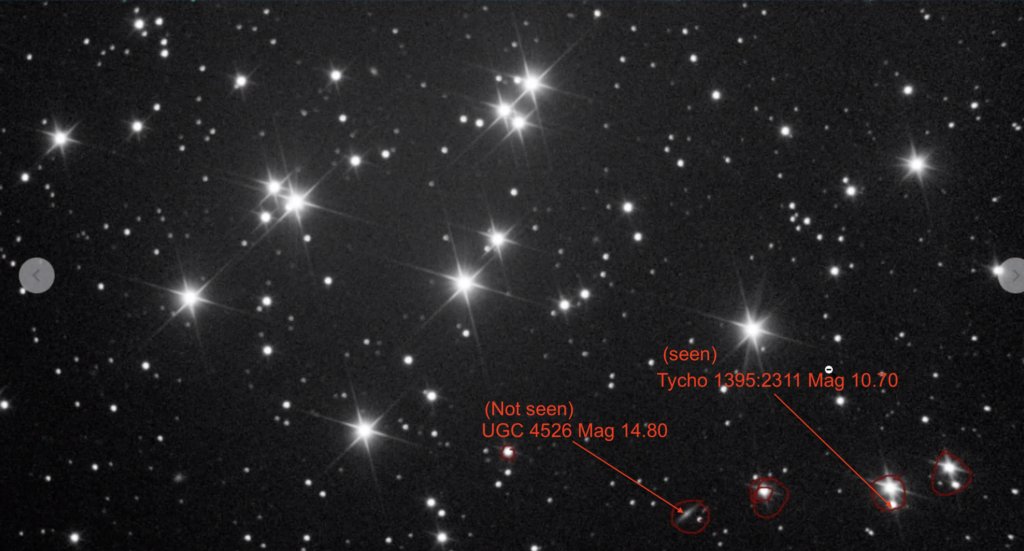
I then joined the BAS Zoom call to speak with Derek, Nigel, Bob and Mil Dave. We discussed M44 taken by Bob and suggested if I could see the UGC 4526 galaxy. So I went out to take a look.
M44 and UGC 4526 from Bob
M44 Observing Notes
Looking at M44 with Nagler 31mm at 75x Mag…..
I landed up finishing M48 at 23:47. I took 30 x 300s but then checked through the last few when the dome closed and I actually got 26, I might have lost the guide or the dome slewed incorrectly or shut, not sure which.
Addendum – It turned out to be loosing the guide star and because the camera wears not in focus, so connecting the focuser and moving from 14000 to 21000 position fixed it. The star profile was much better and SNR was 25-30 instead of 10.
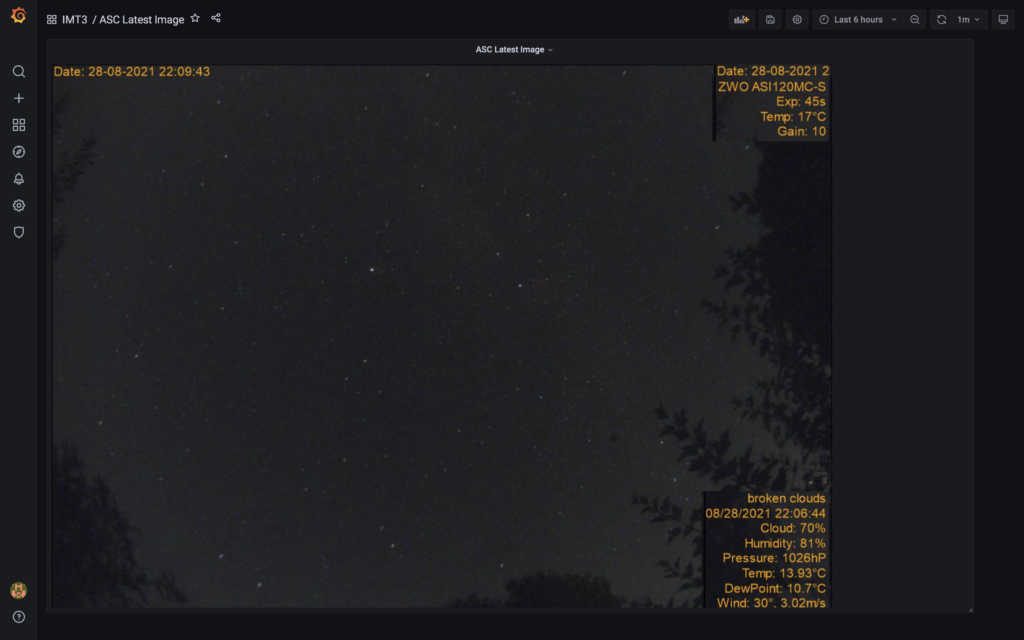
Clear night! So I’m going to setup and let the dome run all night if it stays clear which is the forecast as I have work tomorrow.
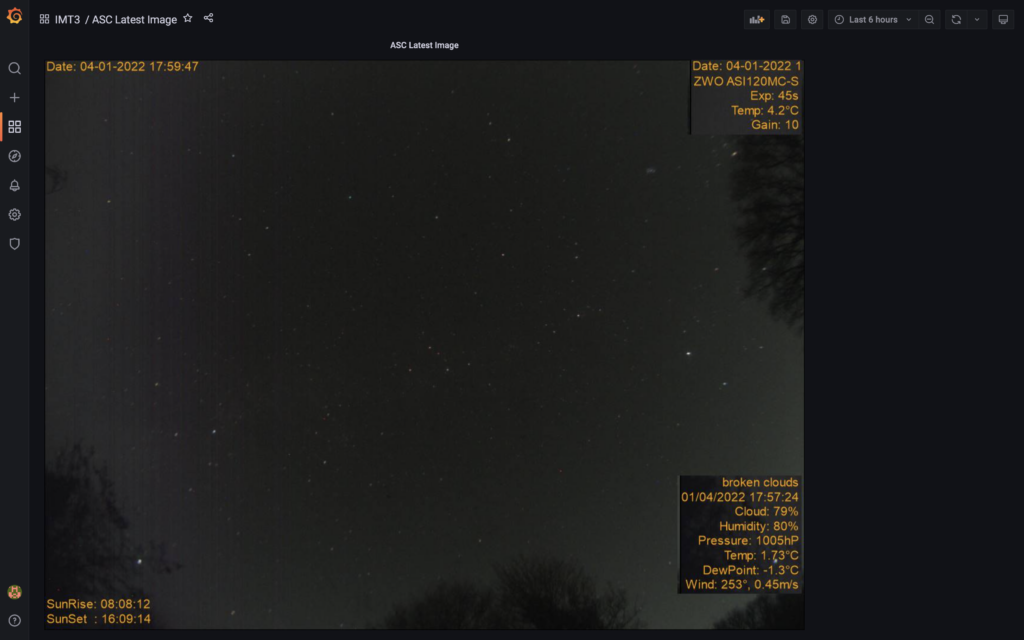
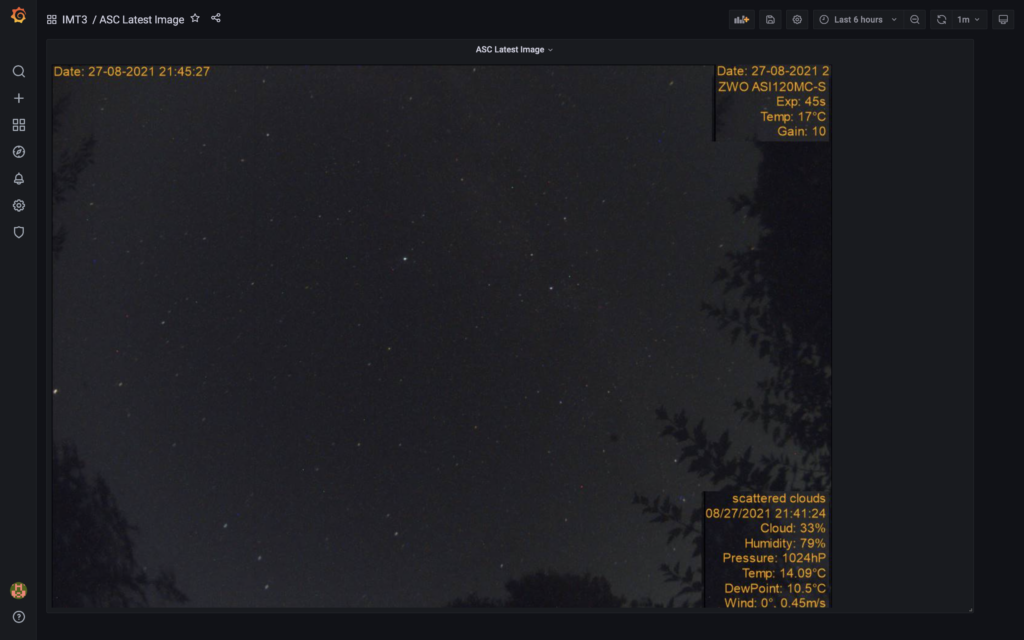
All Sky Camera
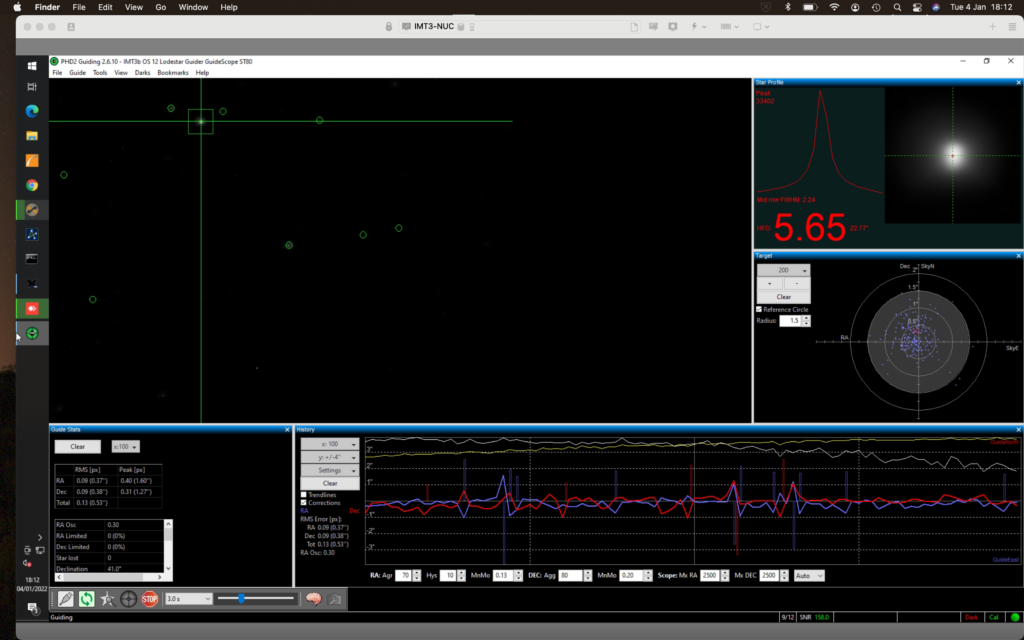
I have run the guiding assistant on PHD2 so that I can hopefully better track objects. The drift in frames from the last time out whilst using the ST80 as a guide scope was less than ideal. I have now put al the new settings suggested into the PHD setup and have swung round to do a focus run on a star near to M32.
PHD2 new settings
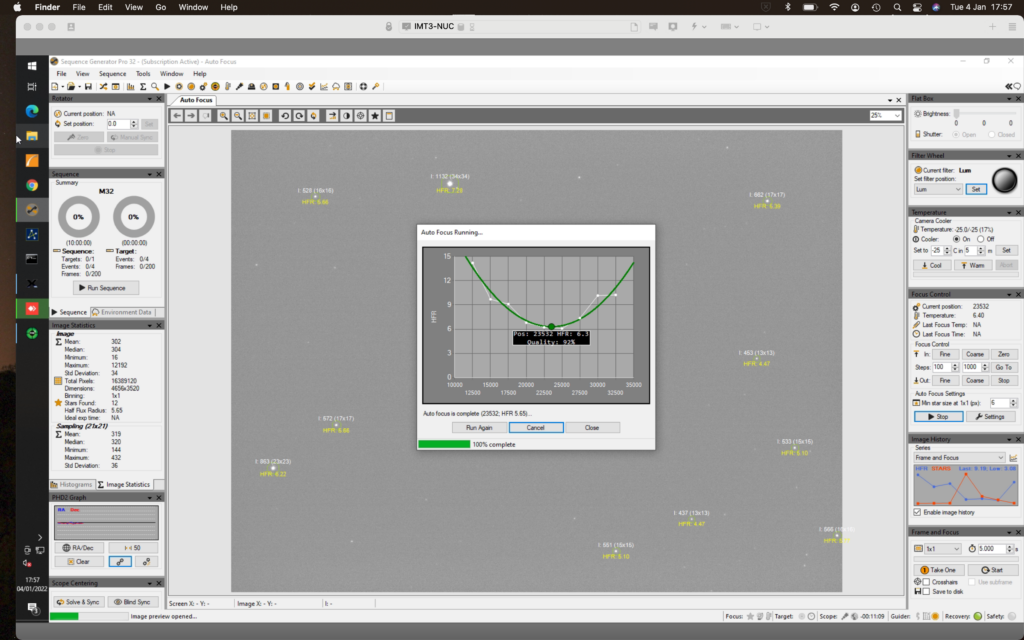
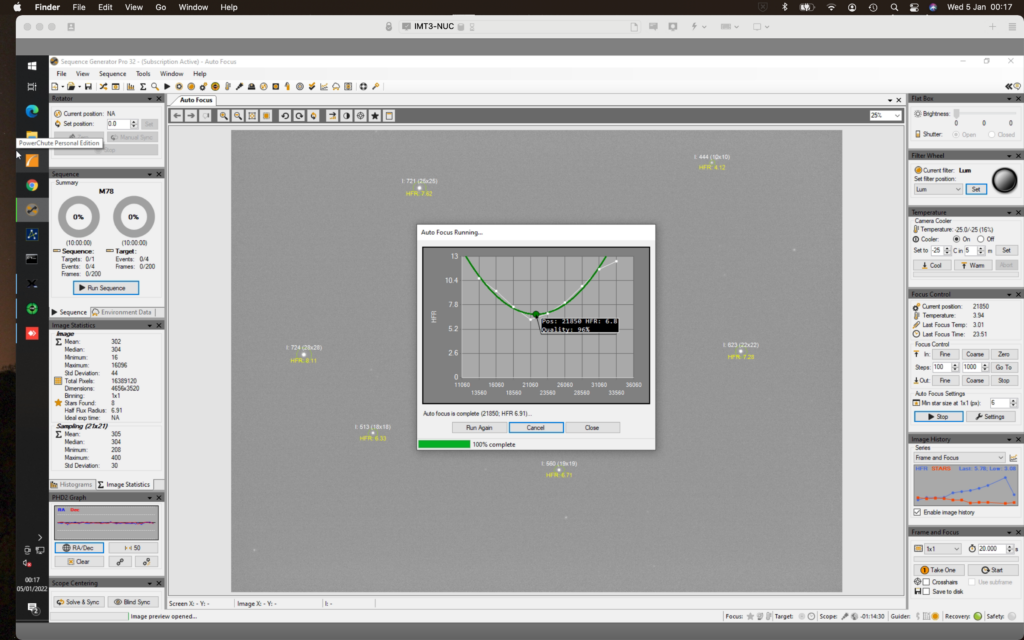
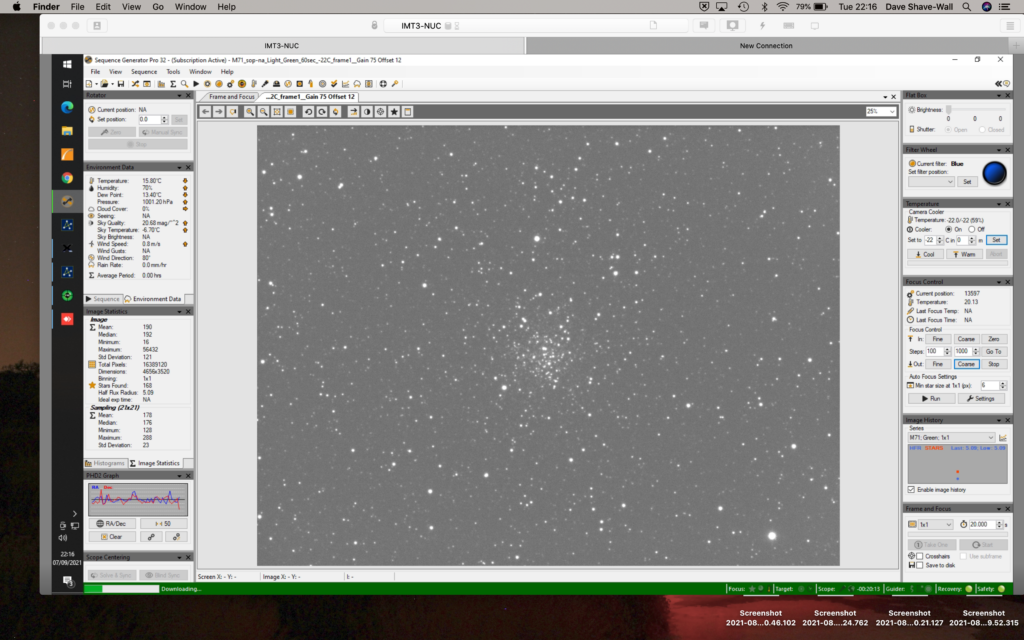
After successfully running autofocus in SGP at 23,560 on Luminance I have now slewed to M32 to gather more data that is desperately needed to resolve the outer spiral arms of the companion giant galaxy M31.
SGP Focus RunM32
So it is now just gone 9pm and whilst the guiding is managing to stop trailing of stars, the image is moving between frames, enough to loose the object over the course of 4-8 hours. This is clearly not good enough and it does look like the focal length of the ST80 is simply not long enough.
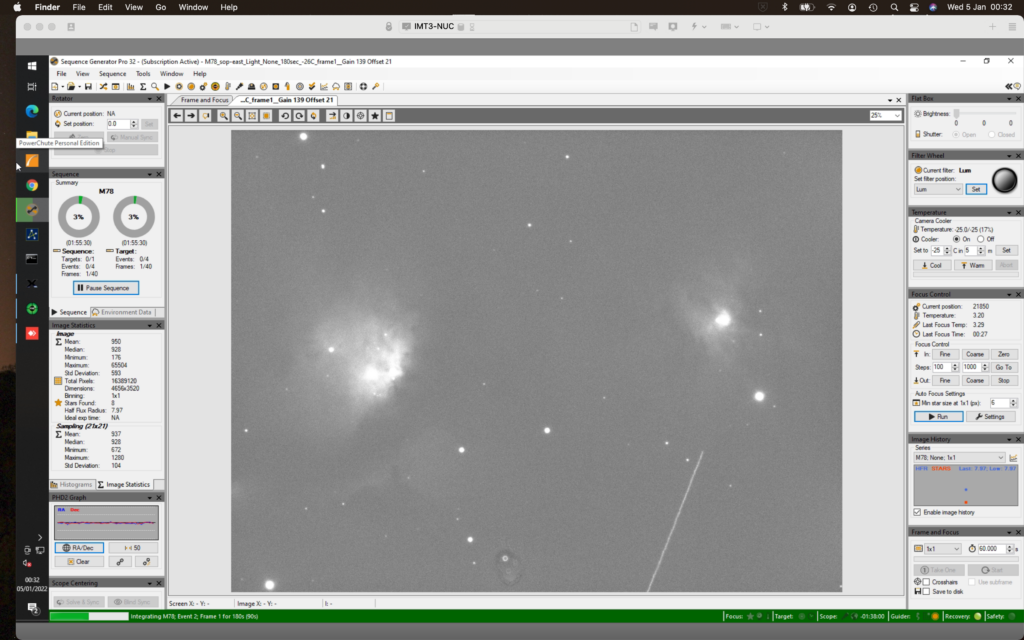
To get around the problem this evening I have turned guiding off, as the exposures are short (3 minutes) the trailing of stars is not an issue. At midnight I took flats for M32. I then centred on M78 for the rest of the night. Before starting I performed another focus run as the focus point had changed over the night with the temperature drop.
Auto Focus
I choose the same exposure settings and Gain 139 and Offset 21 settings as for M32. -25C was the temperature but this time I rotated the camera by 90 degrees to also fit in NGC 27309.
M78 & NGC 27309 and a satellite trail
So I left the scope running and it completed at around 2:30am with 40 frames taken across 4 filters giving me 30 minutes per channel. This will be enough to get started and if clear tonight I will setup for another run at M78 and hopefully improve the guiding.
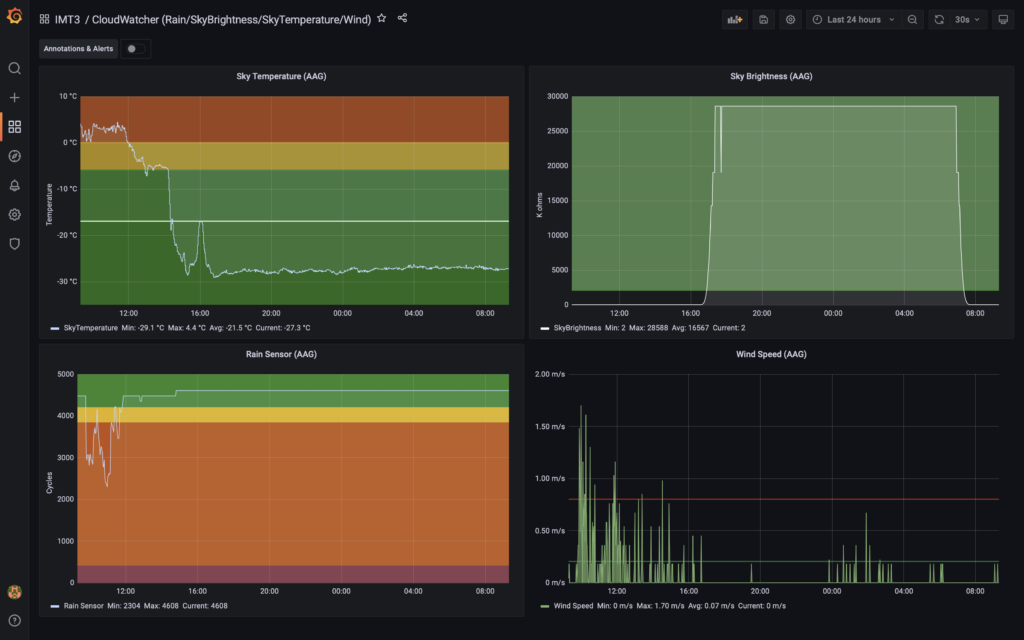
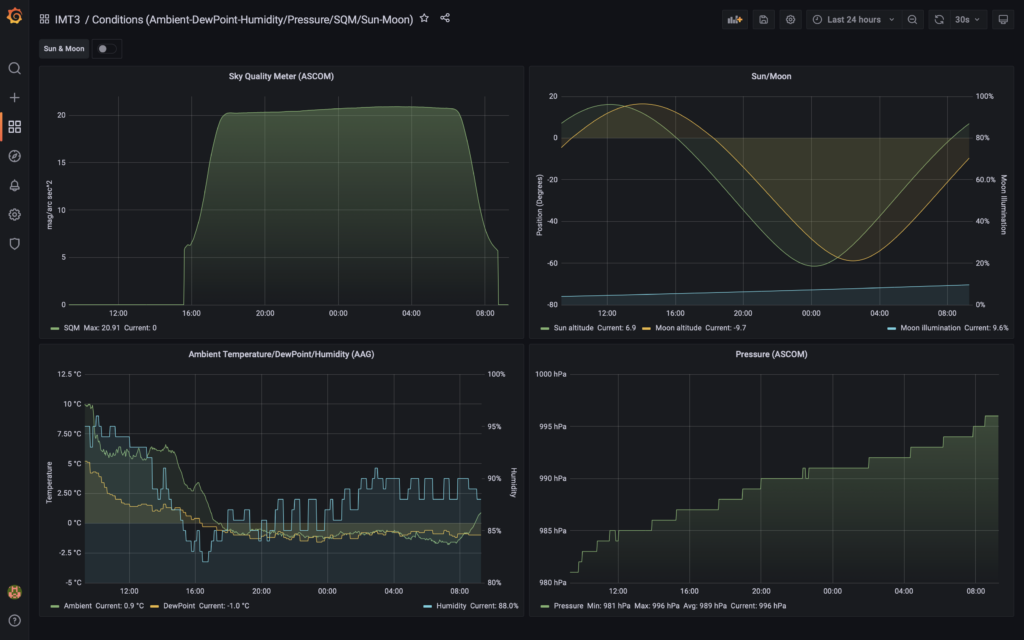
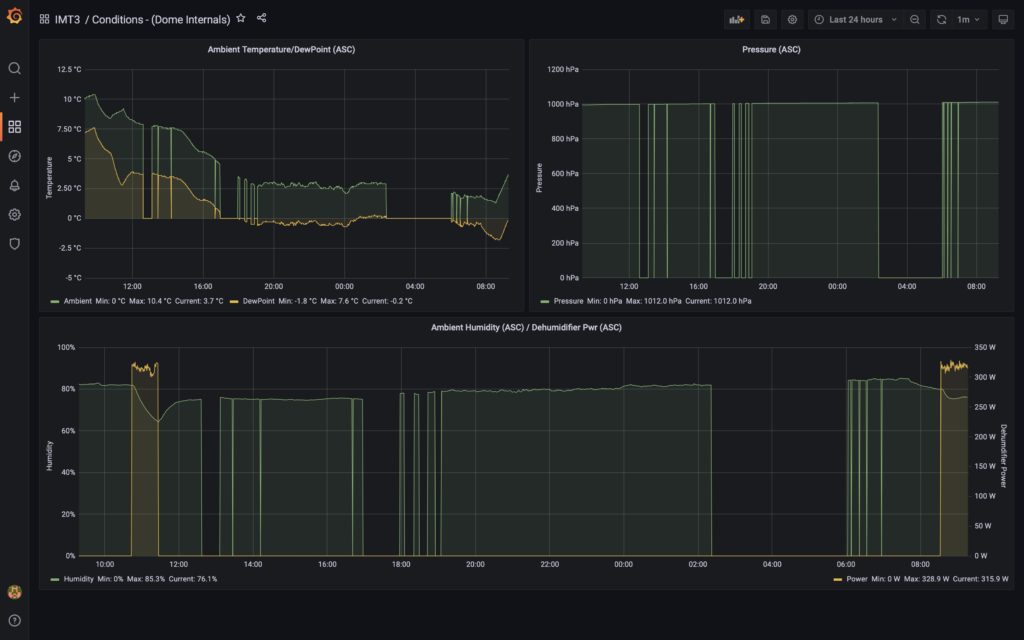
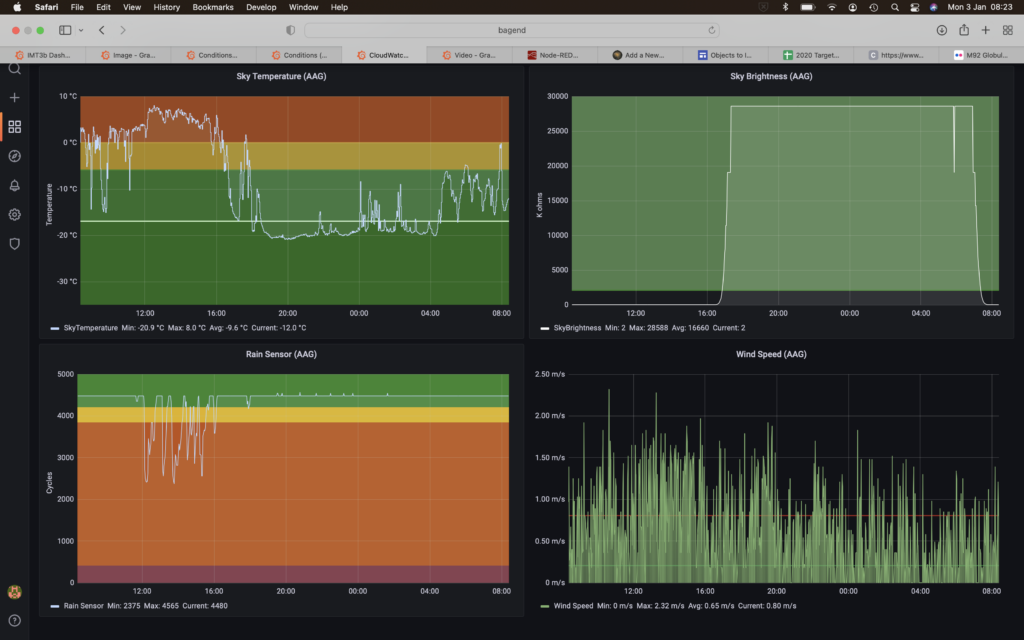
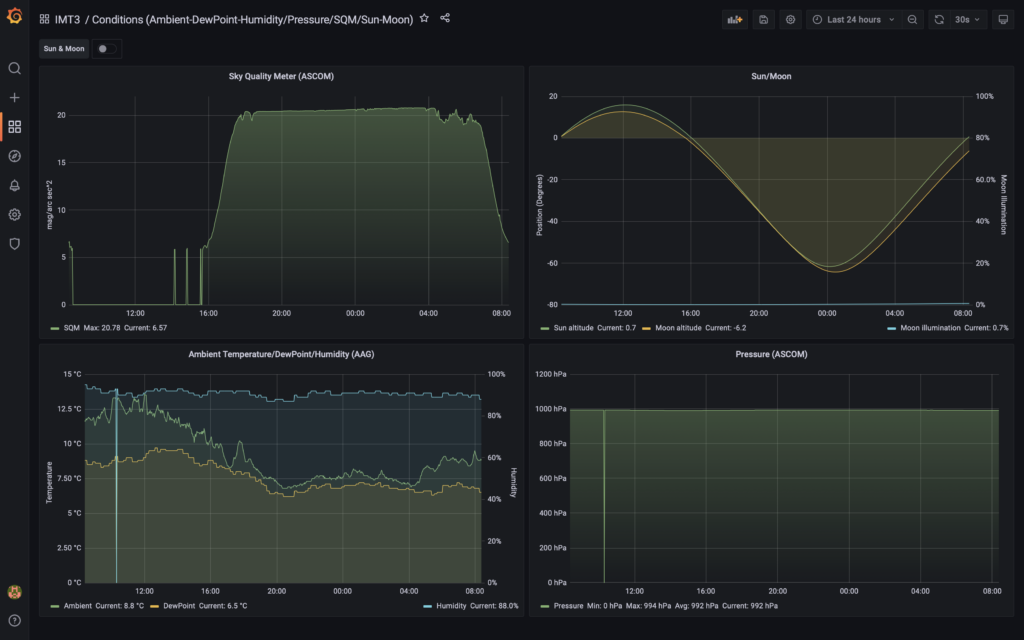
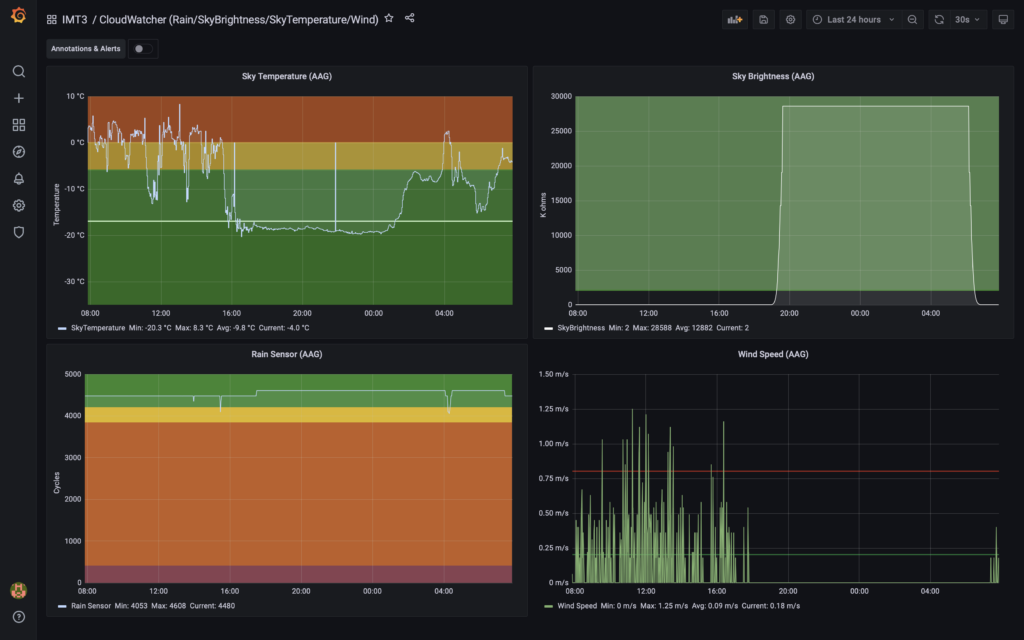
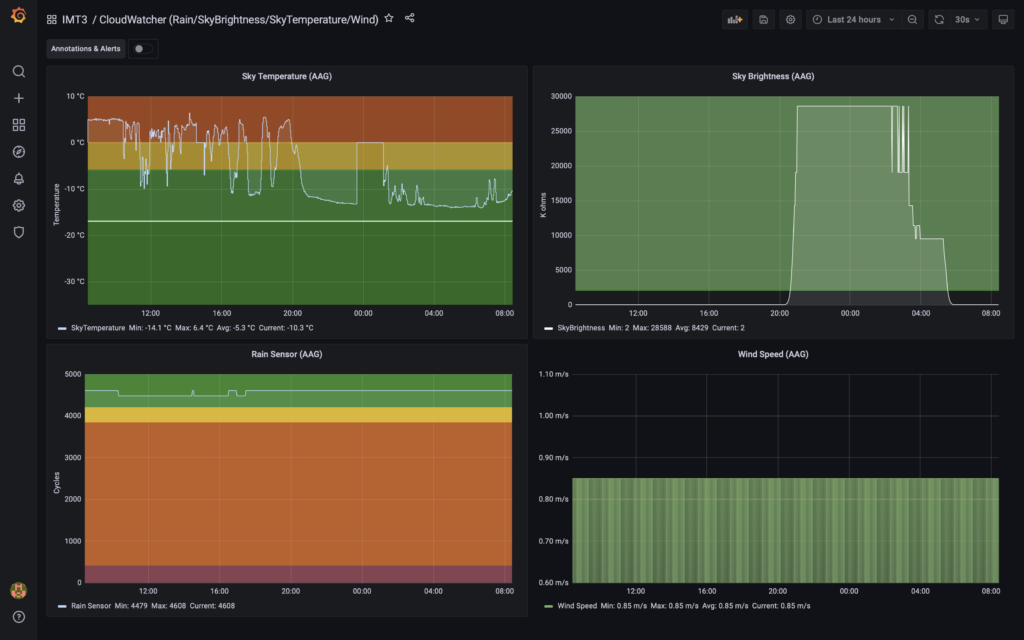
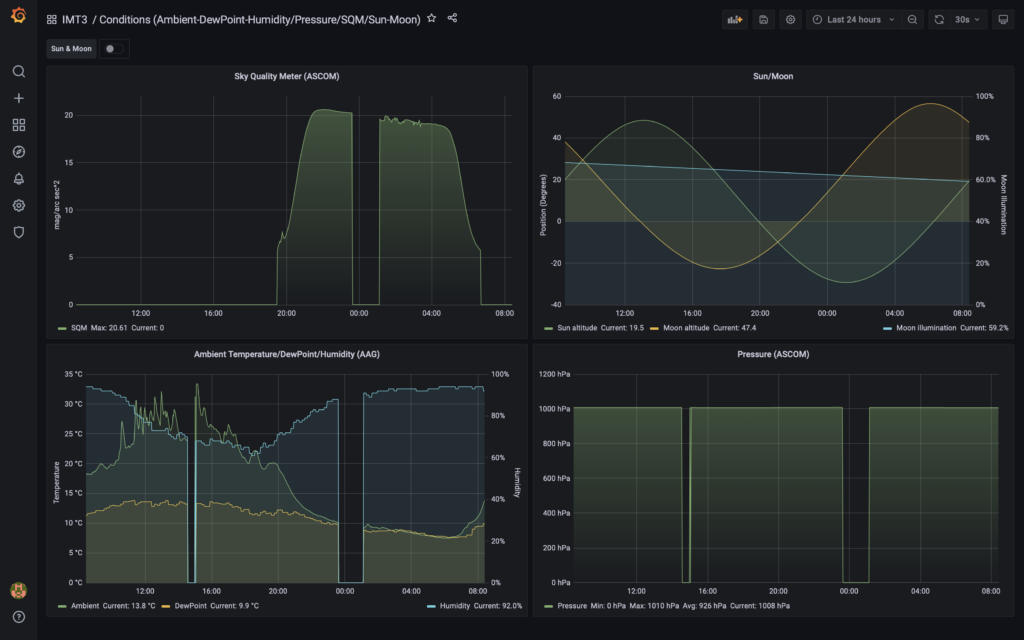
Update. On reviewing the files this morning it looks like I forgot to select the filter in SGPro which means all my M32 and M78 images from this evening are in fact luminance only! Which is ok for M32 but for M78 I need some colour. Below is the weather data for last night.
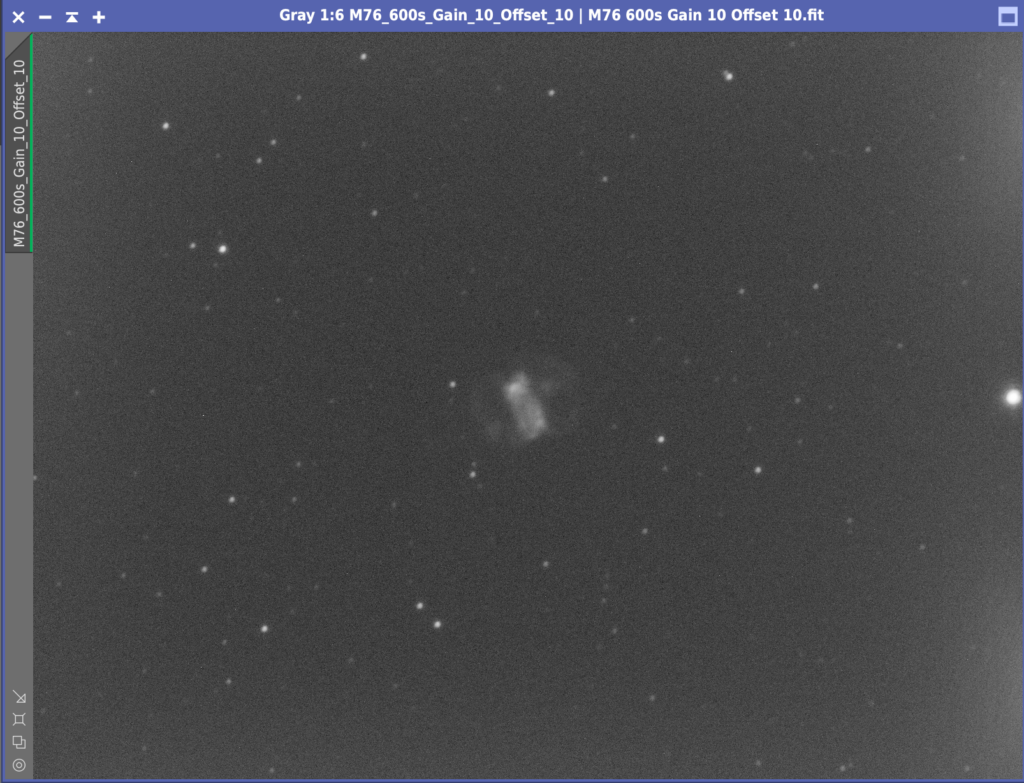
I started with M76 Ha as I need some frame for this object. I already have many hours in OIII. However after starting to image I realised the guiding, which is currently being tested through Dave Boddington’s ST80 was not pointing through the slit correctly as M76 was near the zenith. This means I have suffered from trailing as the guider was trying to guide on long stars due to diffraction.
M76 – 1 x 600s Ha
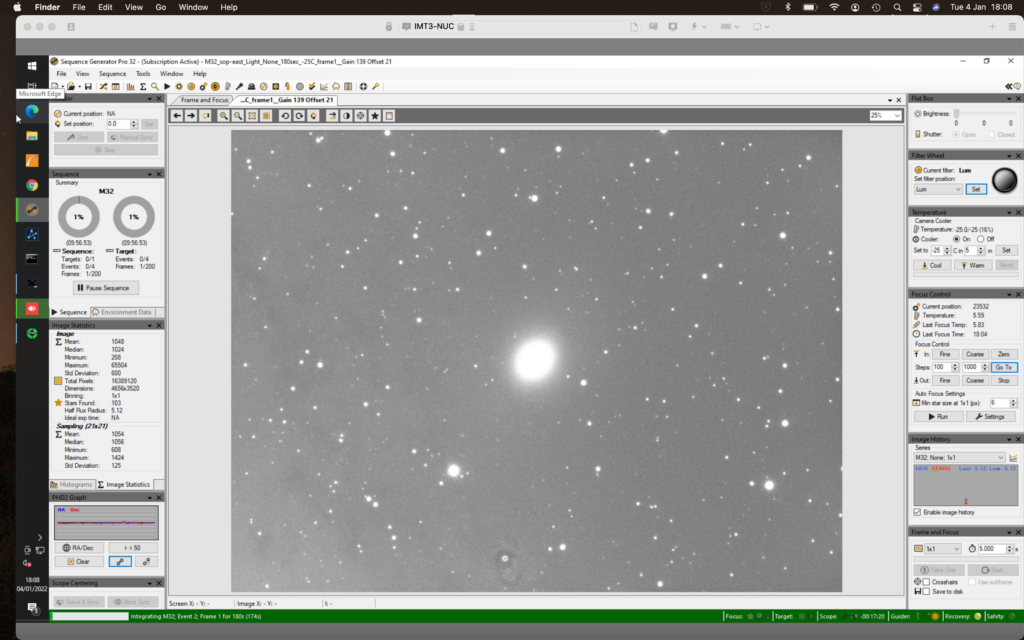
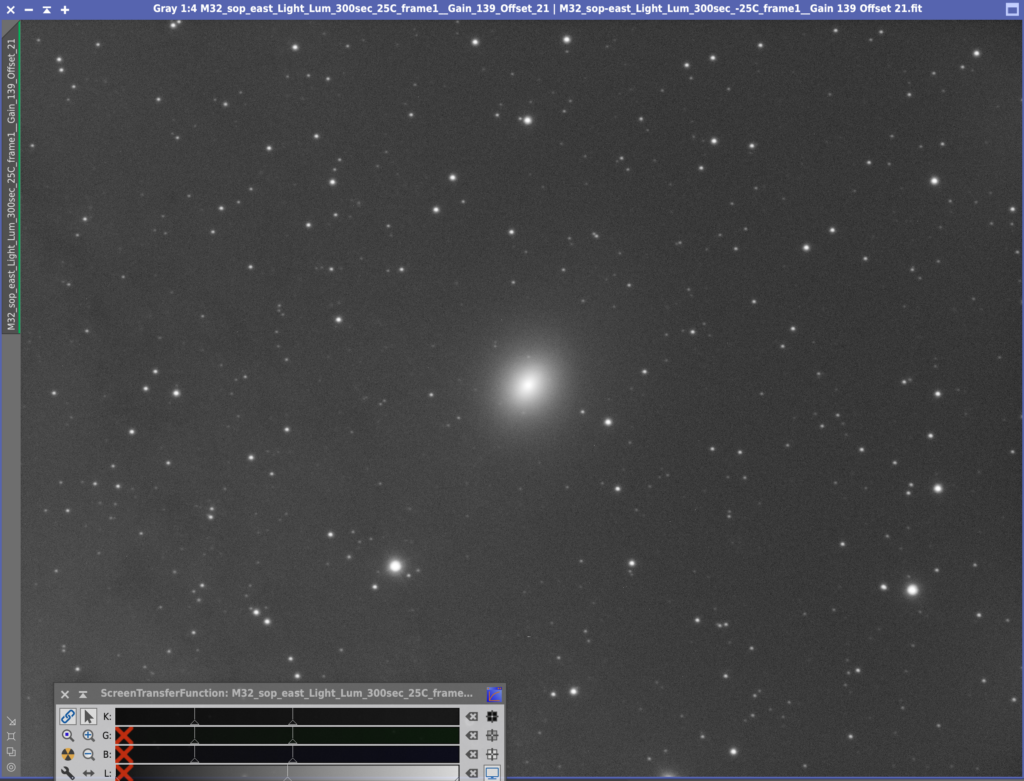
I swapped to a different object, this time M32 as I have not imaged this directly before, just as a happenstance of imaging M31. I have chosen 180s exposures using Gain 139 Offset 21 to keep the saturation of the core down. At 300s the core was blown out.
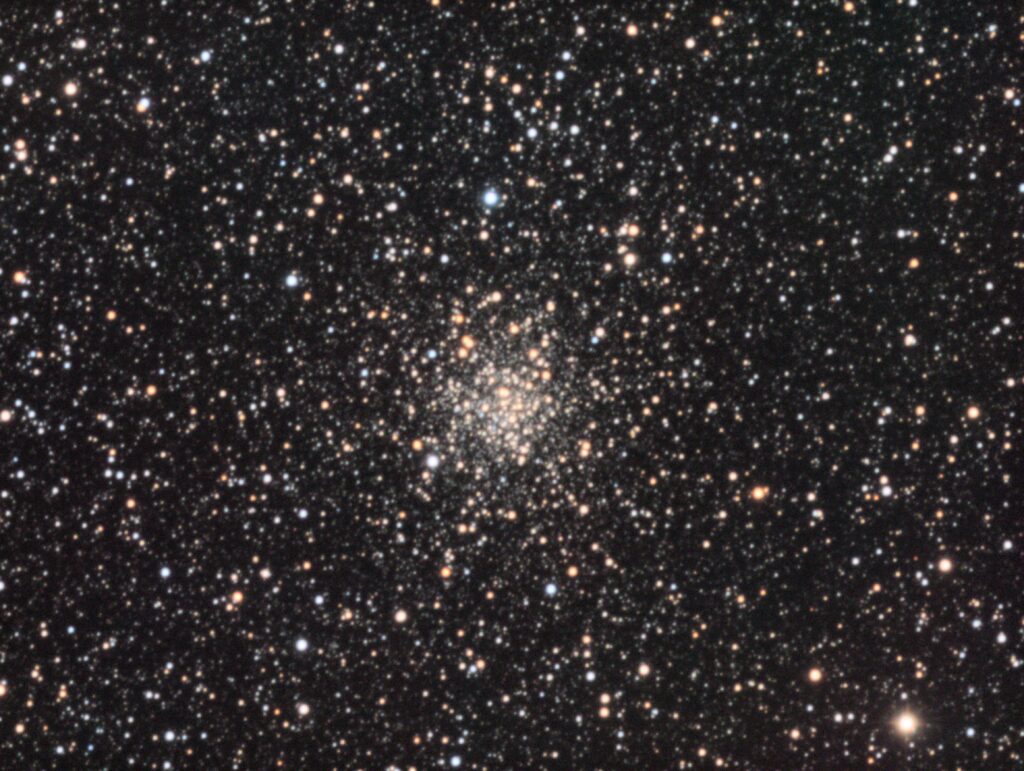
M32 – 1 x 300s Lum
M31 can be seen to the left and lower left of the small galaxy. M31 covers a large part of this image! So how well was my guiding doing?
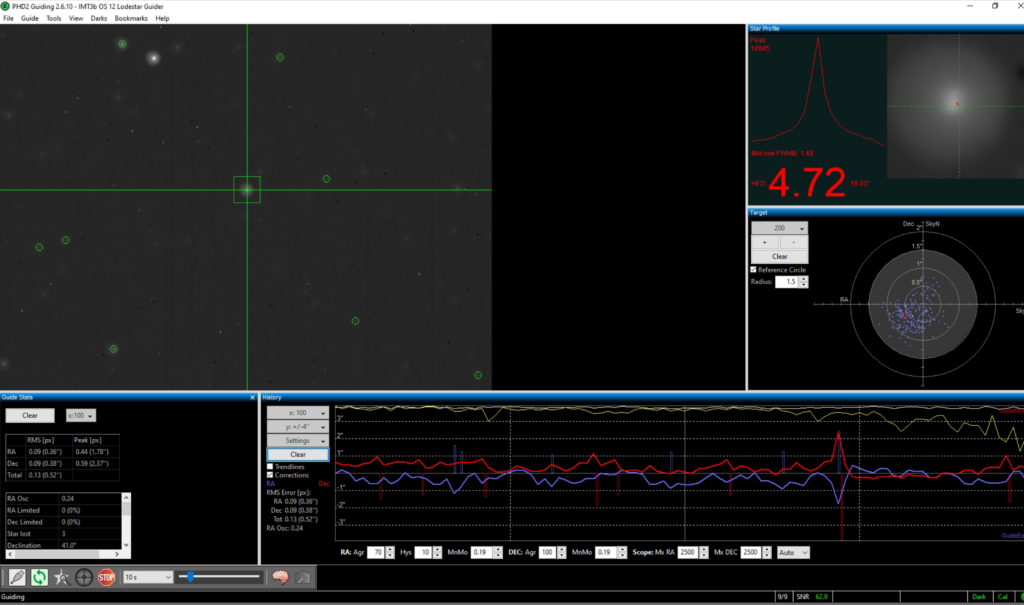
Guiding with the ST80 guider
The guiding looked fine. 0.52 arcsecs total error which I am happy with. I stayed up until just before midnight and then left the observatory running. In the morning I noticed the dome shut around 1:30pm due to the images after that looking like flats.
I also noticed this morning that the images were drifting so the guiding is not quite right as the image drifts. I will next time out run the guiding assistant and see if that helps.
Update the image scrubbed up fairly well but I lost a lot of frames to drift and trailed stars and then the dome closing. Resulting image around 3 hours 12 minutes exposure of which 48 mins was Luminance but there was cloud affecting many frames.
IC5067 Pelican in OIII and SII, rotated to new angle to allow guide star on West side of the mount. 10 x each channel at 600s and Gain 139 Offset 21, left running and dome shut later in the morning.
Rotation angle 218 from SGPro plate solve, 171.750 from TSX
Progress meridian flip tonight. Nearly worked, challenge was I lost the only guide star and then it fixed on hot pixel. I have now made the setting for star recognition min 3 HFD but still not guide star present. I need guide scope……
Tonight I am at Kelling Heath star party with Shane and Mark Radice. After a fantastic board game with Mark, Shane and Shane’s wife we then headed back to camp and I started to look through there binoculars using the NSOG (????) book as my guide. Whilst I realised I could have got away with bringing the Milkway edition, instead I brought along the Autumn/Winter version.
I had packed my 100mm Altair Astro binos so it was going to a visual night with some rudimentary drawing. I looked around and set my gaze on Pegasus and turned to the pages in the guide to set me off.
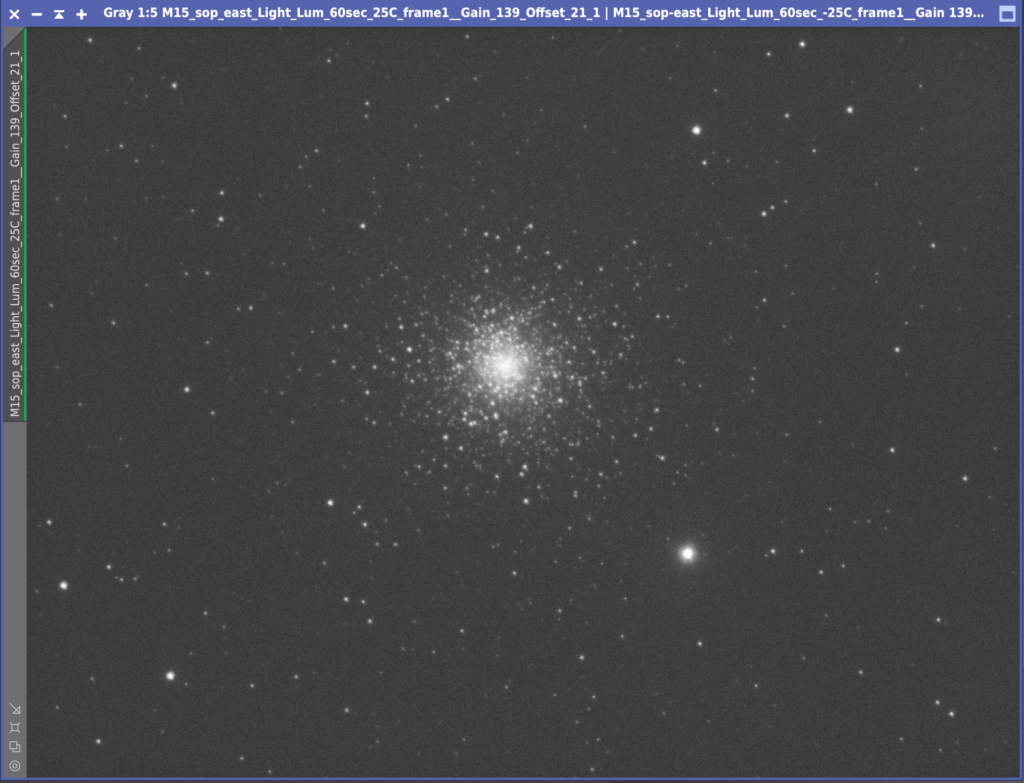
First on the list was M15. It appeared relatively close to
m15 – seen
peg 1 – seen
3 peg – seen
53 peg major seen not companion
ngc 7217 – not seen
ngc 7331 – seen with averted vision
ngc 7332 – not seen
ngc 7814 – not seen
M39 seen
M42 seen
veil eastern seen
North American seen
tried UHC filter baader from Mark in 1 eyepiece in binos abs made nebula stand out
bed at 3:52am due to fog and 9deg c
looked at M81 and M82 through Keith’s 18”
could not see horse head
M42 WOW!! and M43 both through 13m Ethos 100 deg and then 21m Ethos
imaged for 1hour 36 mins and then the safety went off and it stopped imaging, no idea if the dome closed at that point or if it just lost a guide star but that was it, despite it being clear all night. So I need to not set the Boltwood OK to image setting in SGPro and I need to find a way of time stamping the dome closure
OIII LRGB 20 x each, 600s on OIII and L and then 300s on RGB
Rotation angle 29.420
NGC 6765 planetary nebula in Lyra
Everything up until 23:45 is Luminance as the filter wheel was not connected correctly in SGPro and it thought it was moving but did not…..
Went to bed
Looks like it clouded over around midnight so a few images only. I also now seem to have a mark on the Luminance filter at the bottom which is a pain, not sure how that got there on a closed system. Also the scope must have moved during the imaging as a few of the images are of a different FoV.
Opened dome early to cool down, we then had some cloud and it closed, so reopen around 8pm.
As it has been a very warm day, some 28℃ and is still 20℃s, I will set the camera temp to -20℃ and image a different object to avoid several sets of flats, darks and flat darks. I settled on M56 as I had not imaged this for my Messier catalogue yet.
Loads of problems, mount kept saying it was not unpacked, guider would not connect, so rebooted and all fine.
Imaging at 22:10
Gain 75 Offset 12
Rotation angle 29.420
Temp -22 (need correct Flats/Darks and Dark Flats)
When I rebooted I noticed the PHD2 setting are wrong for the guider so need to change the profile to include DirectGuide not Pulse Guide. Also need to change SGPro so that it does not autofocus at the start of a run, also so it does not set the temp to -15.
Off to bed at 22:15 and left it running.
Everything went well, the dome shut at sunrise and the images look ok, maybe slightly soft focus but only when I process will I be able to tell.
LRGB taken, the first set were fine then the dome closed but SGPro kept on imaging as I forgot to set the safety, so I will need to dispose of a number of images.
Quick look at the Bat nebula given there is a break in the clouds. I had trouble with a guide star due to as hot pixel so I had to move the scope slightly to move the guide star. I need to take a some new darks for the off axis guider.
I tried 2 regions within the Bat nebula given its size, but neither showed any signs of nebula on a single 10min exposure.
I then tried Lynds Dark Nebula, LDN 1082 The Seahorse. |However again due to the expanse of this object a small portion was only available in the 12″ so again this will be more suited to the Esprit.
I then went for Palomar 10, a Globular cluster in Sagtta.
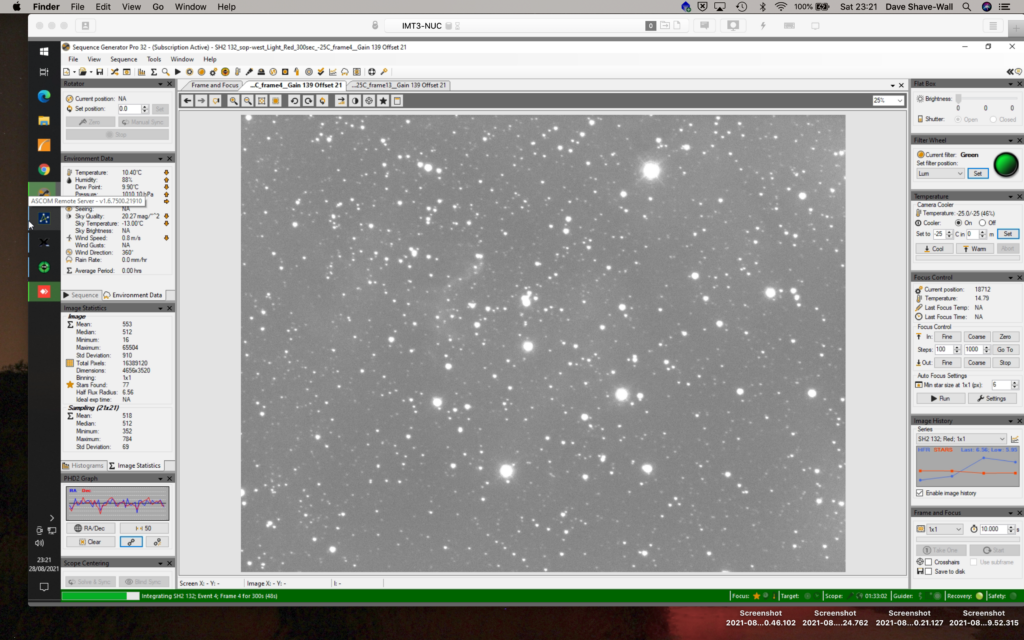
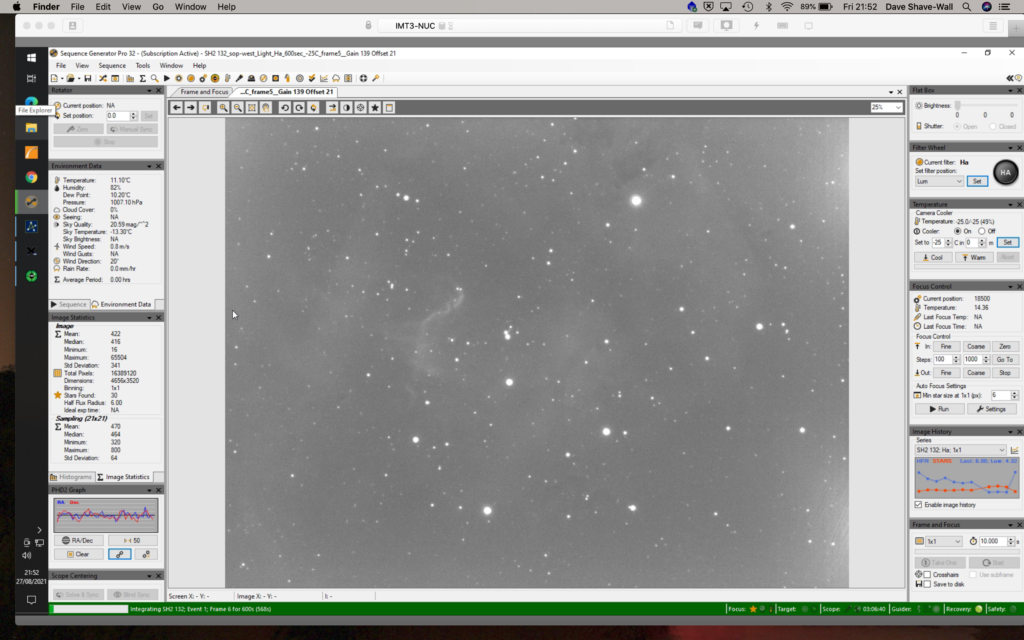
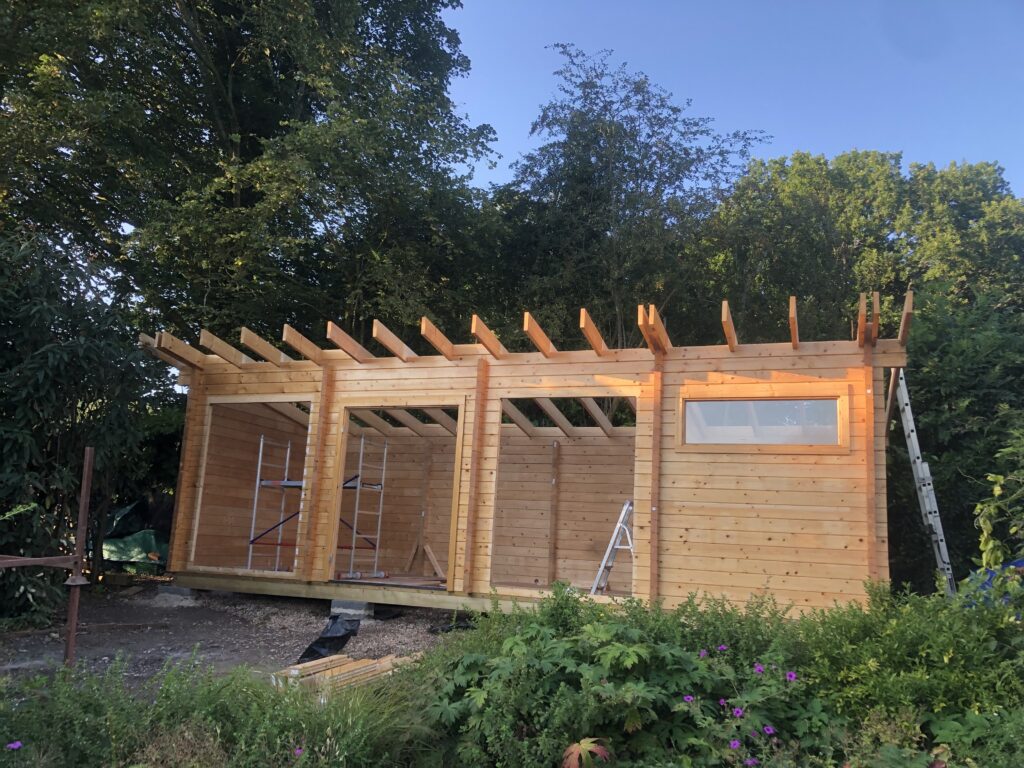
After a long day of building the new astronomy building with a few friends, I opened the dome on this clear night and start off by imaging SH2 132 until midnight for which I grabbed 18 x 600s Ha images at Gain 139 Offset 21 and temp of -25℃. I then switched to SH2 183 and went to bed.
All Sky Camera
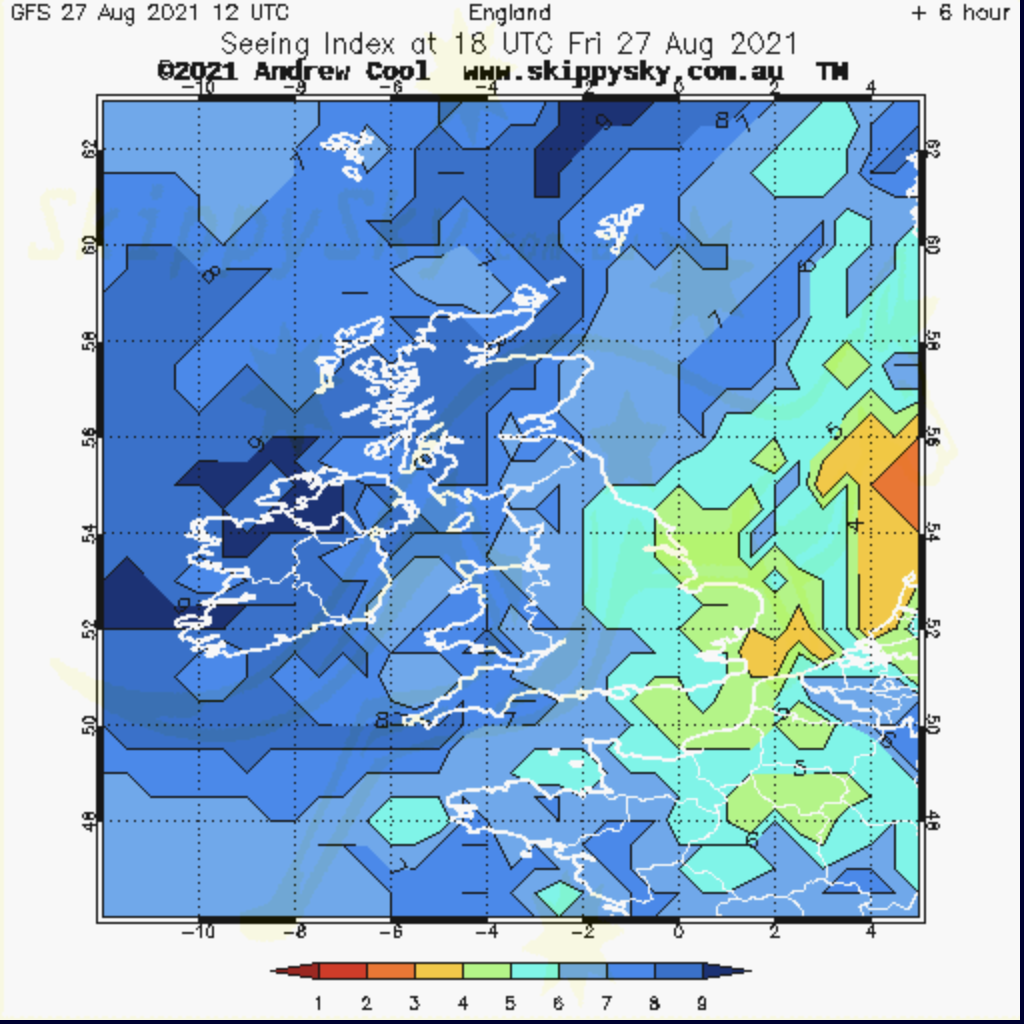
On waking this morning I realised I got 22 x 600s Ha images at Gain 139 Offset 21 and temp -25℃ before the clouds rolled in ands the dome shut around 4am. The seeing was particularly good as can be seen from the satellite image from skippy sky.com
Grafana dashboard was not reporting anything from AAG, this turned out to be a bug in the code from Gingergeek which he will fix. First image from the camera came out blank from SGPro, restarted a new image and problem went away. Started imaging SH2 132 but clouds rolled in.