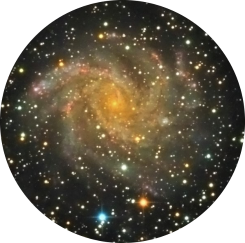
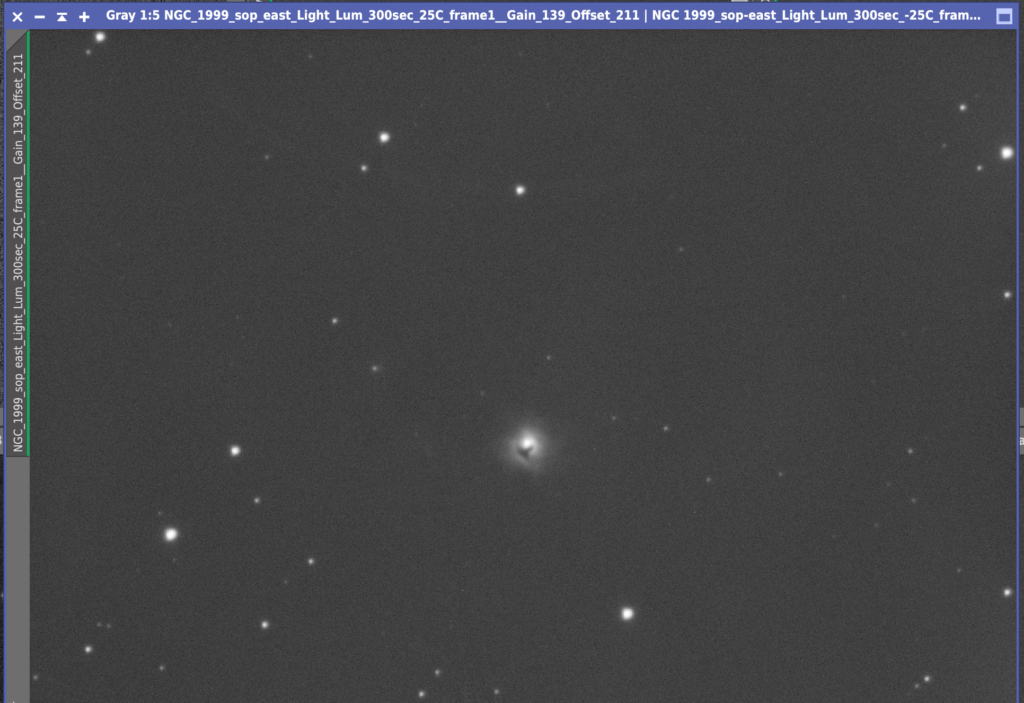
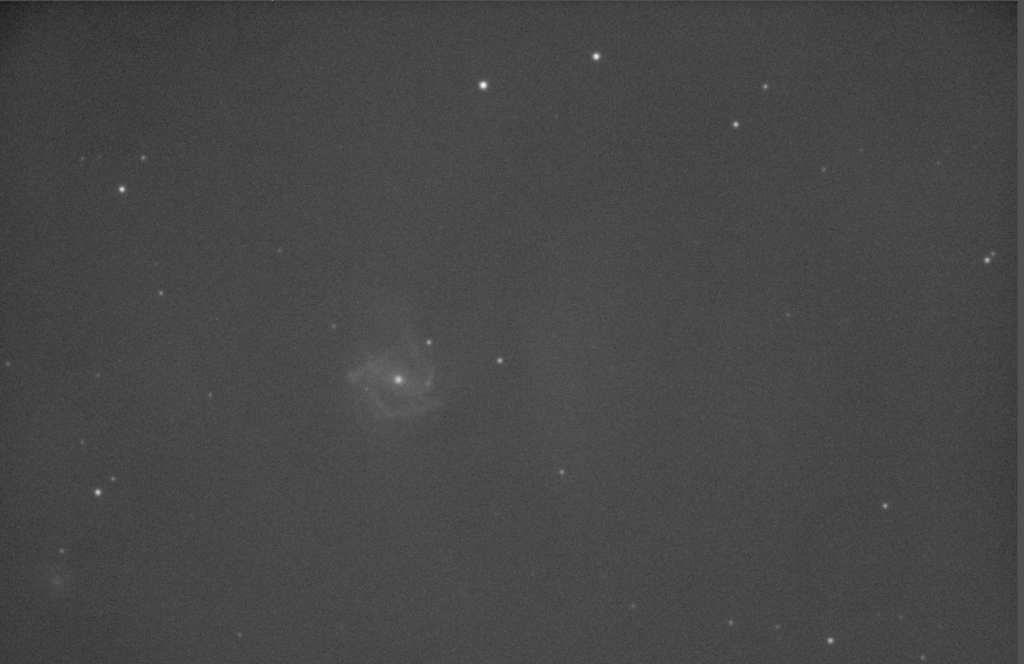
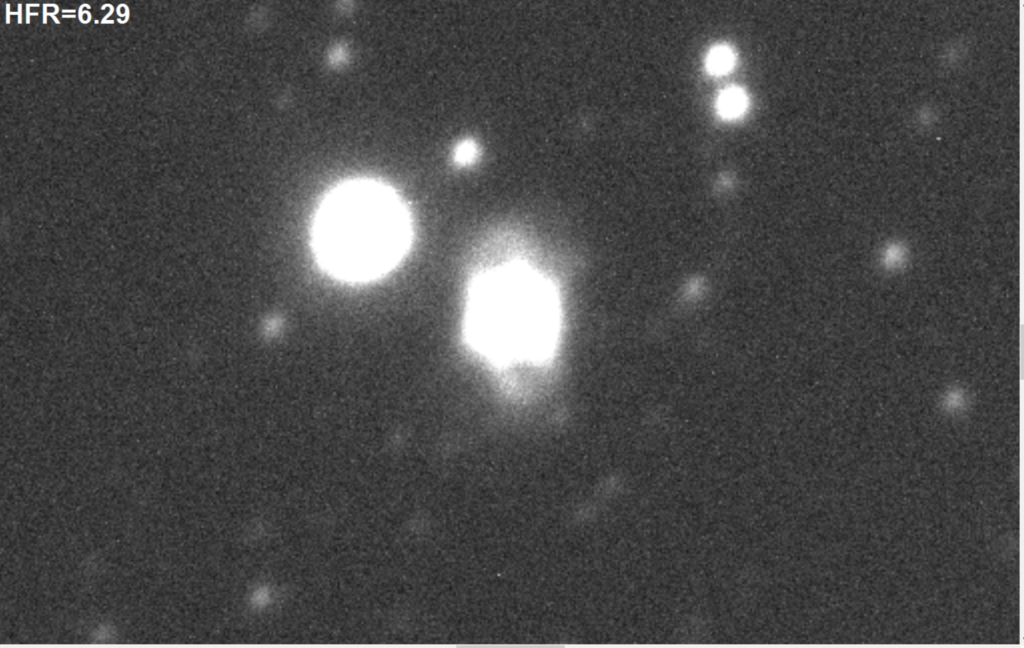
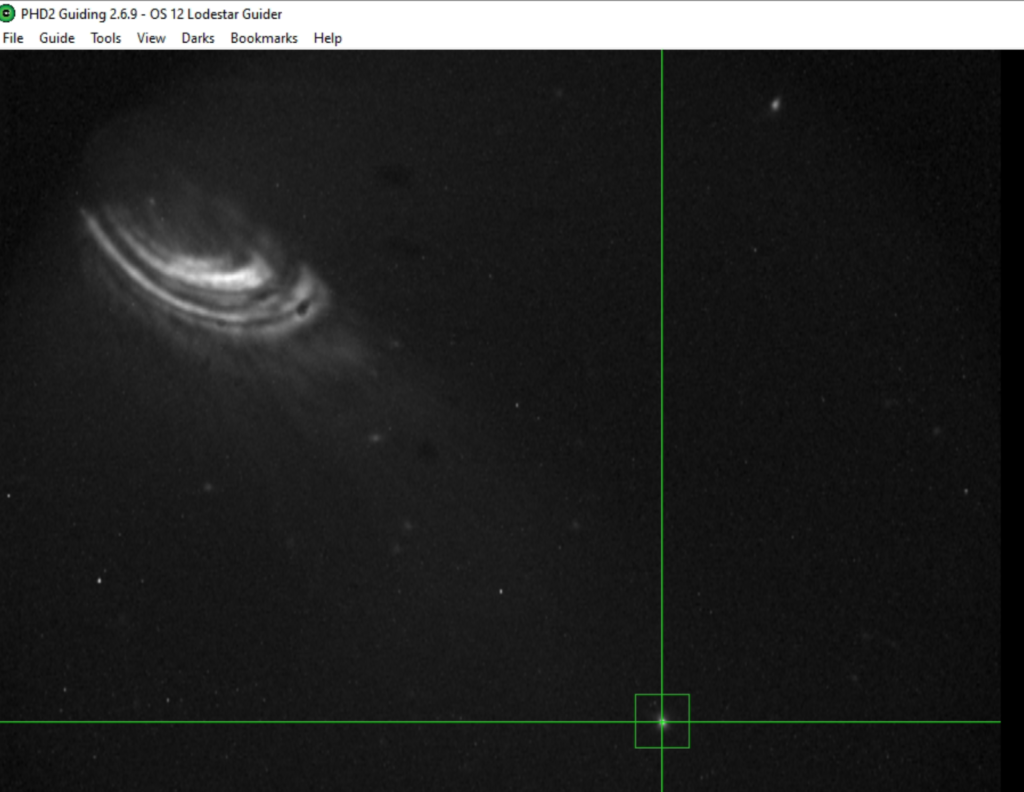
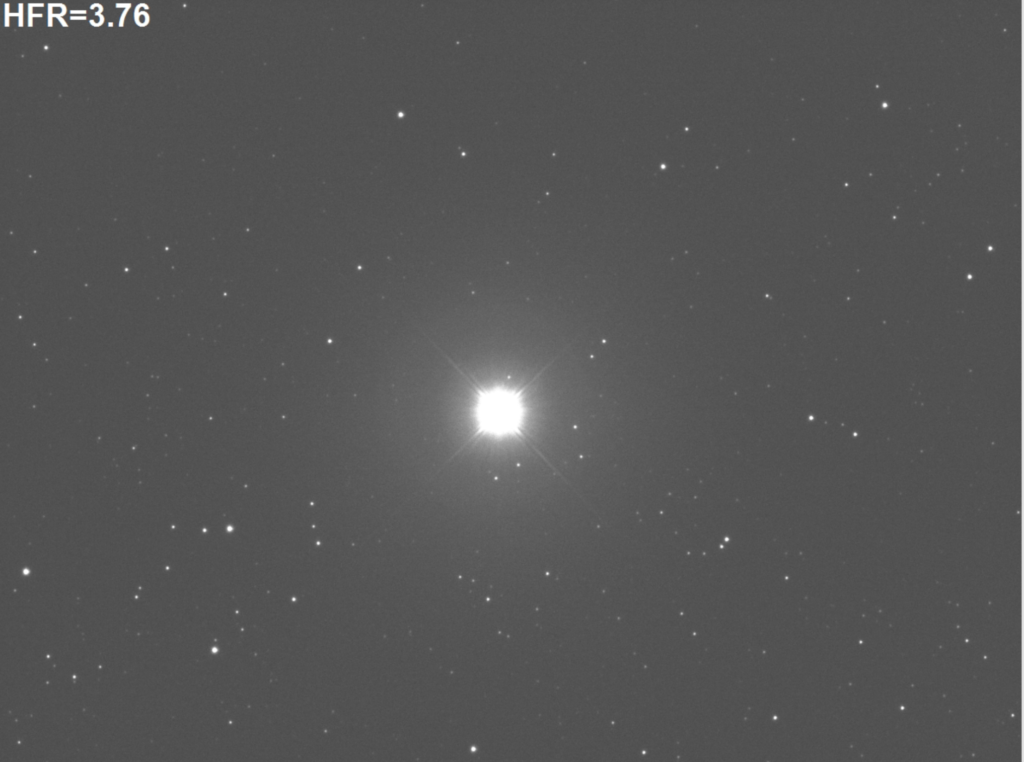
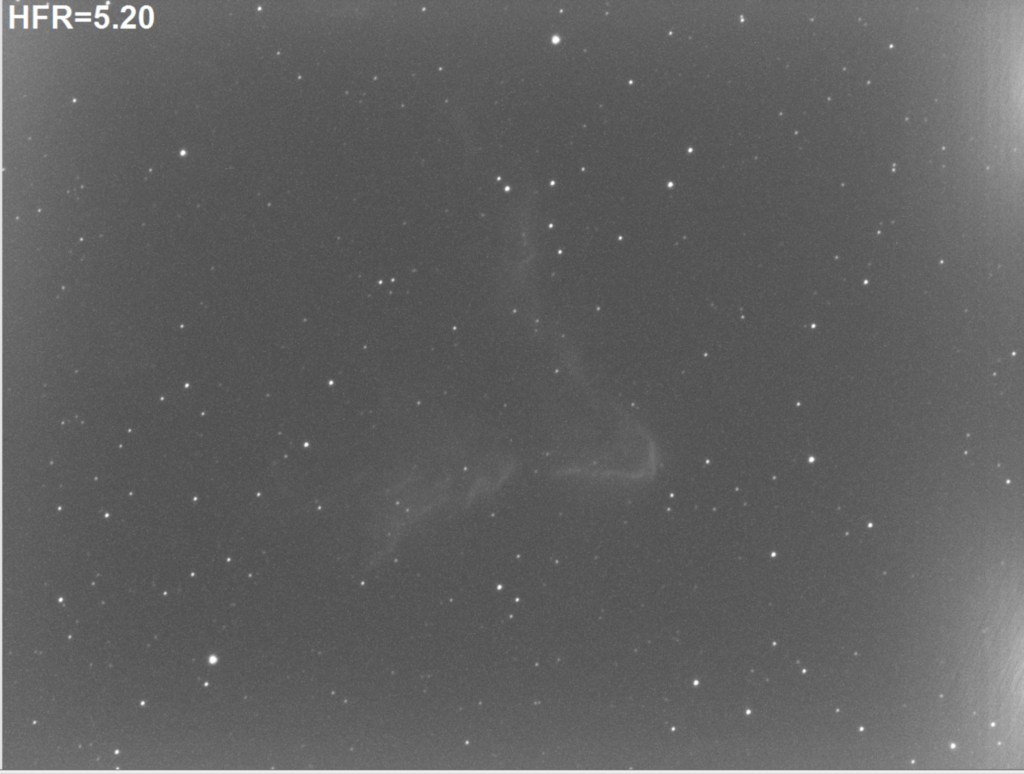
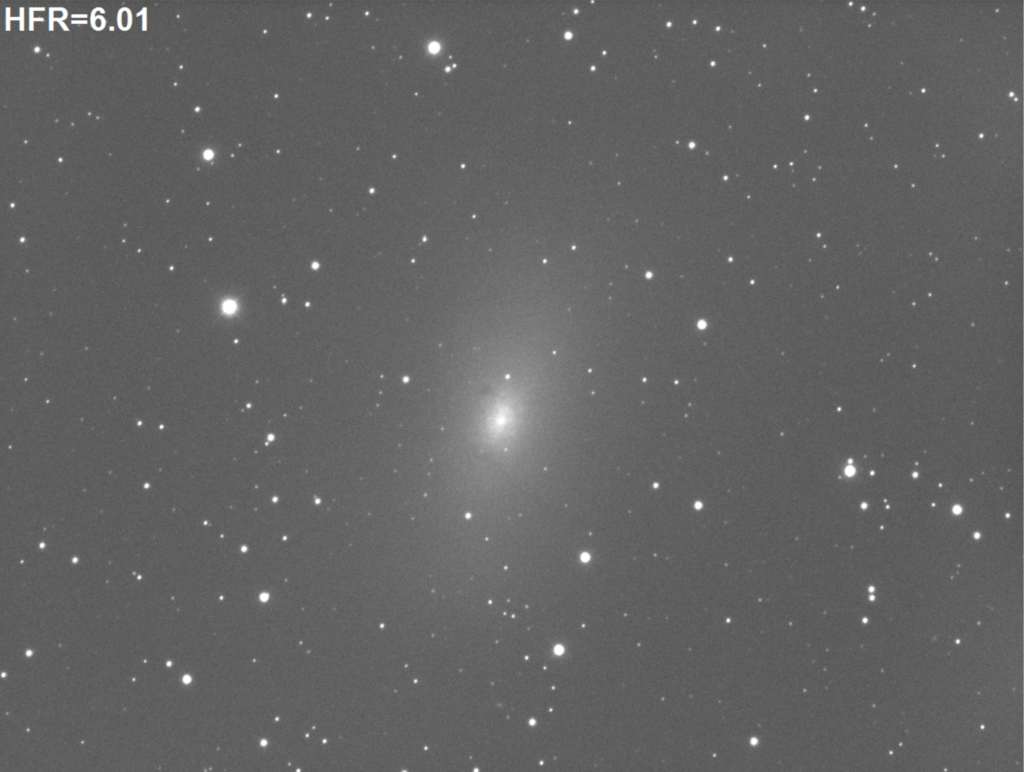
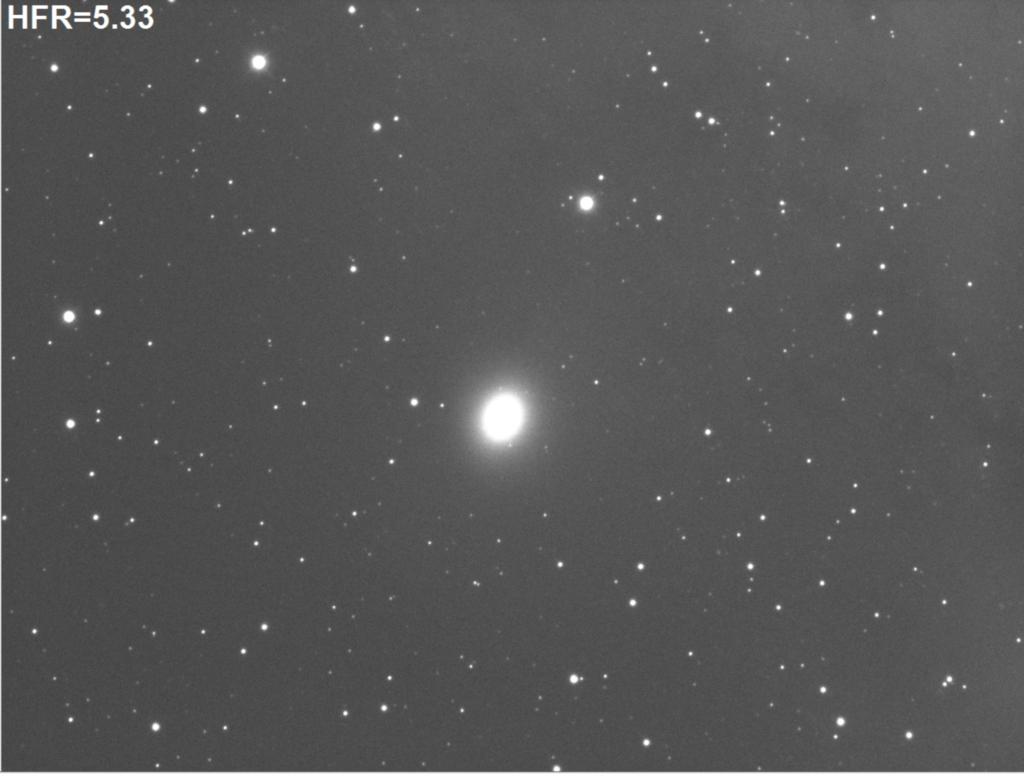
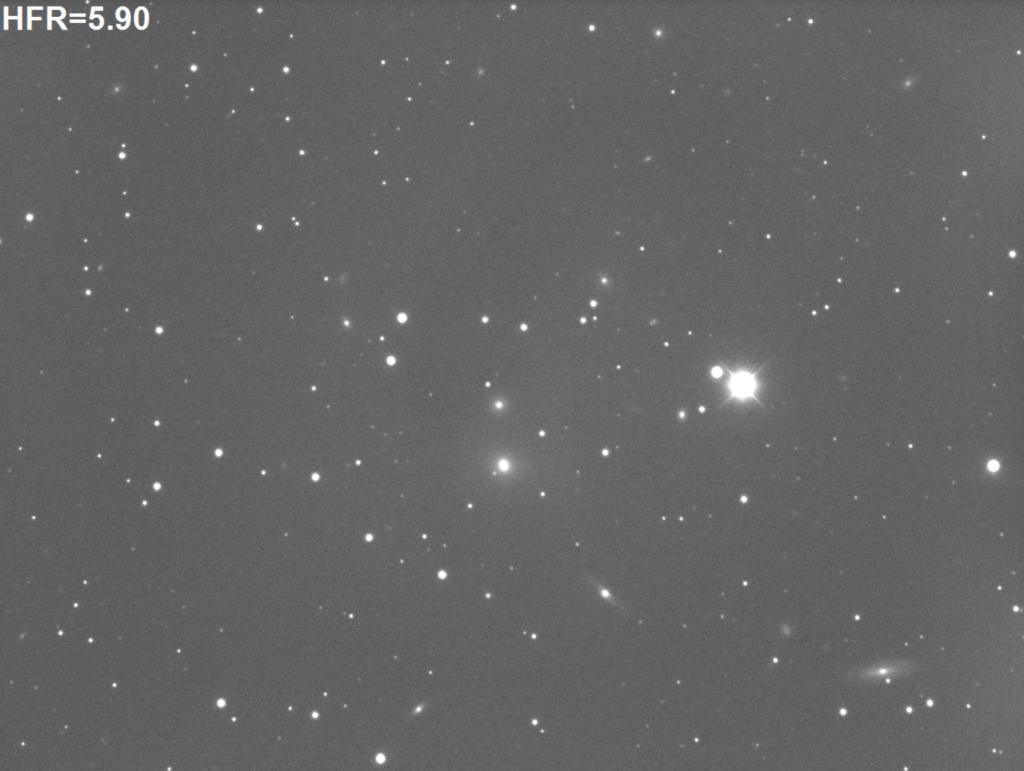
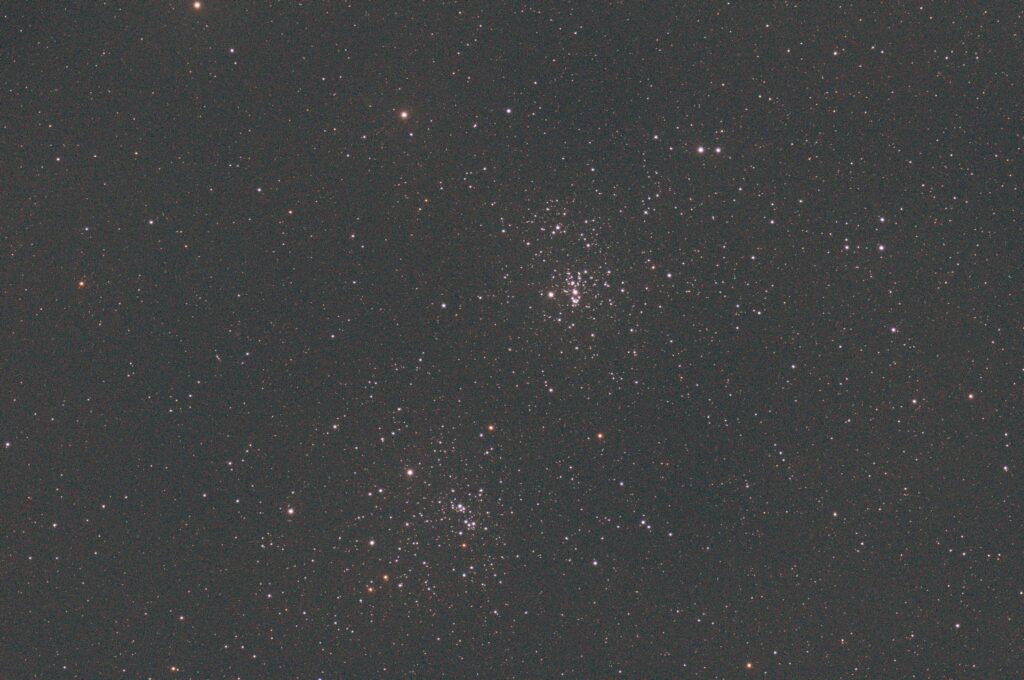
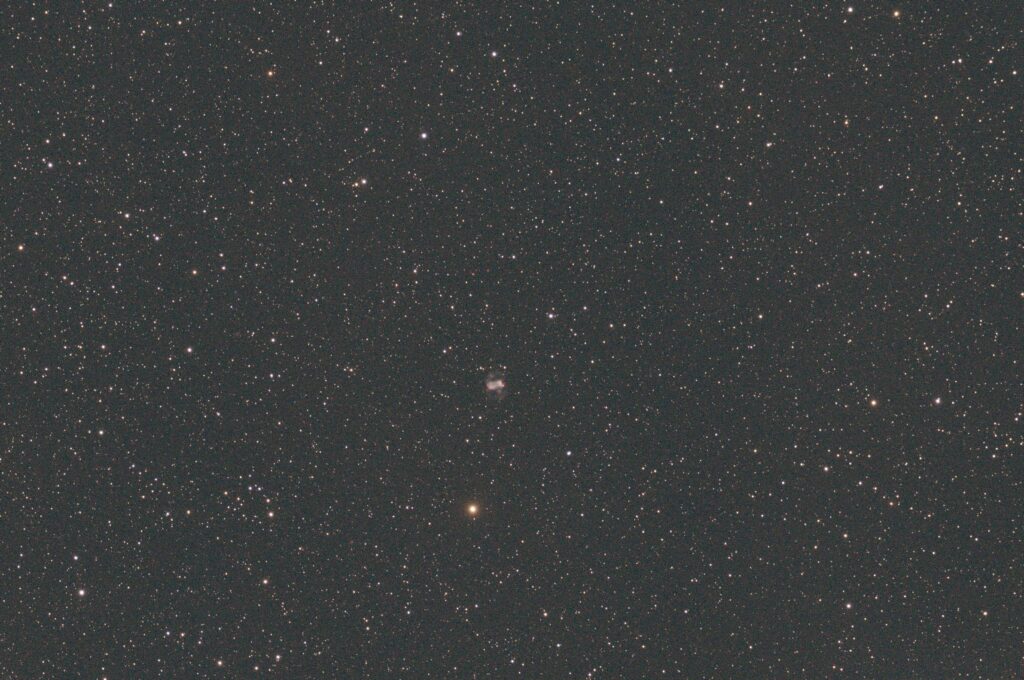
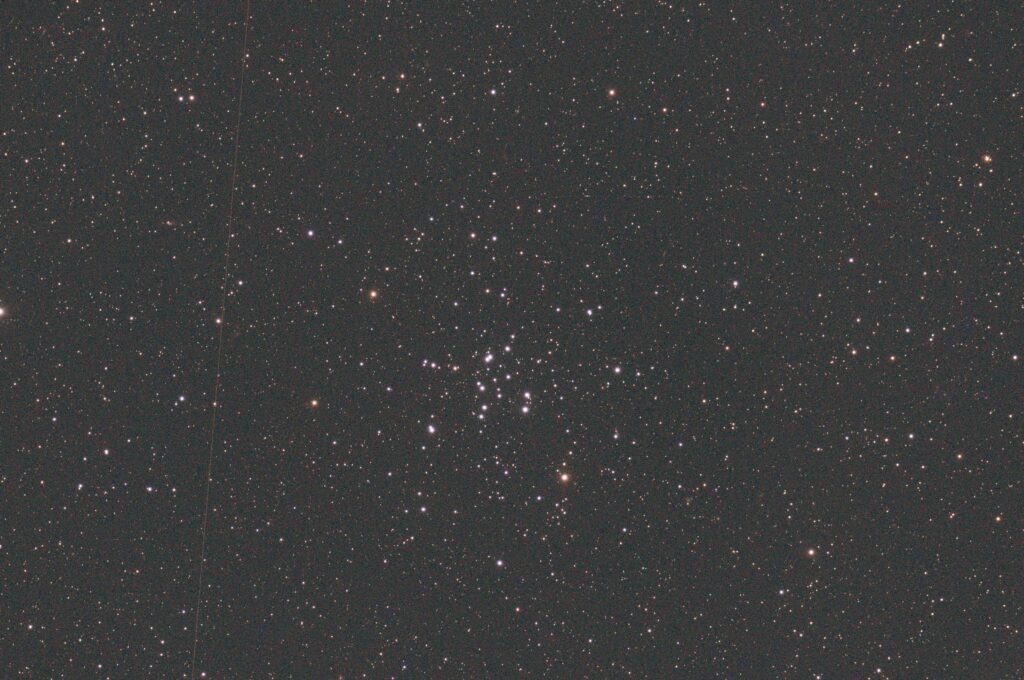
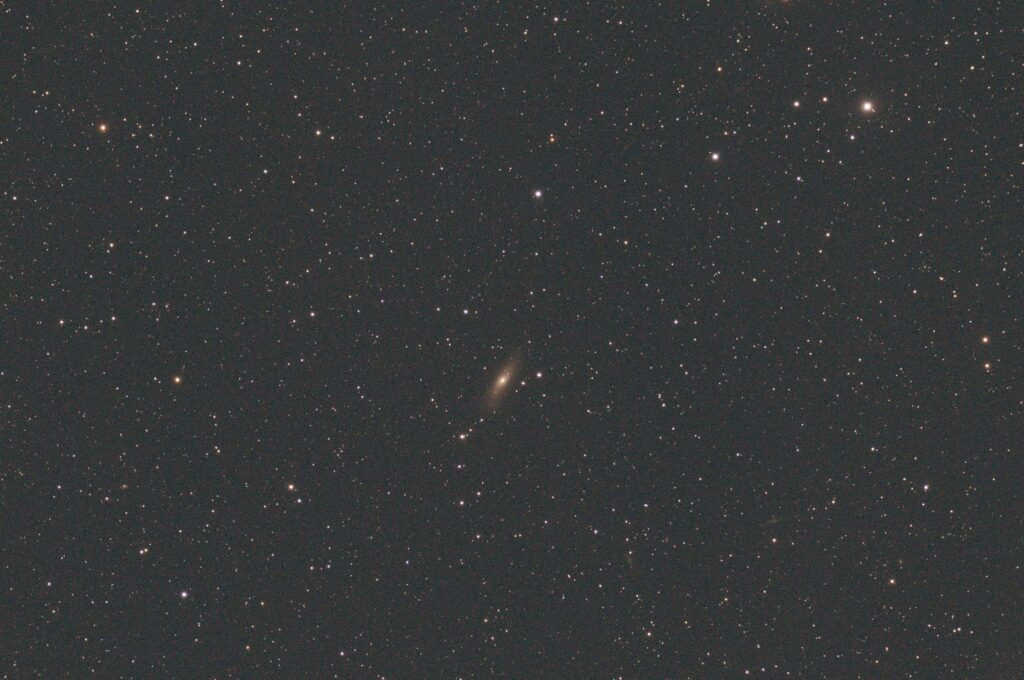
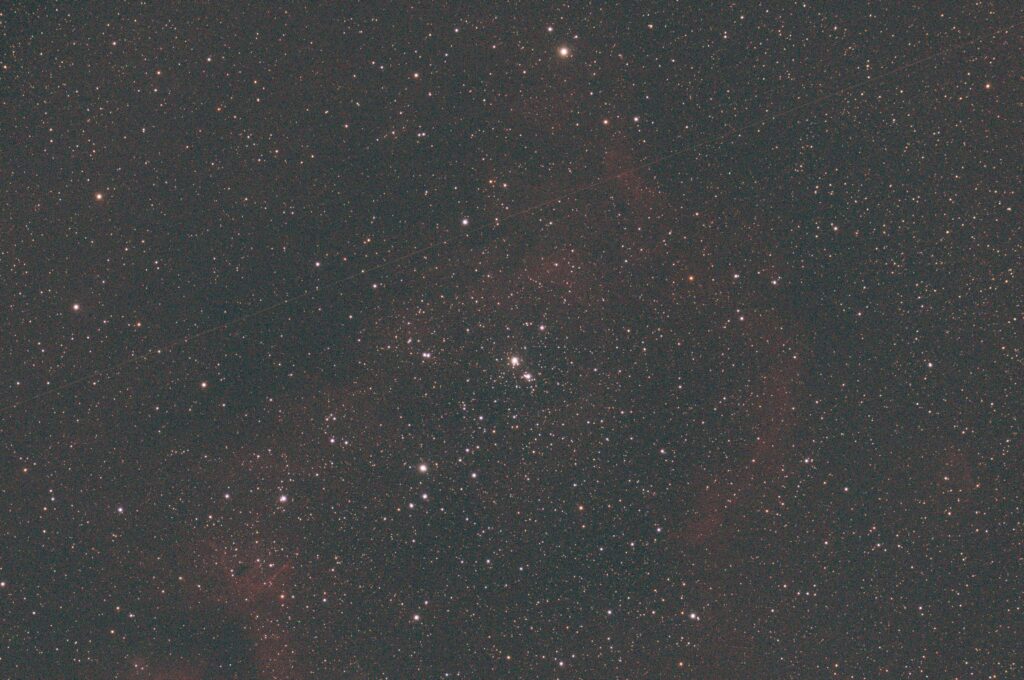
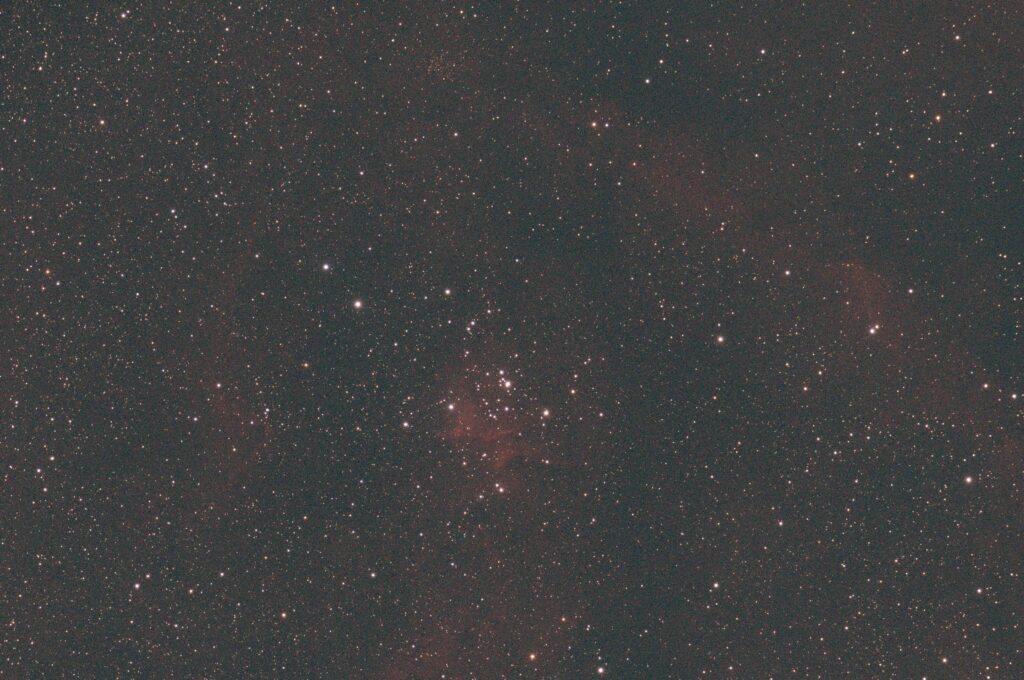
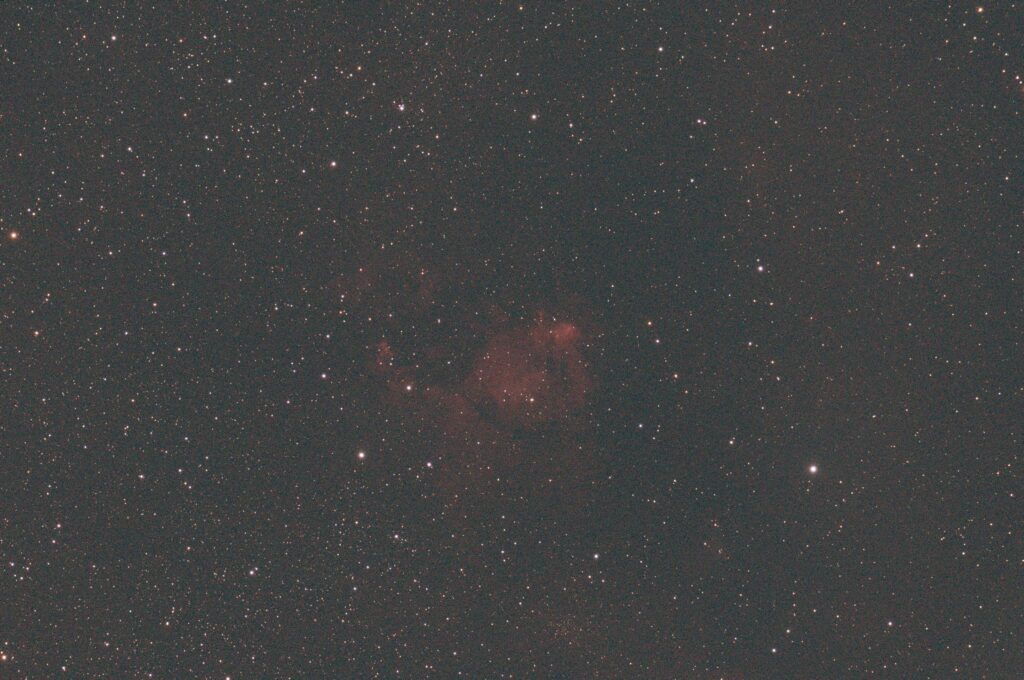
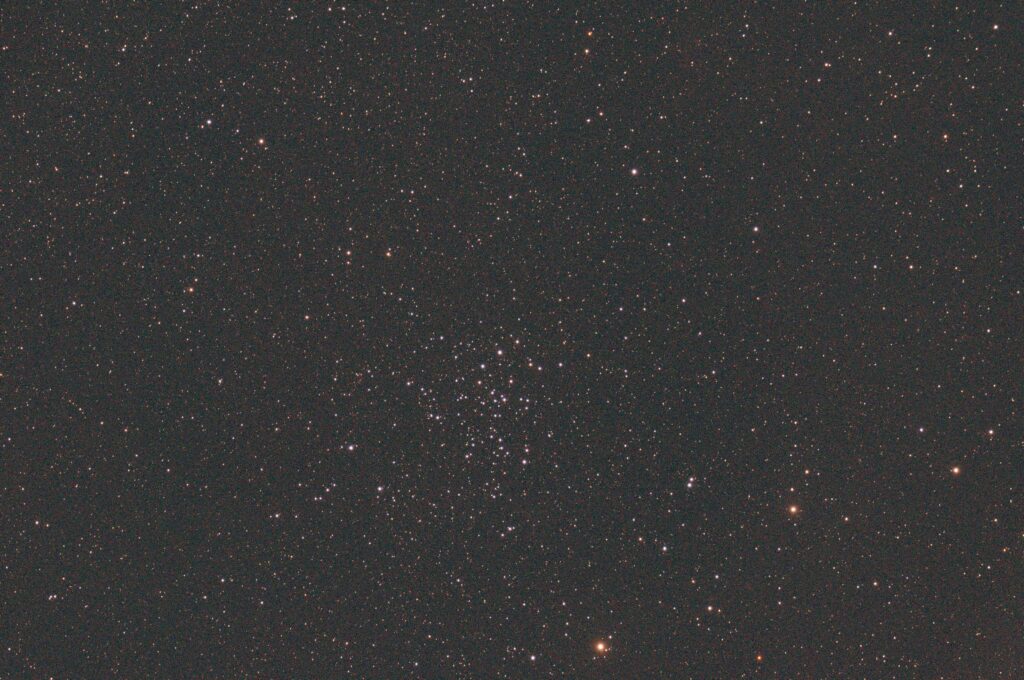
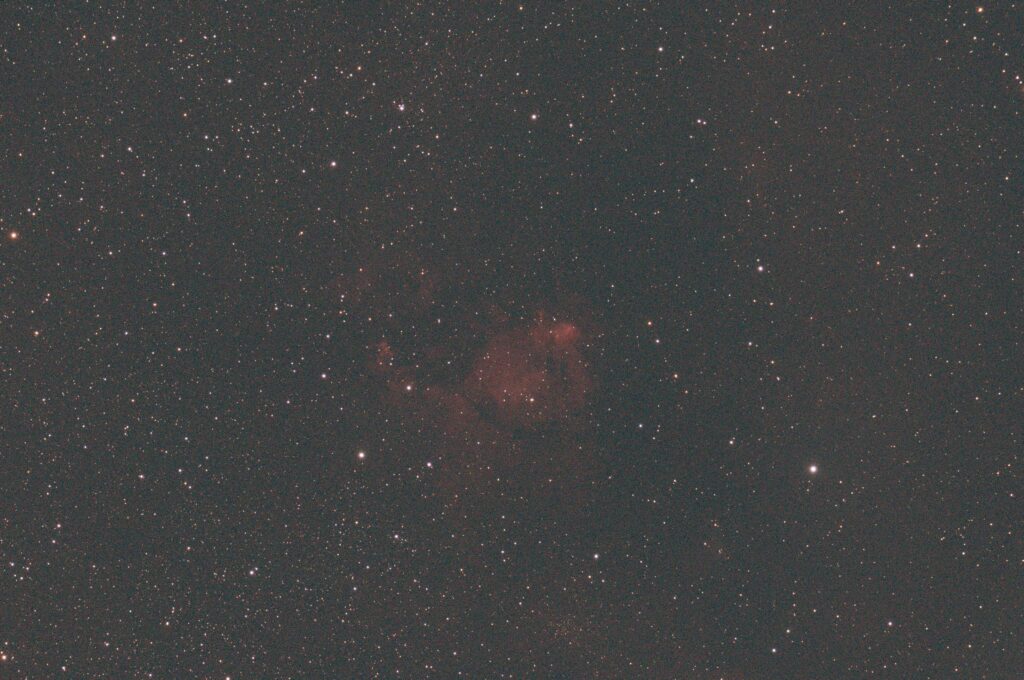
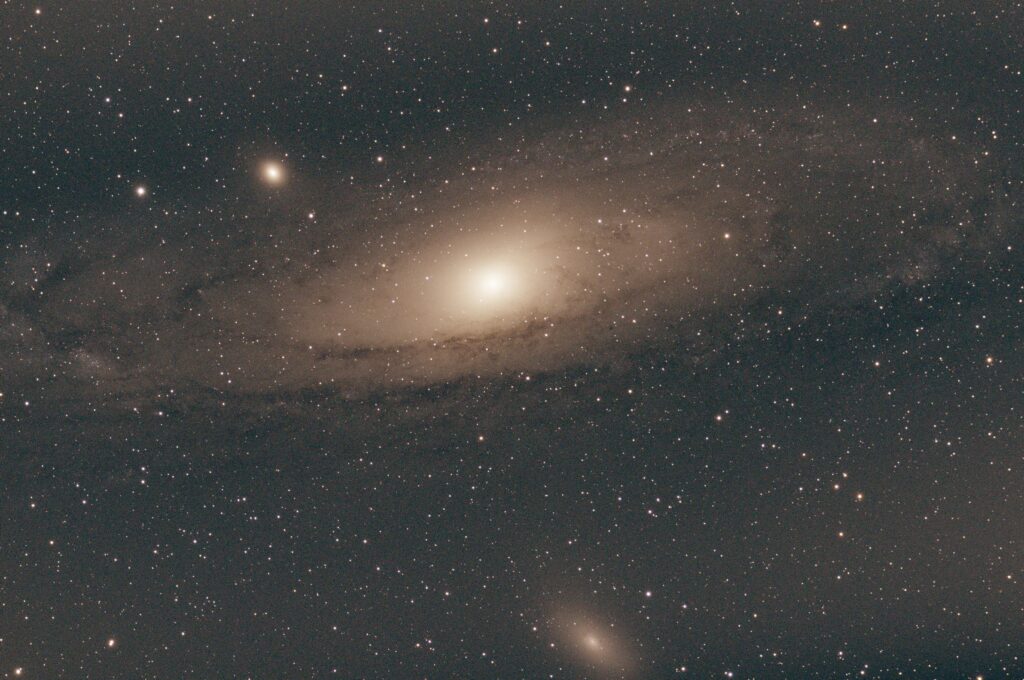
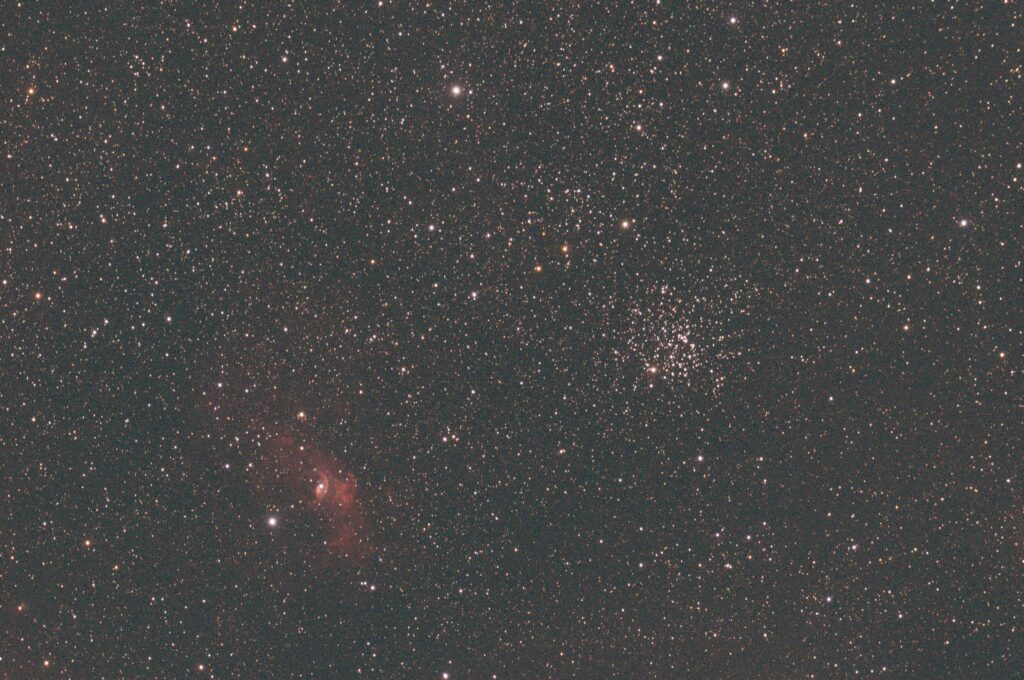
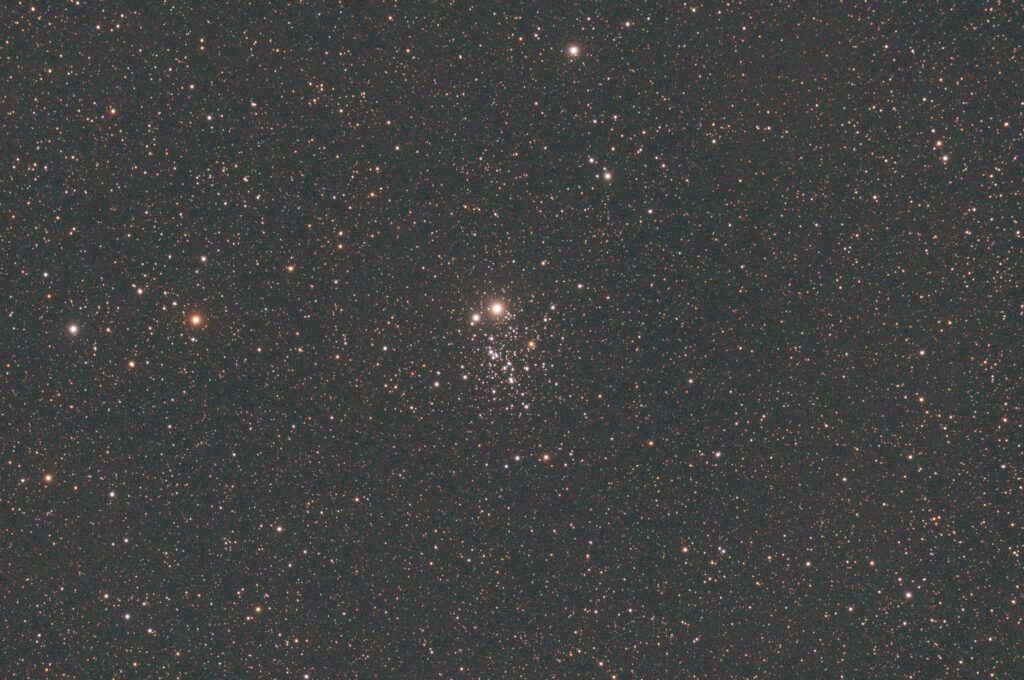
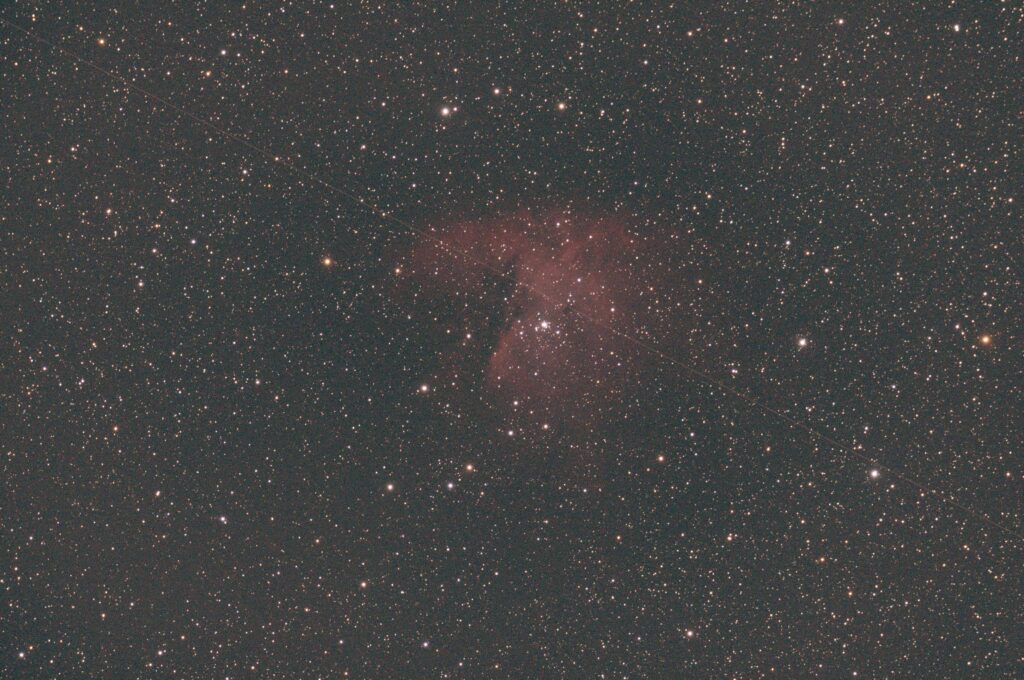
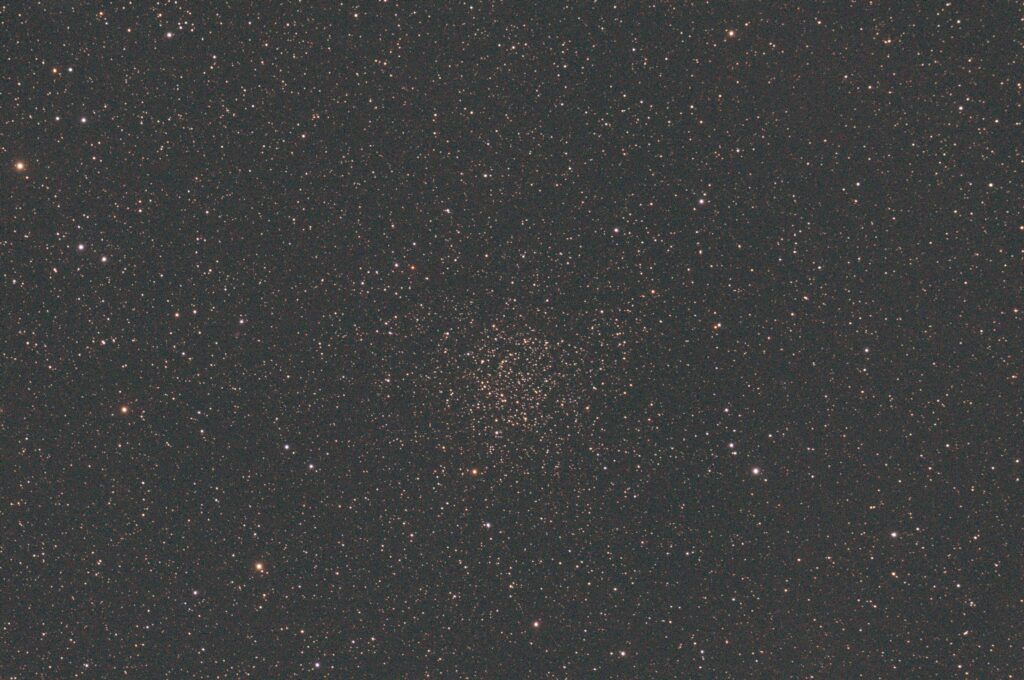
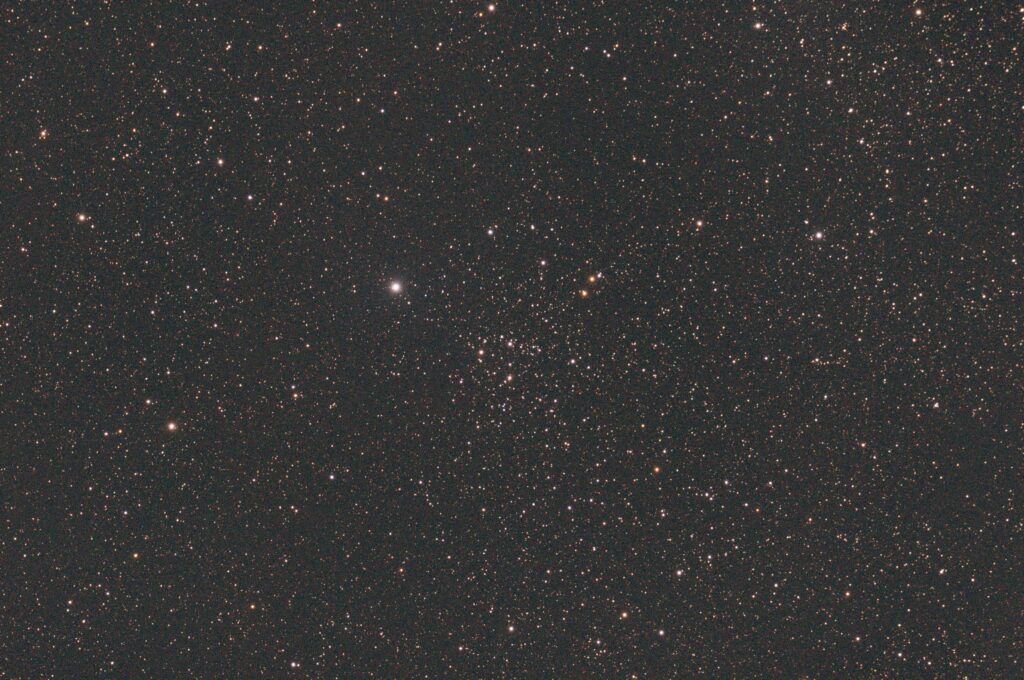
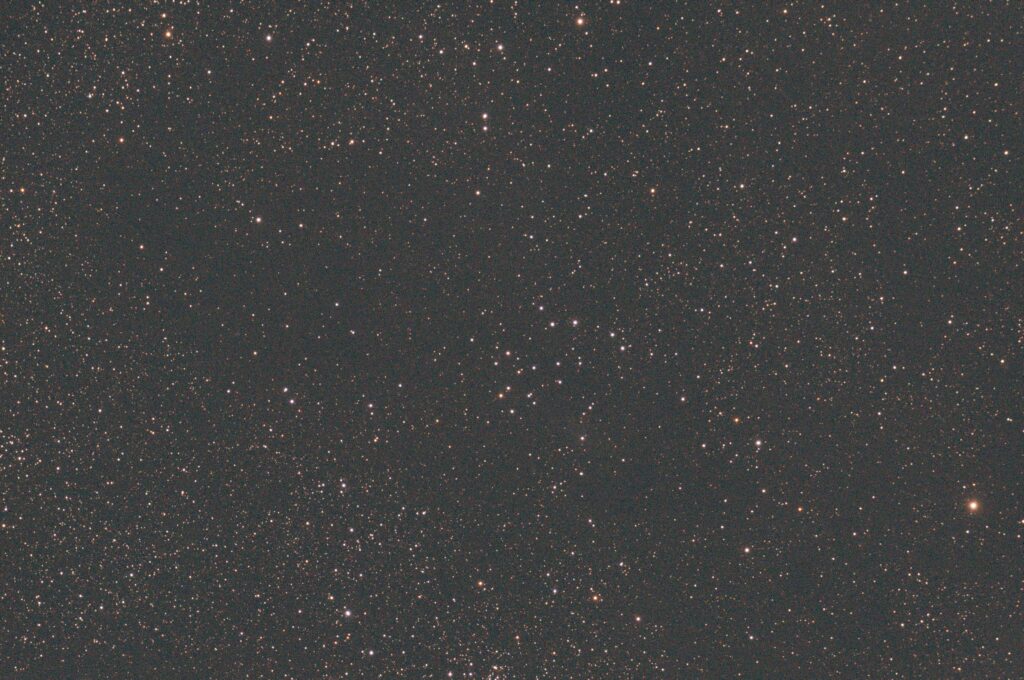
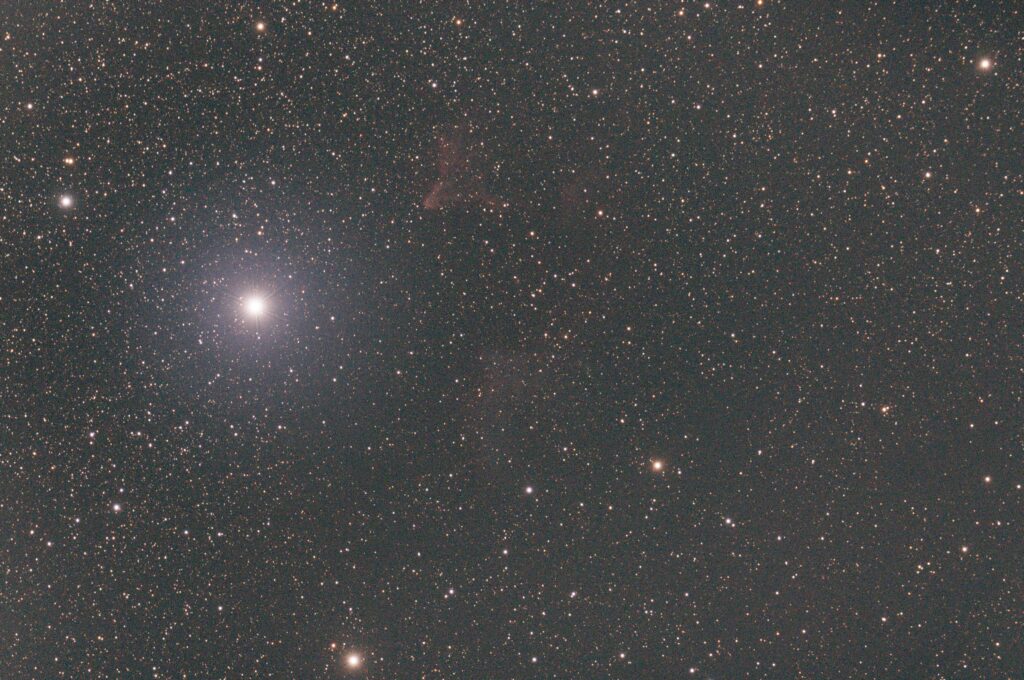
A quick imaging run this evening, again for NGC 1999, this time LRGB, 5 frames of each at 300s then it was too low and my bed time on a school night 😉
Before shutting down I made sure the Tak 102 profile for the dome was correct for the 120 Esprit as it is fixed on the same side of the 12″. I then slewed and it centred fine and the dome was in the right position. I tweaked the focus too in preparation for the Messier Marathon with Basingstoke Astronomical Society this Friday.
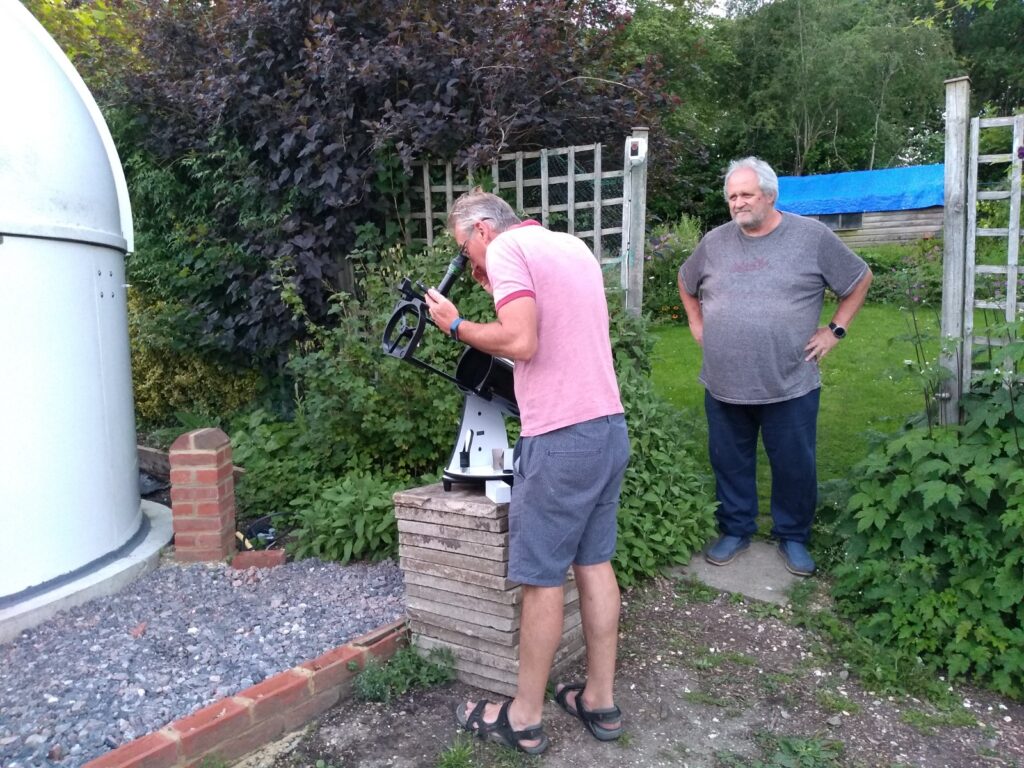
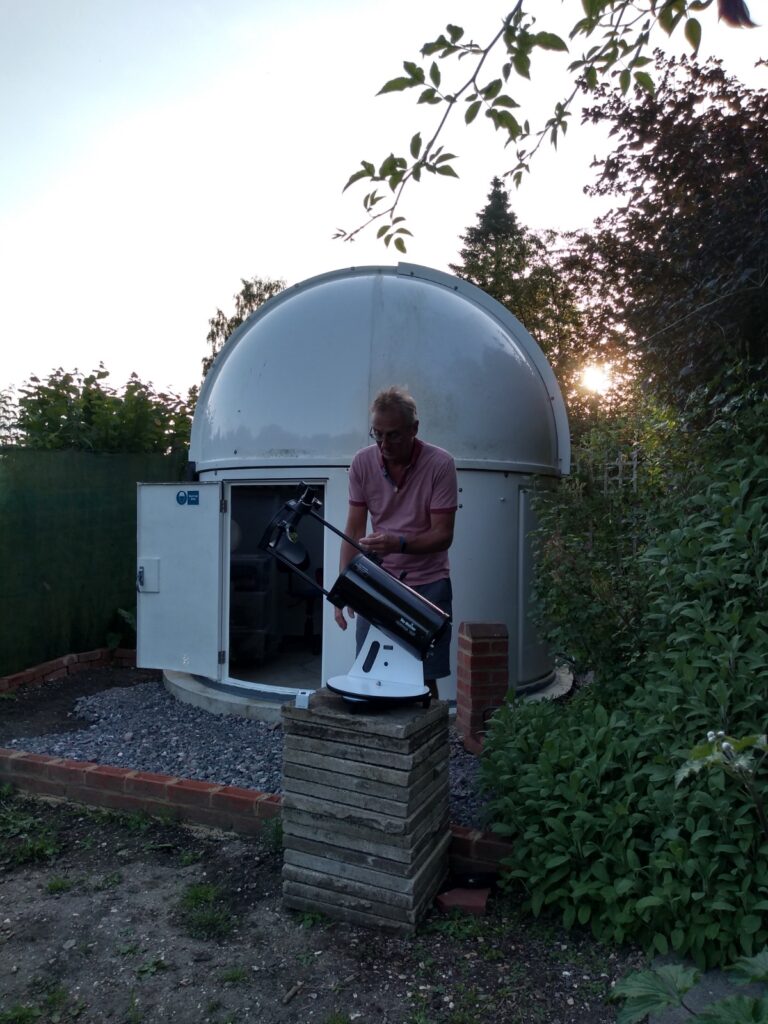
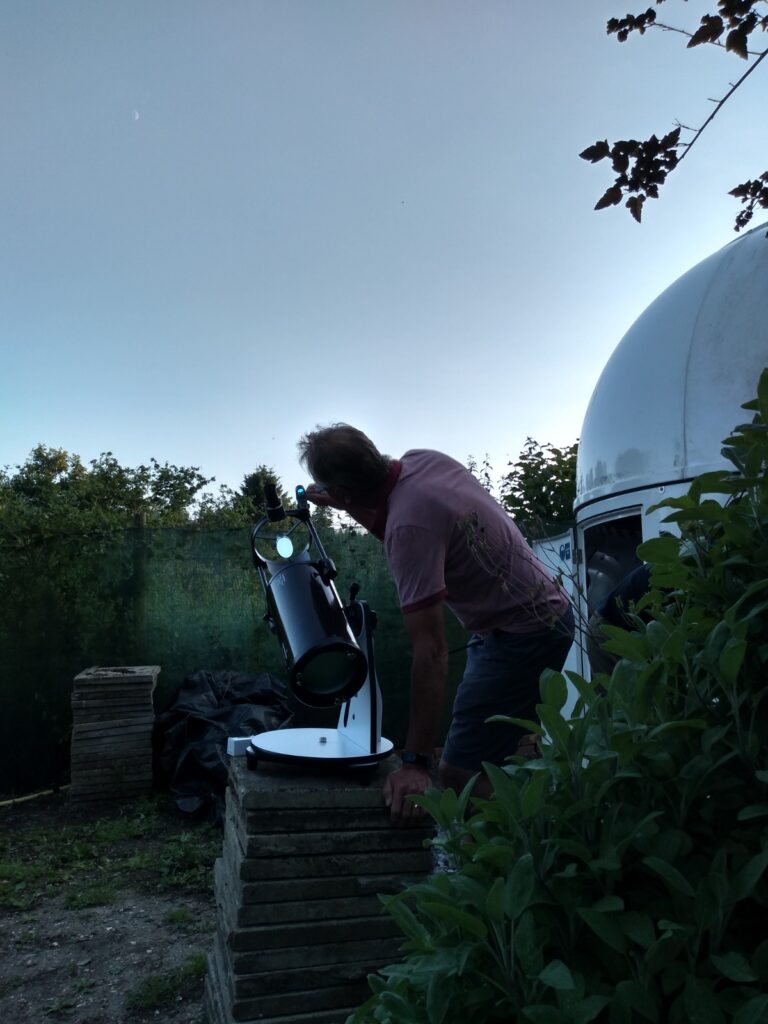
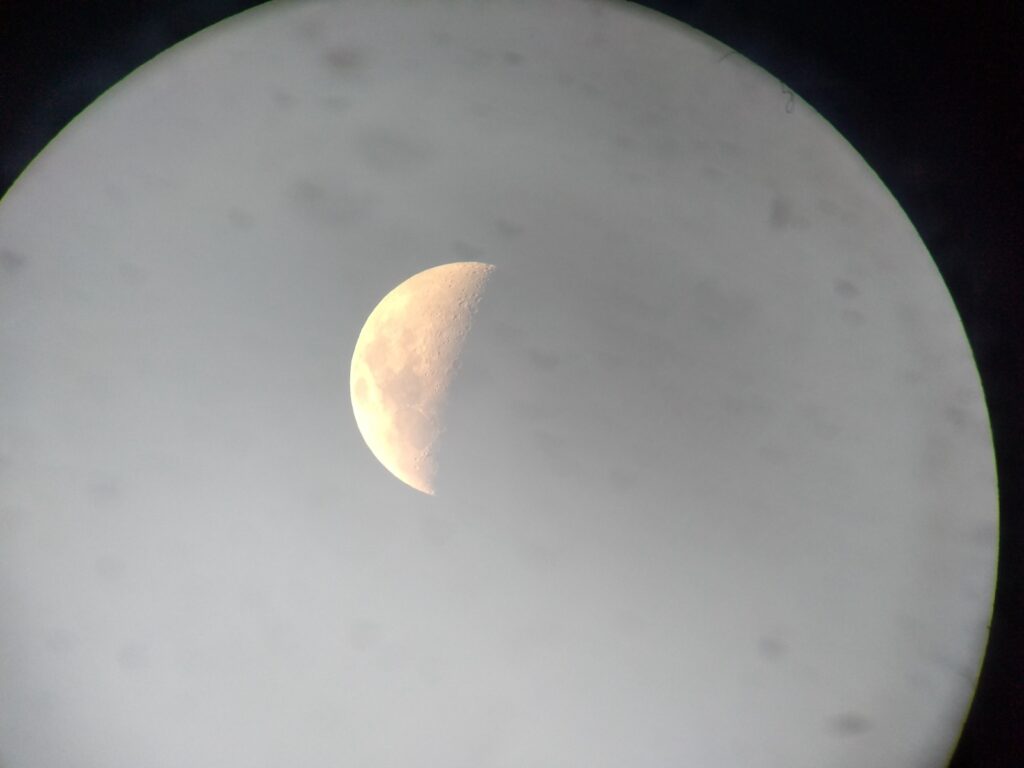
After a glorious sunny Sunday where I spent a lot of the day building the new decking for the Summerhouse for my wife, I planned on a short, sharp observing session until 9:30pm (turned out to be nearer to 10pm) starting after dinner at 7pm. In preparation for this I setup the 22″ dob on the observing patio and opened the dome for the 12″ to start to cool down whilst I ate with the family. My daughter and her boyfriend’s famous pasta dish was for dinner tonight which was great 😋
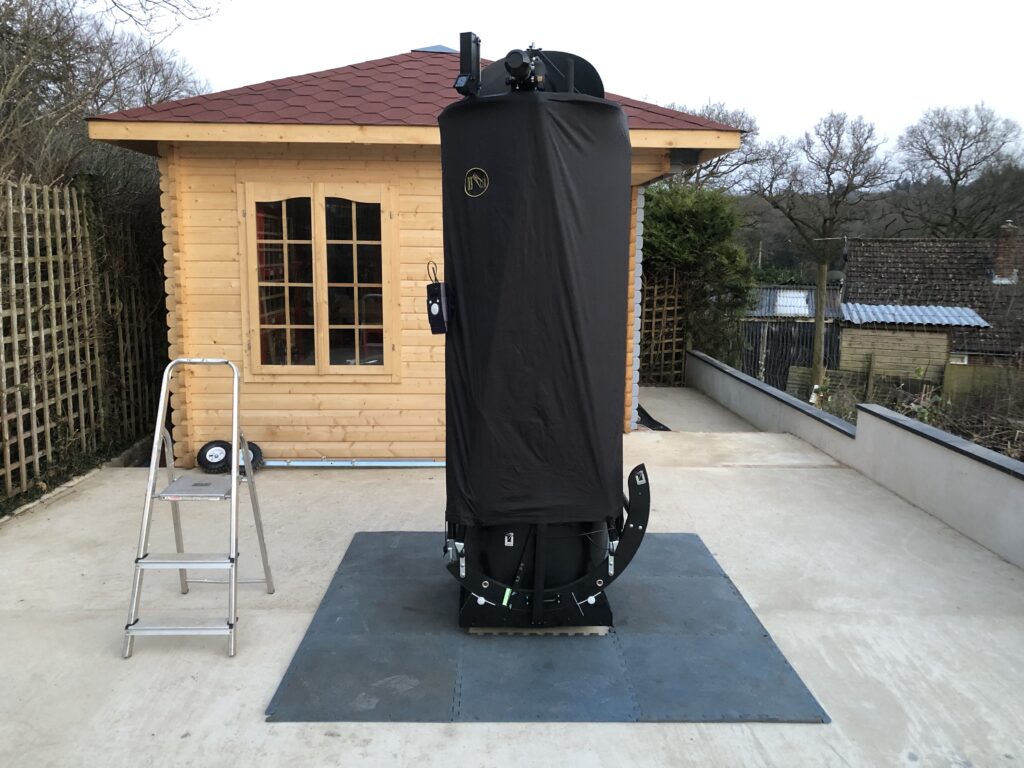
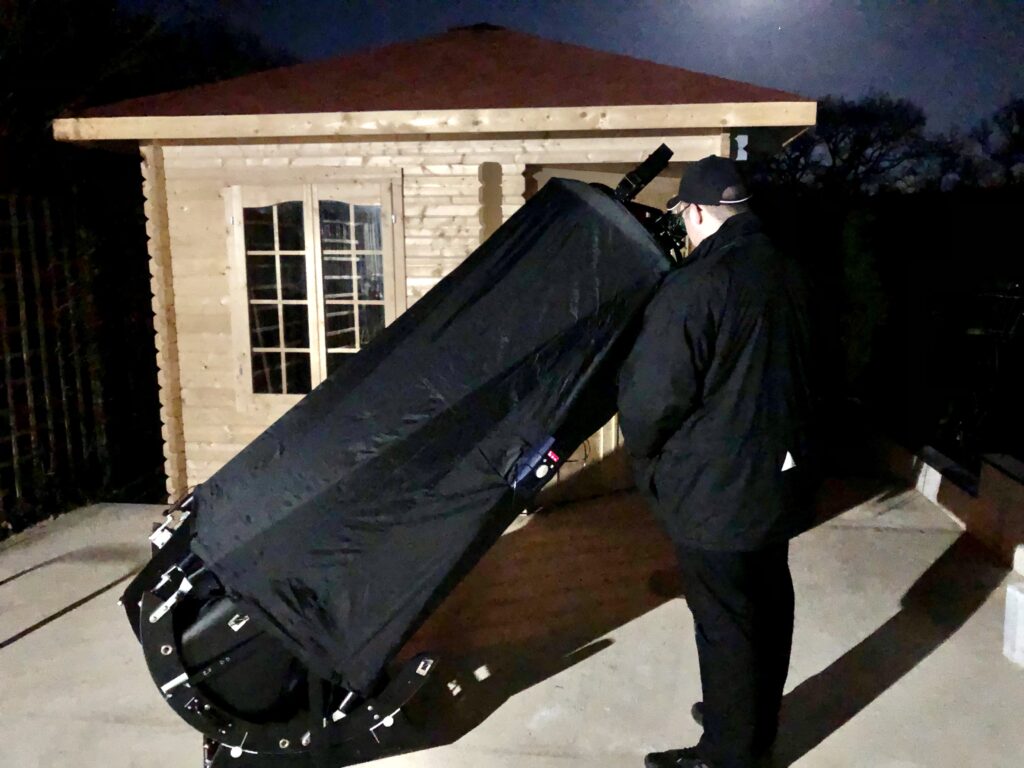
22″ Obsession ready to go
With dinner finished I headed to the sofa and set the 12″ running on NGC 1999 in Luminance so I could then go out and observer with the 22″. It took a while to do the usual, sync and centre on a star, get the focus right and set the imaging run up. But after 45 mins I was then able to wrap up warm and head outside.
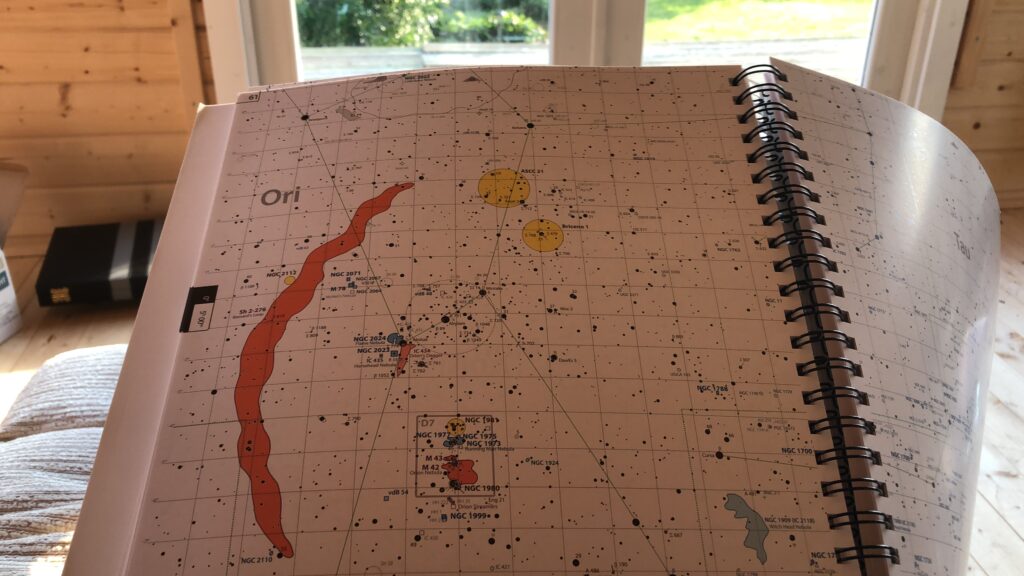
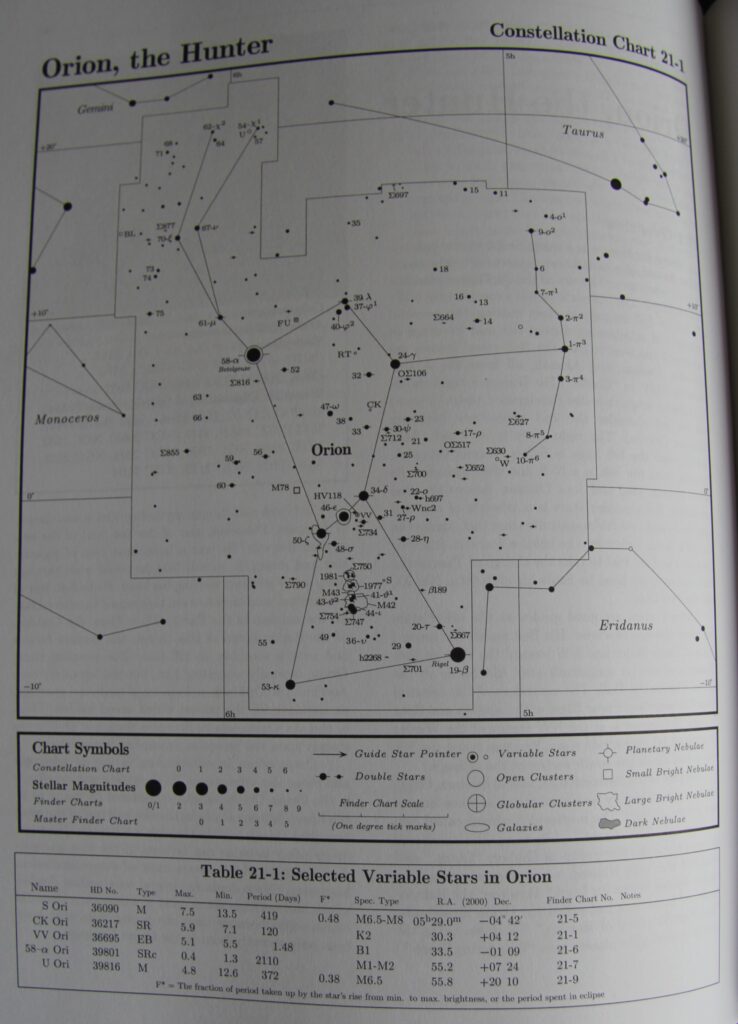
I have read an article in Sky and Telescope of visually observing NGC 1999. With that information I opened my newly acquired Interstellarum Deep Sky Atlas to look at the area where NGC 1999 resided. I then referred to the Deep Sky Guide to look at the photos and drawings of the objects in the vicinity including this reflection nebula.
Deep Sky Atlas
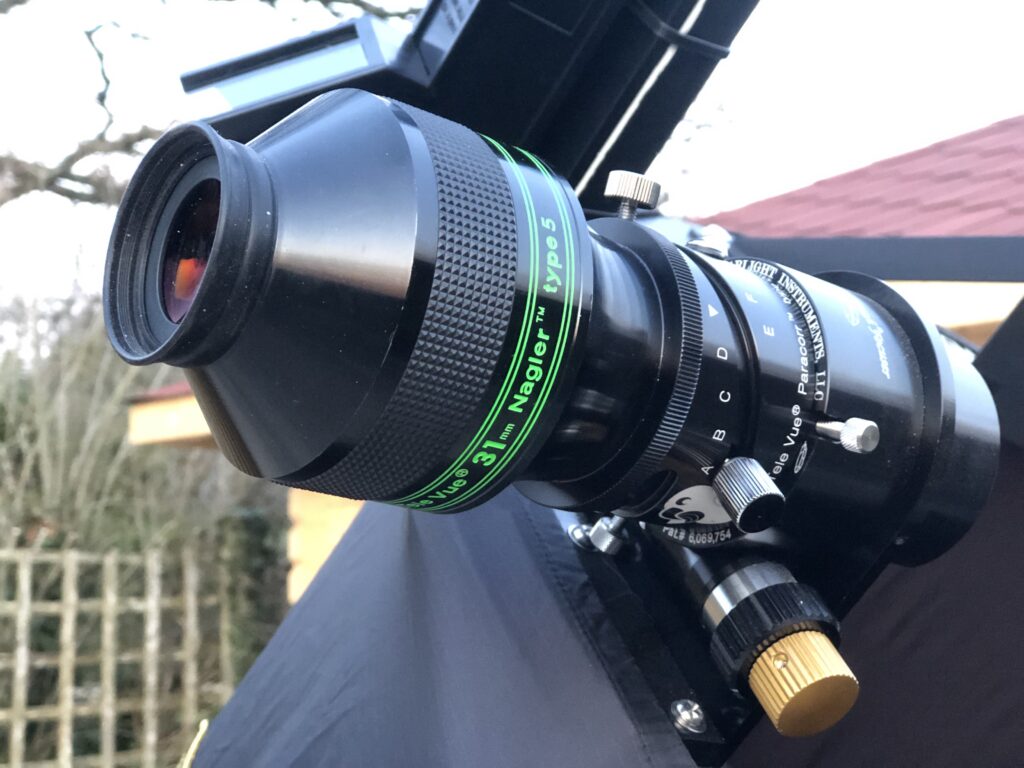
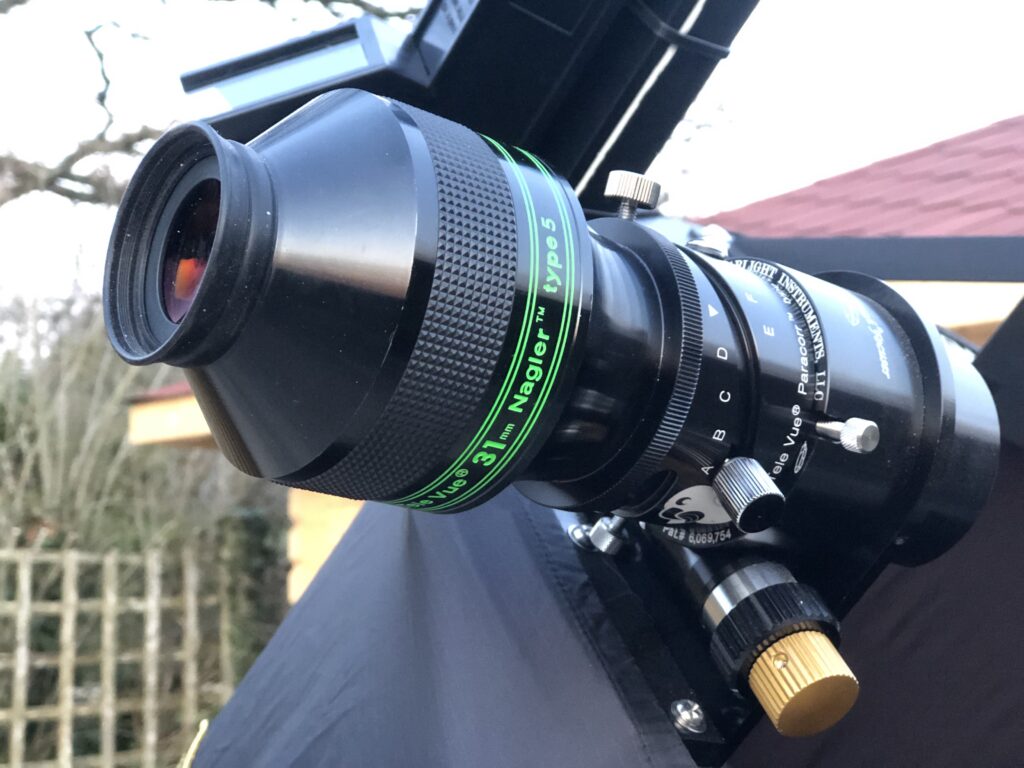
There was a potential to observe two Herbig-Haro (HH) objects but I was afraid the sky would be a little to bright given the Moon rising at 9pm, in order for me to see them. I placed the 31mm Nagler in the 22″ and then dialled in NGC 1999 into the handset and pushed the scope until the numbers for Azimuth and Altitude were as close to zero as possible and looked through the lens. Surprisingly I could see a small fuzzy object with a star embedded to one side just off centre in the eyepiece. I reviewed the star chart on my phone using Sky Safari 4 and confirmed this indeed was NGC 1999. I guess it was just off centre due to my alignment and next time out I will use the 13mm Nagler to centre and align the scope during the initial setup.
31mm Nagler
On looking at the reflection nebula I could tell there was something to one side of it due to the offset nature of the nebula to the star. I changed to the 13mm Nagler and set the Paracorr accordingly back to H from the A setting for the 31mm Nagler. I then recentred using the Argo Navis computer and too a peak through the eyepiece. I could now see a distinct whole in the nebula, but clearly not as good as the Hubble image I had looked at, however it was there. I ten went looking for the two HH objects but I must say I could not confirm them at all. There were two star like objects near by but again looking at my Sky Safari star chart I was not convinced. I would leave this for another night when the Moon was goner and I had cooled the mirror with the fan, that is still not connected to power yet.
For a laugh I then pushed to the Horse Head but could not see it, not surprised given you need a Ha filter. I will buy one.
I then had a quick look at M42 again which is a wonderful sight in the scope. Orion was now getting low with NGC 1999 and M42 at +18 degrees at about 9pm. I then started to pack away the scope to head in doors and look at the 12″ and see how it was doing.
NGC 1999
I reviewed the set of images for NGC 1999 on the 12″ and now due to the altitude I switched and set the scope running on M61 for Luminance and RGB as it is on my list for my Messier wall chart.
At 10pm I left the dome capturing M61 LRGB frames and hit the sack.
So after a successful day at The Practical Astronomy show it was time to head on out to play with my new toys. In this case a new 31mm Nagler Type 5 2″ eyepiece that I purchased from Owen Brazzel.
31mm Nagler
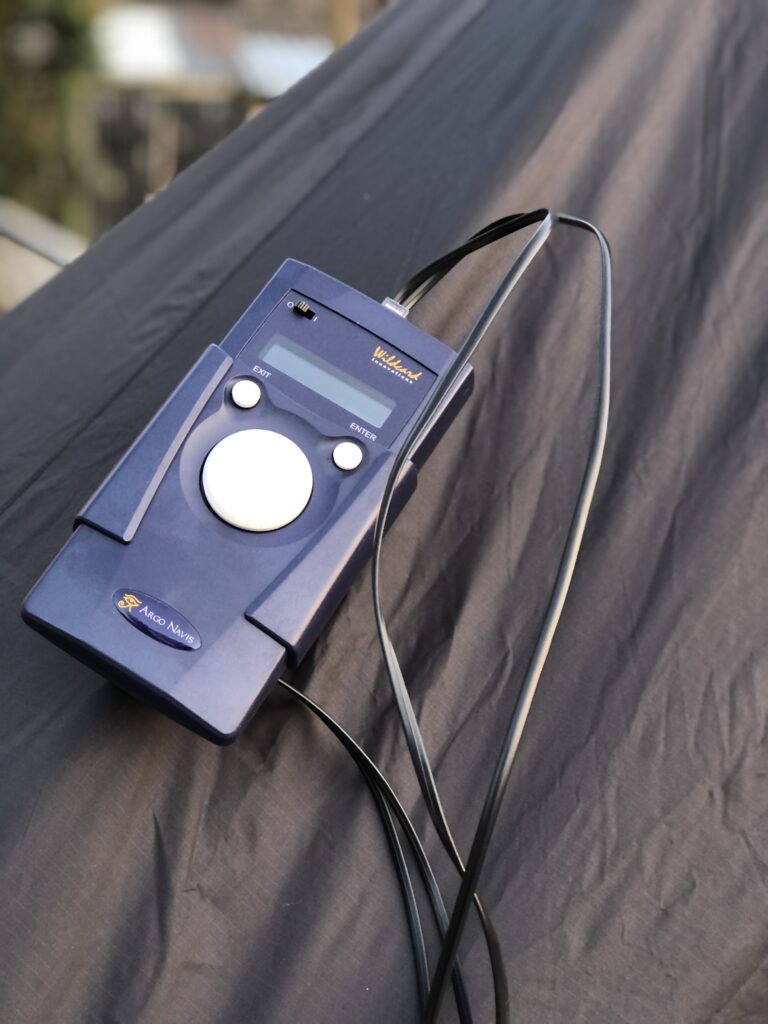
The other aim tonight was to setup the Argo Navis computer to allow me to find objects in the night sky on the 22″. Owen had said to me at the show that this is a must else I would find it difficult to star hop from one object to another without it, which was proved out the last time Bob and I ventured out.
Argo Navis
So I went to the Workshop where the Dob is stored and took it out onto the observing space and started to put it together. It only takes about 15-20 mins and then I set about collimating quickly with the laser collimator.
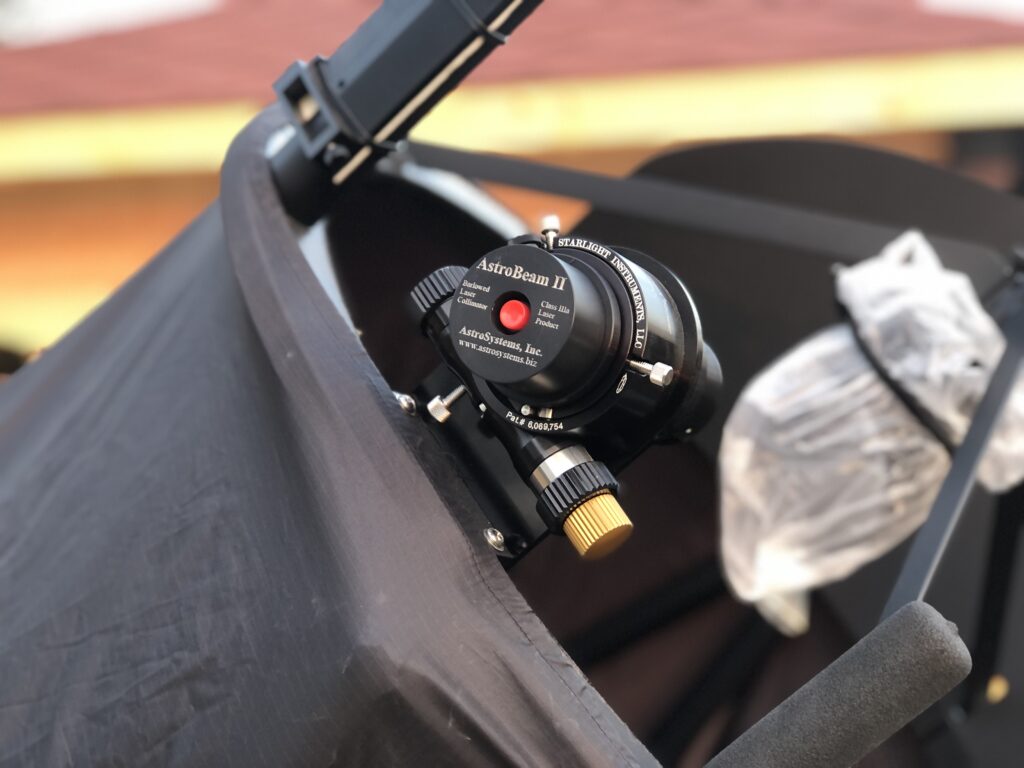
Laser colimator
Once done I fitted the Paracorr optical corrector followed by the 2″ eyepiece. I then set about putting the cables in for the Argo Navis computer and clipping it onto the side of the 22″.
It took me over an hour to finally setup the computer, in the main I did not RTFM and finally succumbed like all good blokes to reading the manual. It was them extremely straight forward. I had a good look through the menus to familiarise myself, but really the only thing to do was to identify 2 stars. The process for this must be followed for it to work correctly.
So I selected Mode Align Star option form the menu clicking the Enter key, then selected a star using the Dial, in this case BETELGEUSE came up. Now DO NOT PRESS ENTER!! Put the star in the centre of the eyepiece and then press the Enter button. Then WARP= +0.00 (1) should appear briefly meaning 1 star is aligned. Now using the Dial select another star (in this case SIRIUS) and repeat. Once you select ENTER then you see WARP= +0.00 (A) which means aligned. Now you are good to go and use the catalogue to tour the night sky.
I then selected some objects including M42, which looked lovely but low, the double double which really allowed the eyepiece quality to show off its abilities. I went round few other objects and Luke came out too, In fact to be fair he helped me get the computer working and then we shared the views in the scope. It was a good evening. We then between us took the scope apart and put it back in it’s home.
Obsession in use with the light on for the photo of course 🙂
went out and put ZWO ASI120MC on the back of the ST80 guide scope. Refitted the Lodestar to the off axis guider. I then setup the FoV indicator on TSX and also got the guider to focus.
Took a bunch of M78 frames LRGB to start with. Then tried a 600s Ha but that showed very little.
Then joined by Bob joined and he reminded me to image JWST.
Then around 12:30am I started imaging M78 again on the other side of the meridian. I must sort out imaging with a frame so that it is easier to get the object inside the FoV and lined up as it took me quite some time this evening. Plate solving was also not working again within SGP so I need to look at that on the next night out.
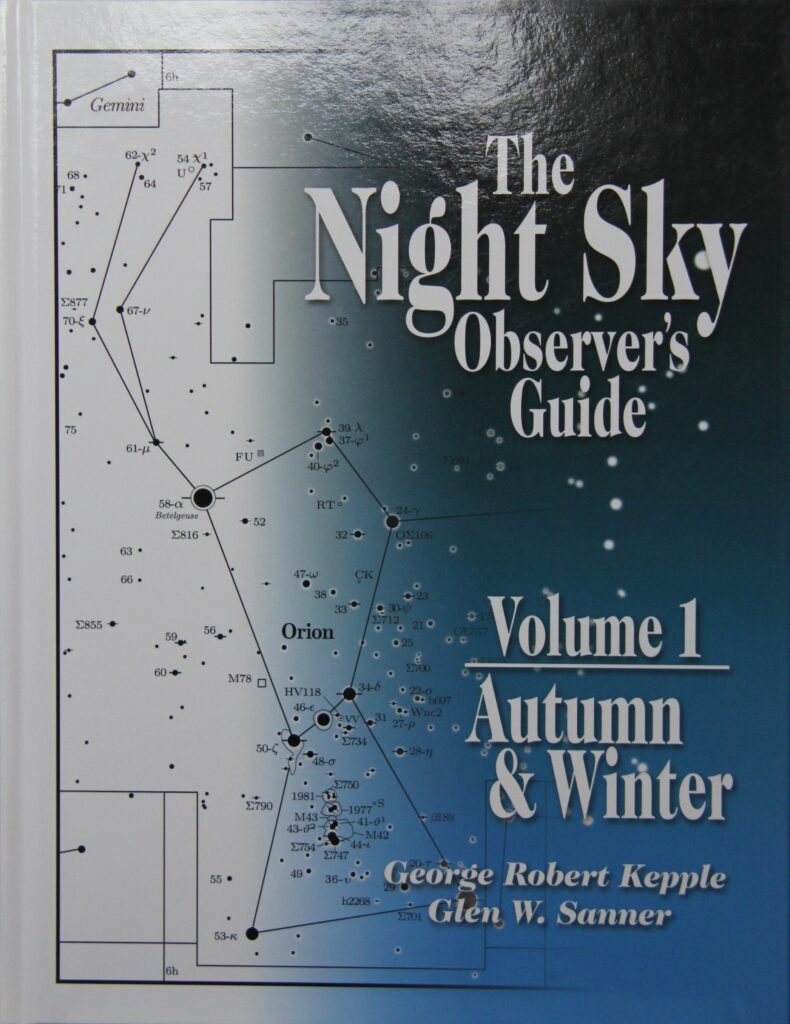
When I started attending the Practical Astronomy Show held at Kettering I picked up my first copy of “The Night Sky Observers Guide Volume 4 – The Glories Of The Milky Way to -54°” written by George Robert Kepple and published by Willmann-Bell inc. These were sold at the Kettering show by the very helpful and knowledgeable staff of The Webb Deep-Sky Society for around £20.
Then in December 2019 ‘The Global Human Malware’ happened and the world went nuts, the Astronomy shows were cancelled year on year and I forgot to complete acquiring the rest of the series. Then suddenly in late 2020 it was announced that the publishers Willmann-Bell had closed and their entire portfolio went out of print.
Unfortunately I did not see the announcement until late Jan 2021, however I managed to obtain a copy of “Volume 2 – Spring & Summer” (ISBN 0-943396-60-3 (V2)) from Zoltan at 356 Astronomy but he told me he was out of stock for the rest of the series.
I contacted the Webb Deep-Sky Society to see if they had any available copies in stock. The president of the society Owen Brazell very promptly replied but informed me that they had sold their remaining stock just days before. He was extremely helpful in trying to help me source any remaining stock but eventually to no avail ! I recommend any avid astronomer should consider subscribing to the Webb Deep-Sky Society here …… I just did 🙂
Well, it arrived this morning and I apologised to my regular postman for having to carry it around by hand all morning.
As with the other volumes the information, maps, diagrams and descriptions are very useful for planning imaging or observing sessions.
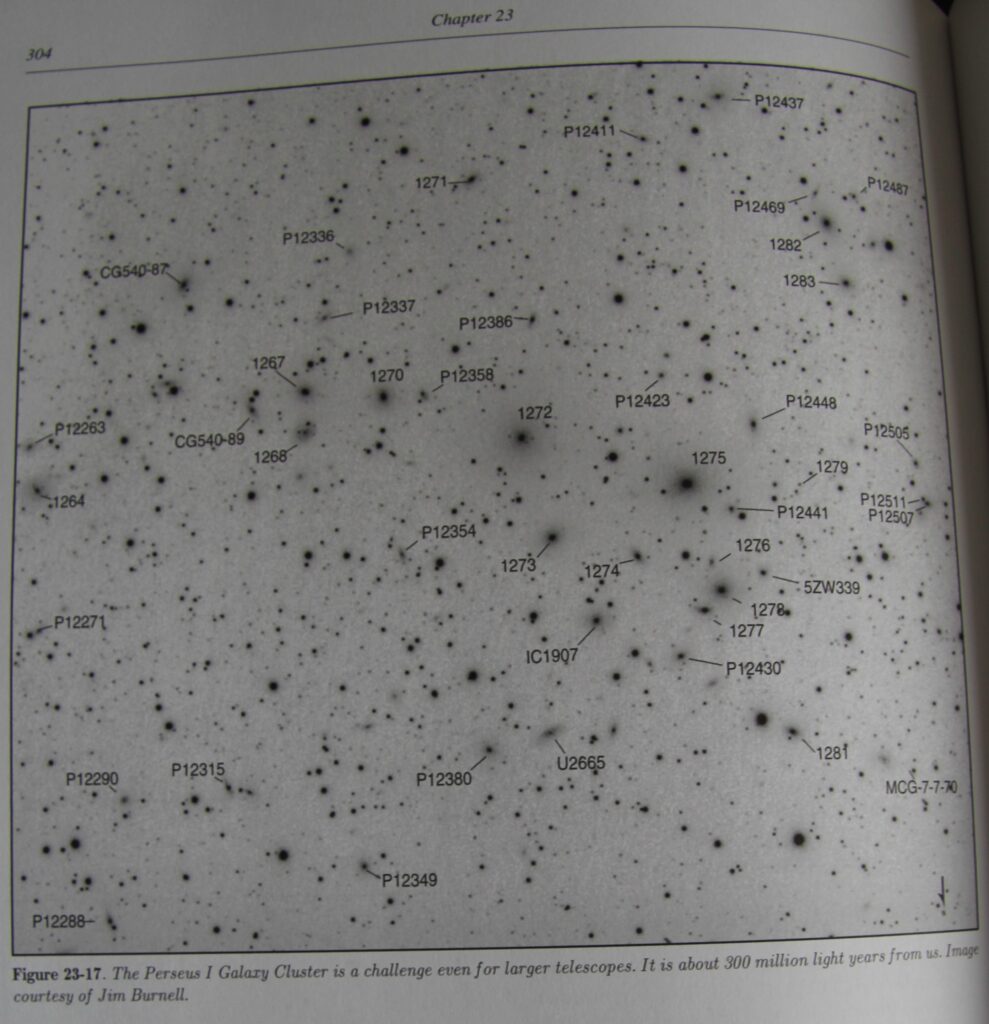
The King of the Northern Winter Constellations – OrionThe fantastic Perseus Galaxy Cluster
I now have only Volume 4 “The Southern Skies” left to purchase but as that would only be a reference for objects I can’t see from the UK it would go mostly underused unless I start using my remote telescope account or travel around or below the equator.
I would like to thank Owen Brazell for all his time and for the ongoing activities of the Webb Deep Sky Society and hopefully we will see them at the next Practical Astronomy Show in March 2022 …. fingers crossed !
Clear night! So I’m going to setup and let the dome run all night if it stays clear which is the forecast as I have work tomorrow.
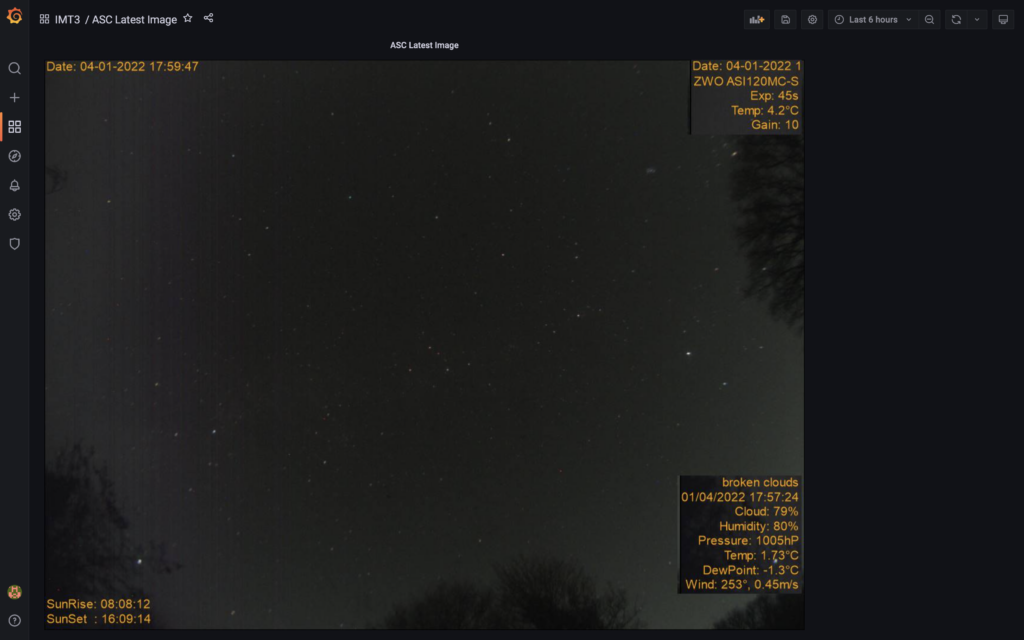
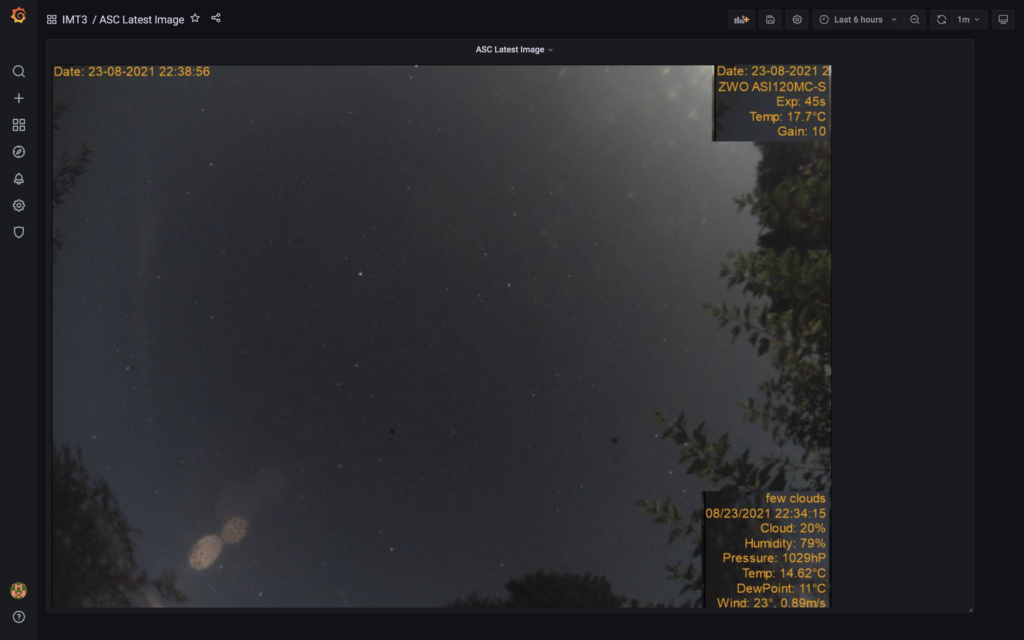
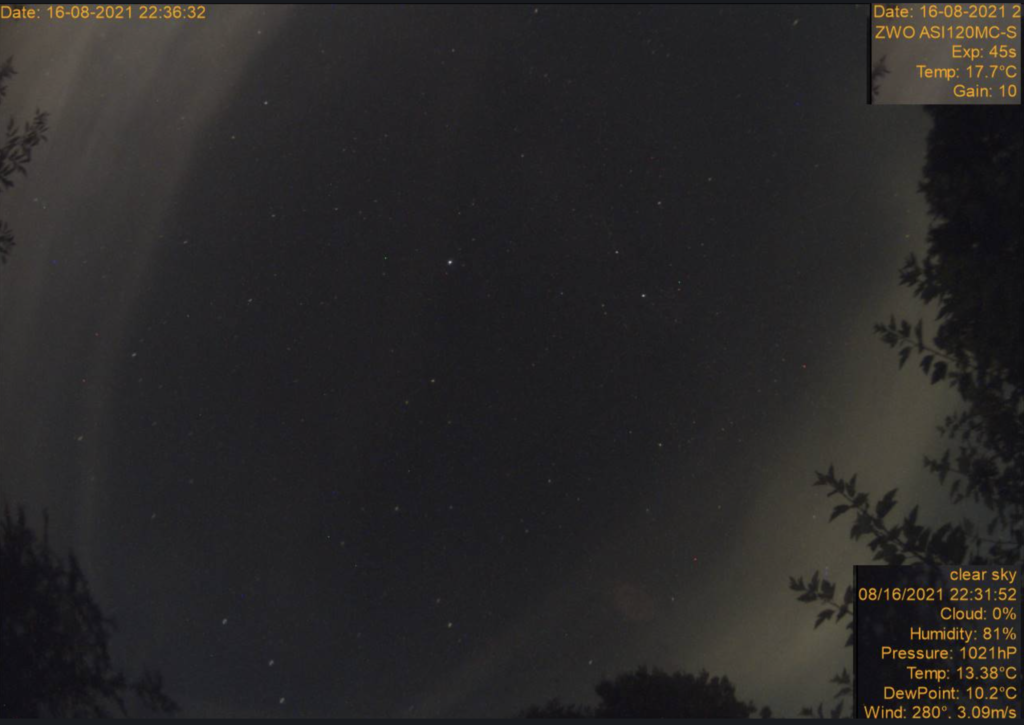
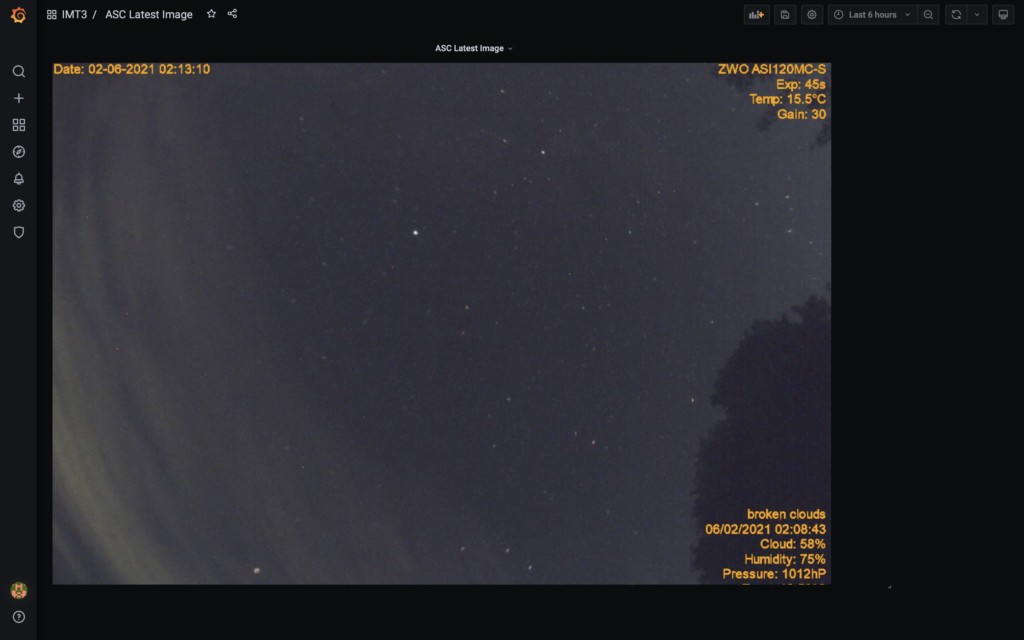
All Sky Camera
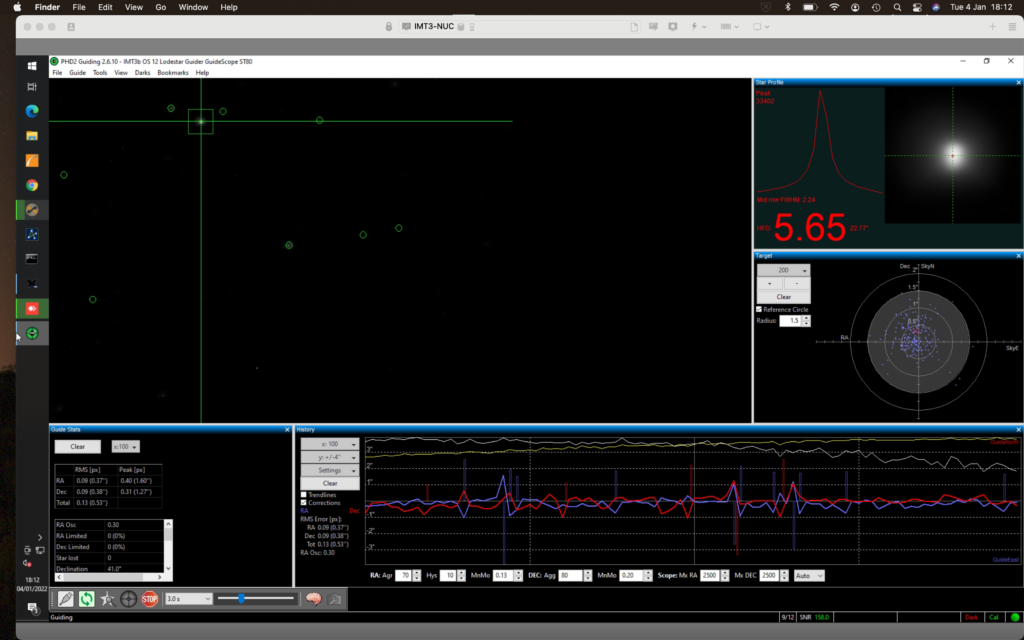
I have run the guiding assistant on PHD2 so that I can hopefully better track objects. The drift in frames from the last time out whilst using the ST80 as a guide scope was less than ideal. I have now put al the new settings suggested into the PHD setup and have swung round to do a focus run on a star near to M32.
PHD2 new settings
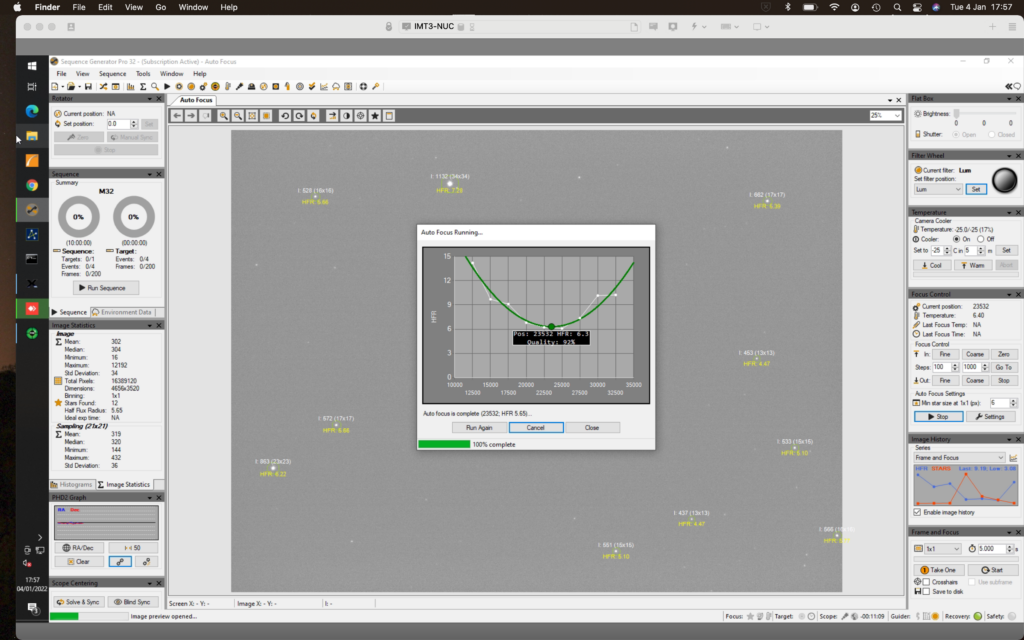
After successfully running autofocus in SGP at 23,560 on Luminance I have now slewed to M32 to gather more data that is desperately needed to resolve the outer spiral arms of the companion giant galaxy M31.
SGP Focus RunM32
So it is now just gone 9pm and whilst the guiding is managing to stop trailing of stars, the image is moving between frames, enough to loose the object over the course of 4-8 hours. This is clearly not good enough and it does look like the focal length of the ST80 is simply not long enough.
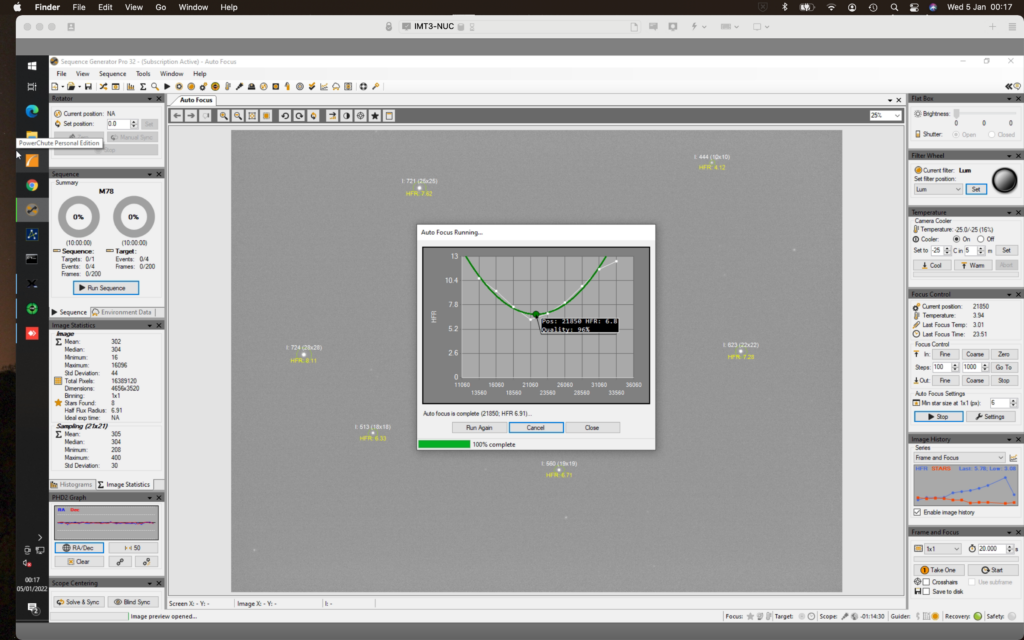
To get around the problem this evening I have turned guiding off, as the exposures are short (3 minutes) the trailing of stars is not an issue. At midnight I took flats for M32. I then centred on M78 for the rest of the night. Before starting I performed another focus run as the focus point had changed over the night with the temperature drop.
Auto Focus
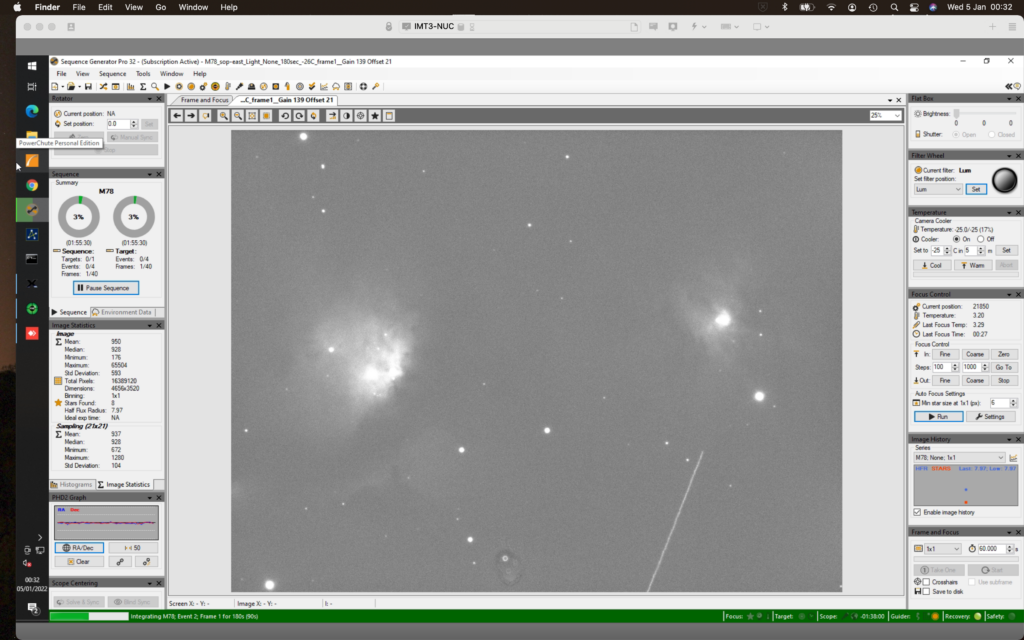
I choose the same exposure settings and Gain 139 and Offset 21 settings as for M32. -25C was the temperature but this time I rotated the camera by 90 degrees to also fit in NGC 27309.
M78 & NGC 27309 and a satellite trail
So I left the scope running and it completed at around 2:30am with 40 frames taken across 4 filters giving me 30 minutes per channel. This will be enough to get started and if clear tonight I will setup for another run at M78 and hopefully improve the guiding.
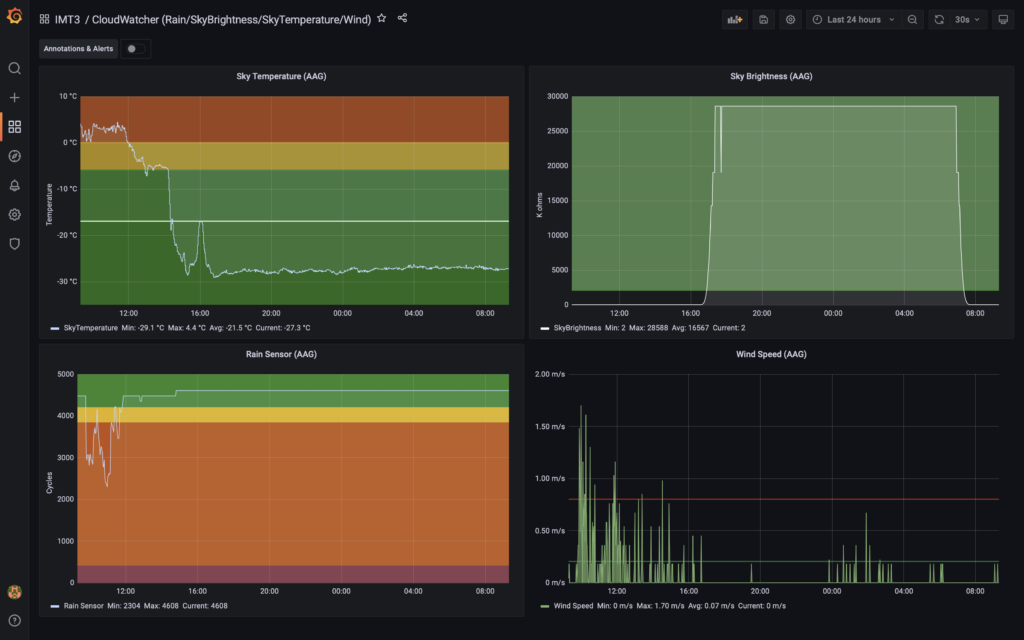
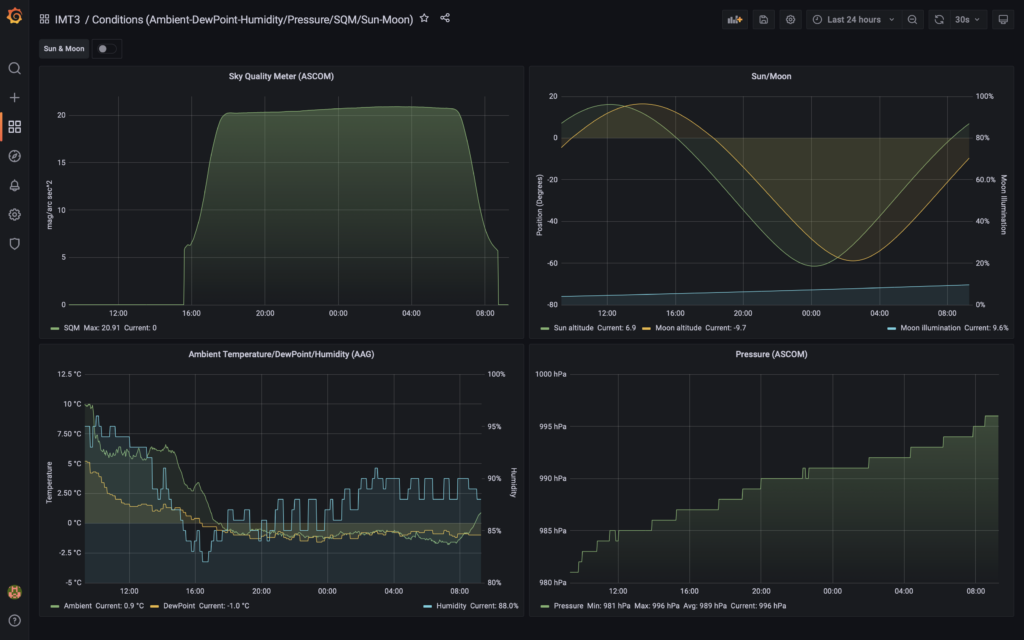
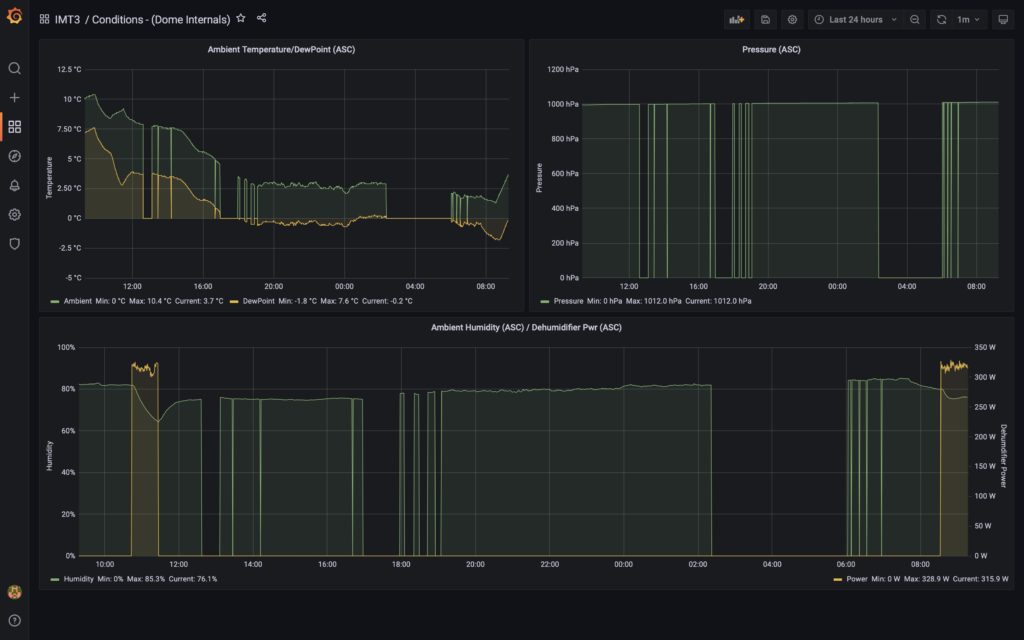
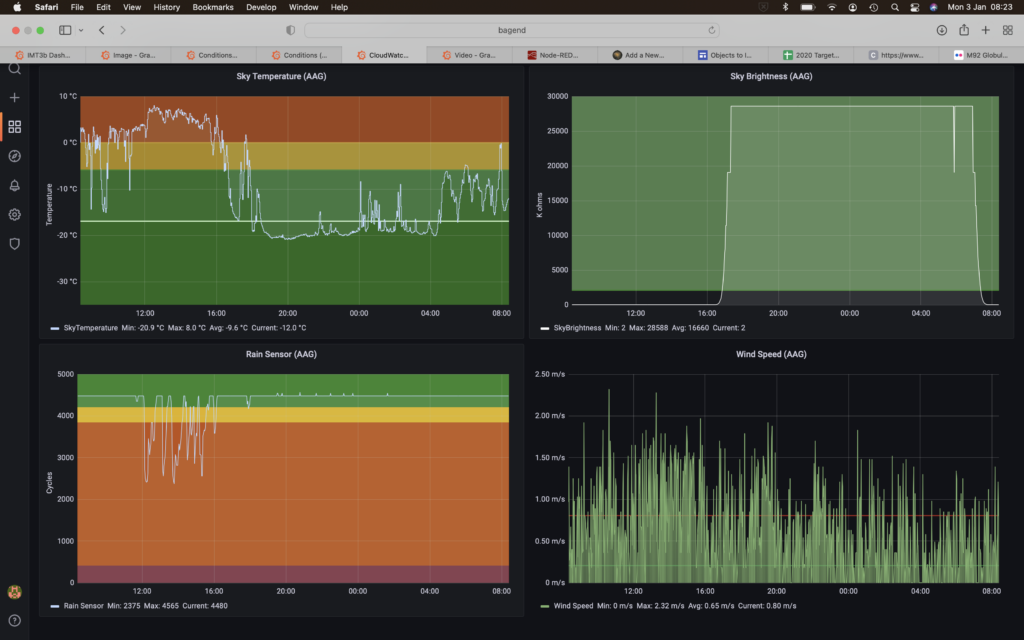
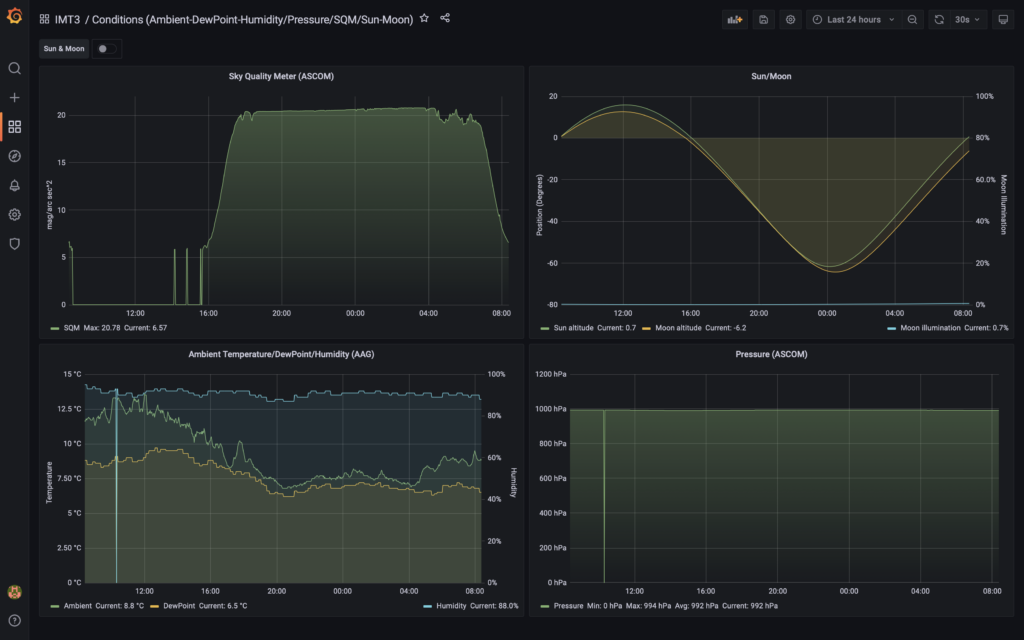
Update. On reviewing the files this morning it looks like I forgot to select the filter in SGPro which means all my M32 and M78 images from this evening are in fact luminance only! Which is ok for M32 but for M78 I need some colour. Below is the weather data for last night.
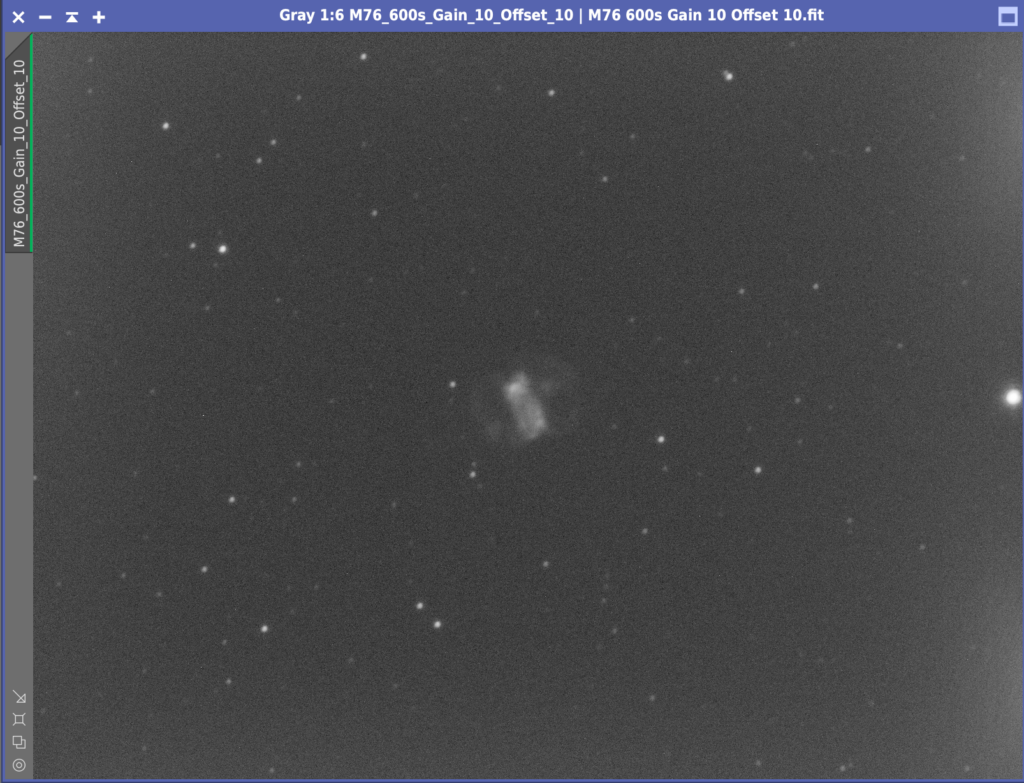
I started with M76 Ha as I need some frame for this object. I already have many hours in OIII. However after starting to image I realised the guiding, which is currently being tested through Dave Boddington’s ST80 was not pointing through the slit correctly as M76 was near the zenith. This means I have suffered from trailing as the guider was trying to guide on long stars due to diffraction.
M76 – 1 x 600s Ha
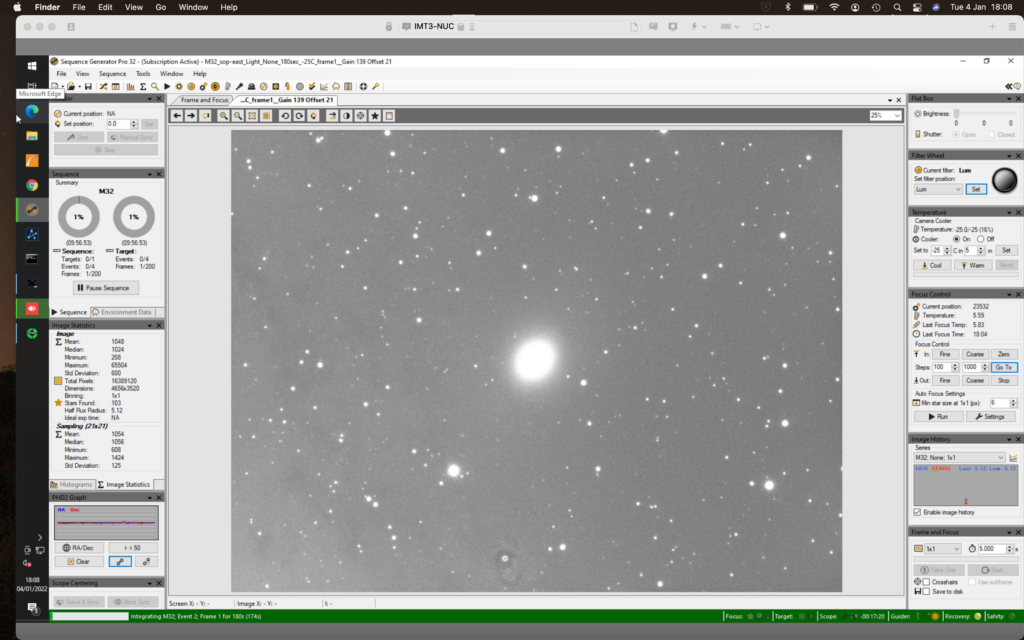
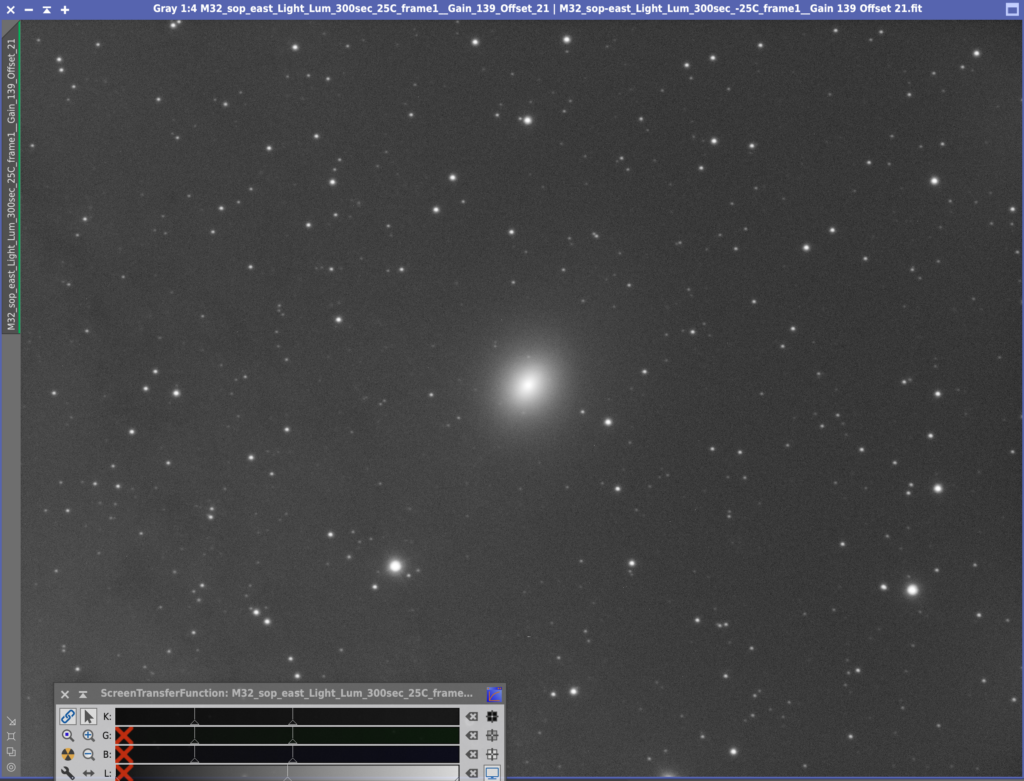
I swapped to a different object, this time M32 as I have not imaged this directly before, just as a happenstance of imaging M31. I have chosen 180s exposures using Gain 139 Offset 21 to keep the saturation of the core down. At 300s the core was blown out.
M32 – 1 x 300s Lum
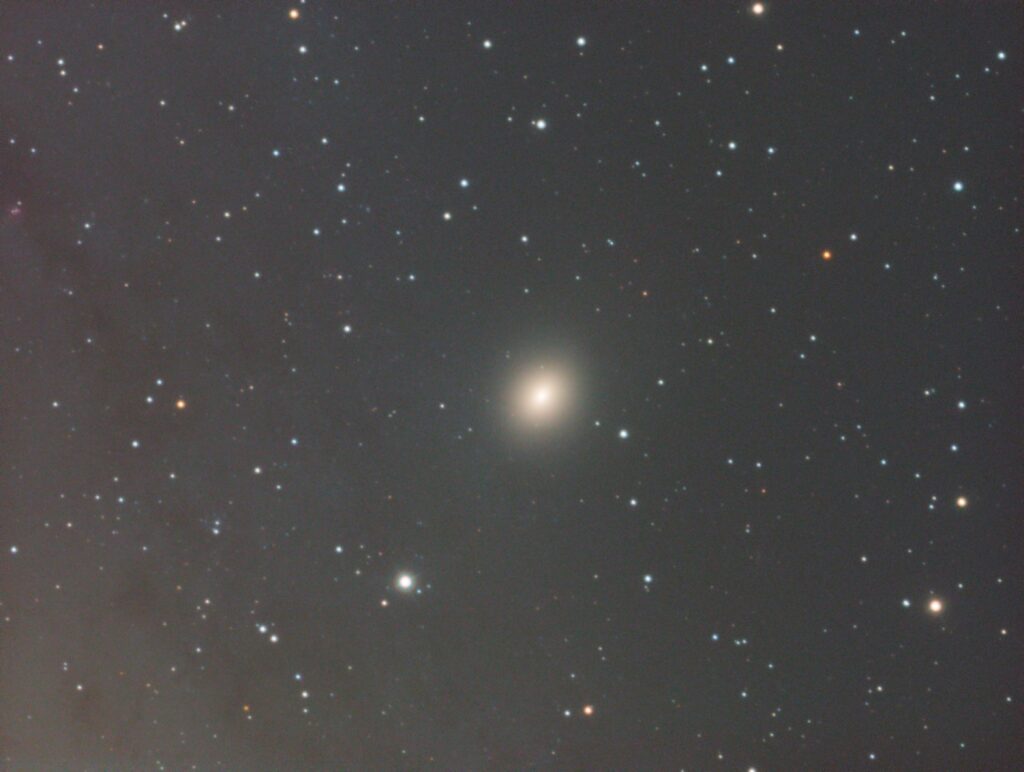
M31 can be seen to the left and lower left of the small galaxy. M31 covers a large part of this image! So how well was my guiding doing?
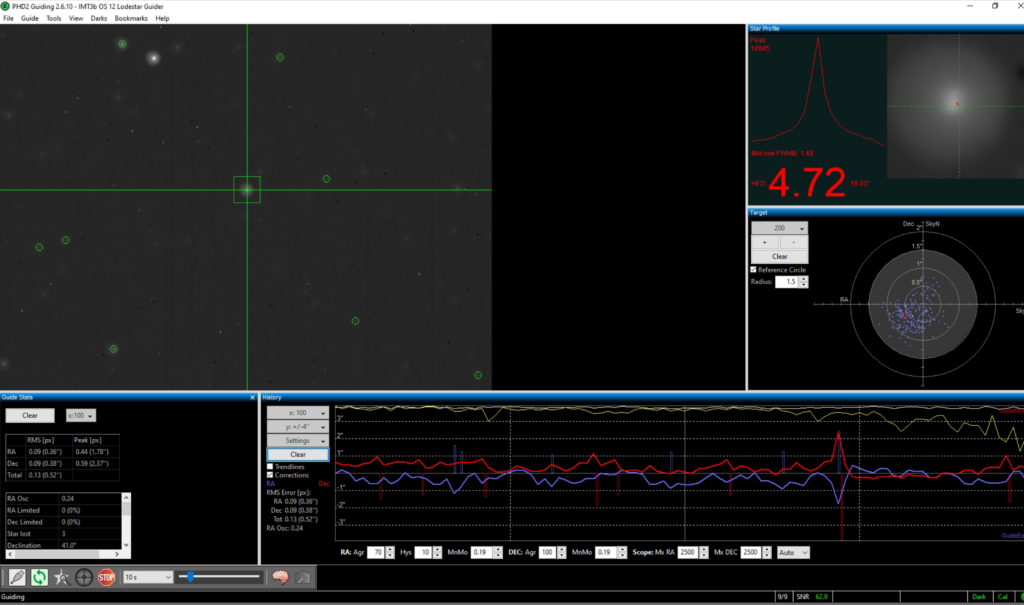
Guiding with the ST80 guider
The guiding looked fine. 0.52 arcsecs total error which I am happy with. I stayed up until just before midnight and then left the observatory running. In the morning I noticed the dome shut around 1:30pm due to the images after that looking like flats.
I also noticed this morning that the images were drifting so the guiding is not quite right as the image drifts. I will next time out run the guiding assistant and see if that helps.
Update the image scrubbed up fairly well but I lost a lot of frames to drift and trailed stars and then the dome closing. Resulting image around 3 hours 12 minutes exposure of which 48 mins was Luminance but there was cloud affecting many frames.
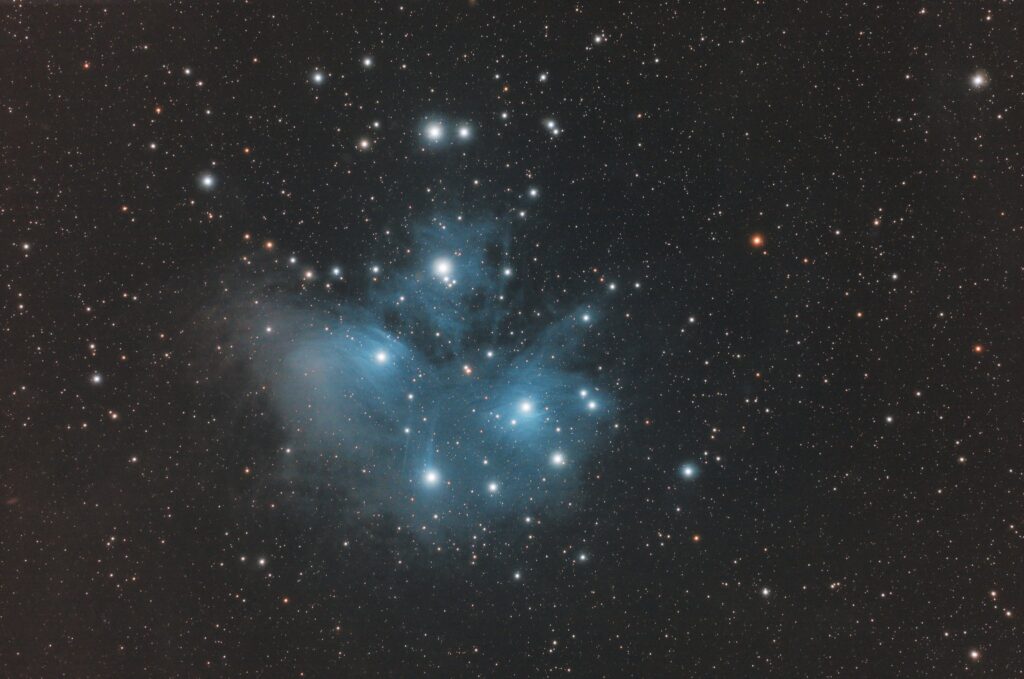
So visiting Dave one evening as we have not met for a while whilst I was updating software Dave processed the QHY268C data we took of M45.
M45 – PixInsight Processed Image
So I’m disappointed that although the image is a good first start I forgot to change the change setting on the gain which in SGPro is in the event settings and not in the top level sequence display 🙁
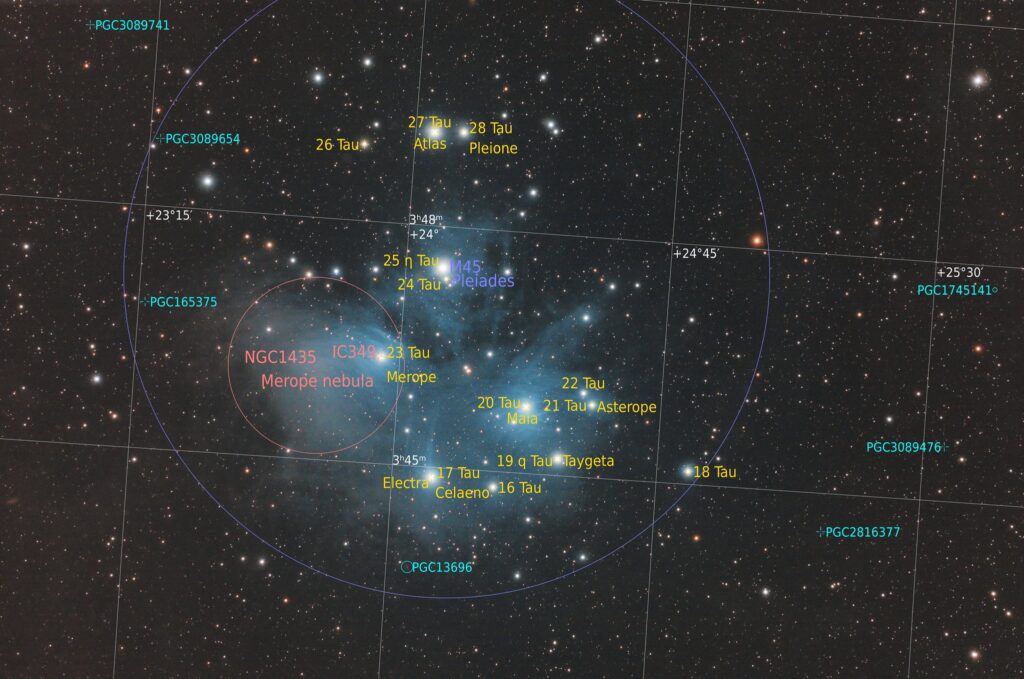
Dave ran the image through the annotate function of PixInsight. The galaxy PGC13696 near the bottom of the image is actually 232 million light years away.
Unusually it was a clear Friday evening. I did plan to be ready to go as soon at the pole star was visible but my imaging PC insisted on updates and the local hard disk was running at 10MB/s (replacement SSD on the way).
By the time I was ready, mount setup, polar aligned and balanced it was already late. I decided not to use the latest SGPro or NINA beta but just use the existing SGPro version. I was delayed starting as I was having issues with SGPro hanging when it couldn’t talk to the SQM (ASCOM Conditions Observing Hub) on a previous COM port, I need to report this back to the devs as a bug.
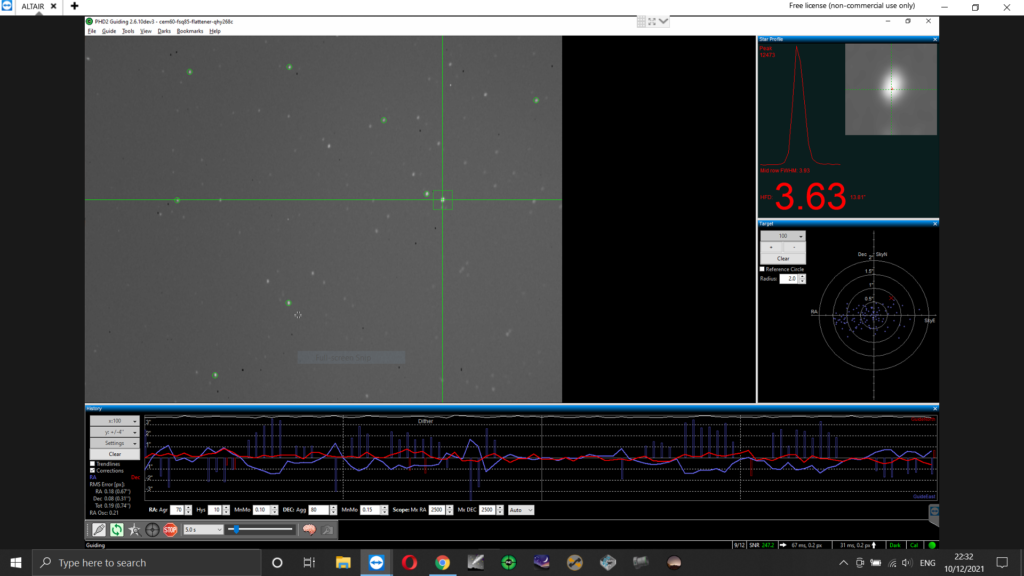
At this point Peg-Leg Dave joined me on a video call and we discussed imaging M45 in different modes on the QHY268C OSC. So we moved the scope to Alp Ari and proceeded to plate solve in SGPro, sync’d the scope Cartes Du Ciel and calibrated OpenPHD2.
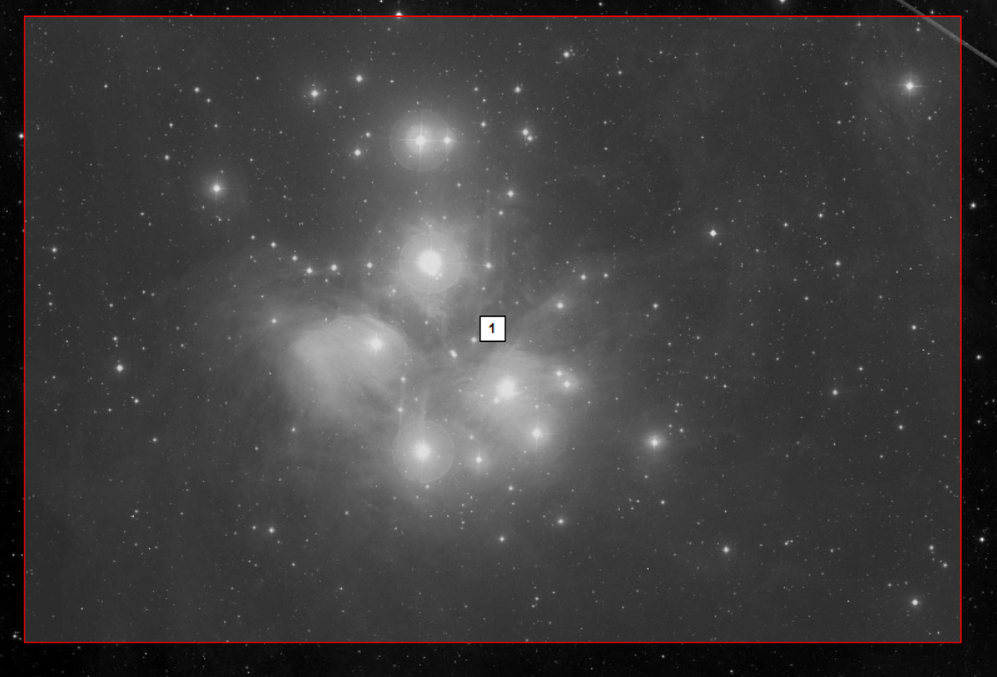
Using the SGPro framing and mosaic wizard to decide on the framing for the target sequence I wanted as much of the reflection nebula as possible rather than being dead center.
M45 – SGPro Framing Wizard (FSQ85/QHY268C)
I’ve used the multi-star guiding in OpenPHD2 since it was first released in an earlier beta and I know Dave is looking forward to using it when he moves from using an OAG on his 12-inch RC to a 90mm guide scope to make it easier to get more guide stars or even one star.
Multi-Star Guiding in OpenPHD2
Whilst trying some mode/exposure tests the guiding started acting up in RA, so parking the mount and disengaging the clutches I redid the balance of the scope. It was only marginally off but it was enough to cause issues for the CEM60 …. it is not forgiving !
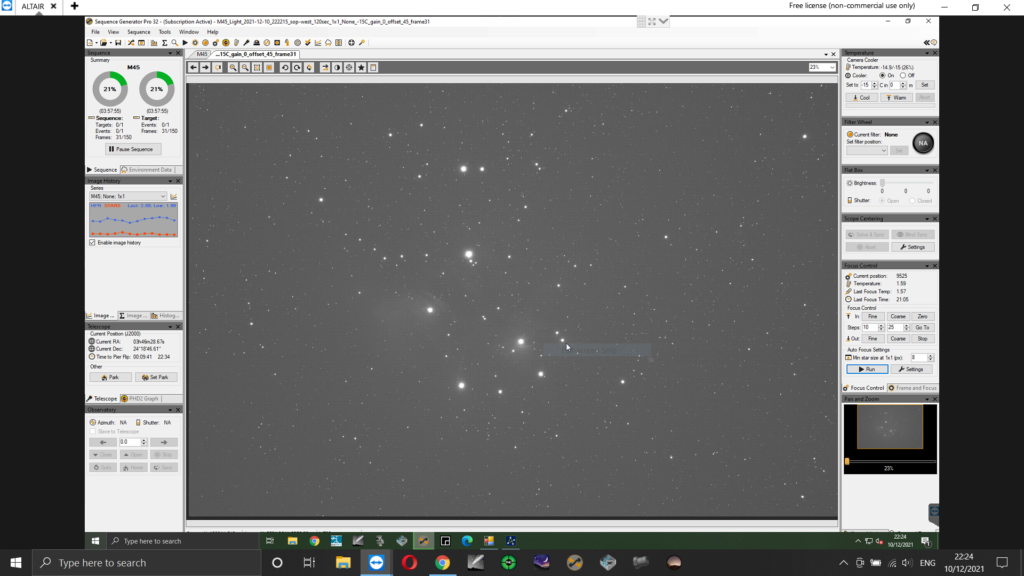
We decided to increase the Gain/Offset to 15/75 and use the Extended Full-Well mode (#2) of the QHY268C, testing the star brightness levels of various exposure times we opted for 180 seconds as that was under the maximum brightness level.
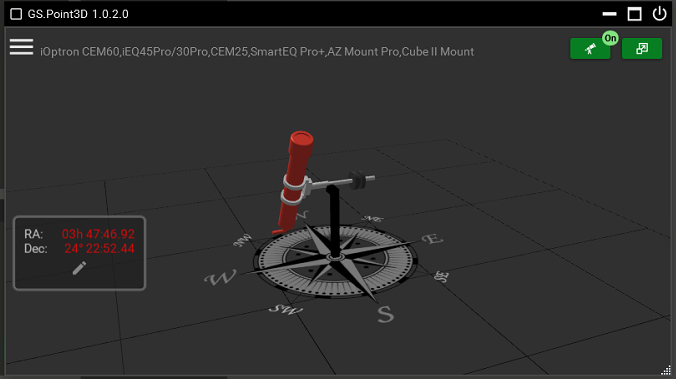
As I currently have no IP camera outside I like to see the mount position using GSPoint3D as I like to view where it is especially during meridian flips. NINA has this built-in now in the recent version 2.0 betas. As SGPro lacks this functionality I can use the view via this is standalone version that connects to the ASCOM mount.
Mount/Telescope virtual viewM45 – Pre Meridian Flip
SGPro paused the guiding just prior to the meridian flip. Following the automated flip, the guider and the imaging sequence automatically restarted after a plate solve and auto centering were performed.
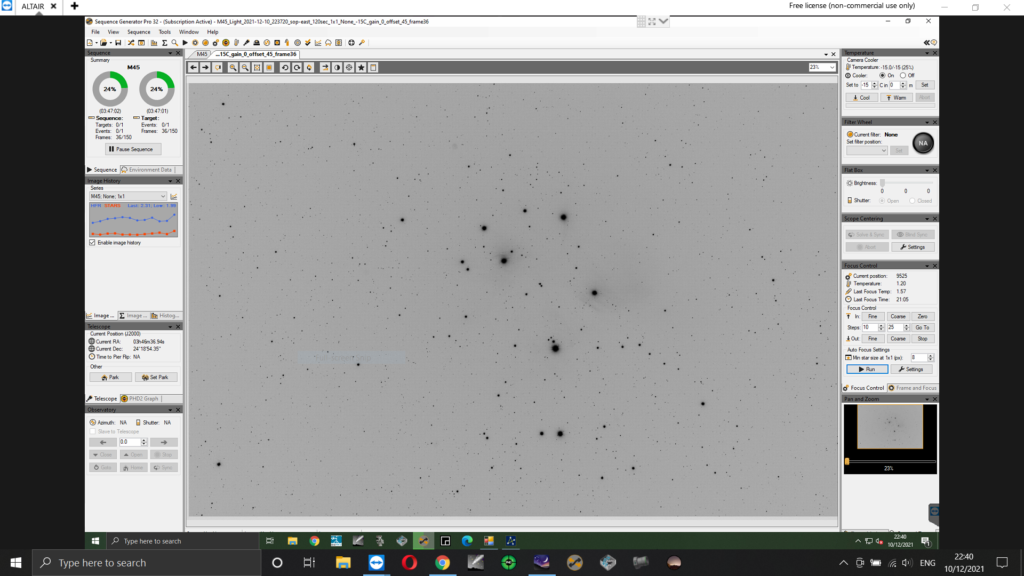
Inverted shot of M45 (180s) – Post Meridian Flip
It gradually got cloudier just after midnight and the quality of the subs declined so I decided to stop acquiring data even though we really wanted over 4 hours of exposure.
I proceeded to take calibration frames. Using a target ADU of ~23,000 the SGPro flat wizard on the Pegasus FlatMaster (100%) gave an exposure time of 9.68s for the Optolong L-Pro filter, 25 flat-frames were taken followed by 25 dark-flat frames of the same exposure time and finally 25 dark frames of 180 seconds.
It was at this point that I realised that the FITs header showed a gain level of 0 and not 15, the offset was correct but I can’t be sure if the EFW mode was used as it’s not in the FITs headers. Only when using the native driver in NINA can you set the mode within the sequence, in SGPro the mode is set in the external ASCOM driver when the camera is not active in SGPro even though though it’s in the ASCOM API as the Camera.ReadoutModes property.
Also for some reason the default setting in the QHY driver is to NOT disable the overscan area which means I have black borders on my images which will make processing the data in Pixinsight a challenge !
I actually got to bed after 3am even though I had planned to stay up until the dawn. Next morning I noticed that my counter-weight had slipped and rotated on the bar. This may have also caused some of the issues with the guiding so I need to set-up earlier and check things more thoroughly in future to avoid these mistakes.
So although it’s not the data we planned it will be worth processing over a wine. The evening was a really a useful experiment and hopefully lessons will be learned …. if I remember the next time.
IC5067 Pelican in OIII and SII, rotated to new angle to allow guide star on West side of the mount. 10 x each channel at 600s and Gain 139 Offset 21, left running and dome shut later in the morning.
Rotation angle 218 from SGPro plate solve, 171.750 from TSX
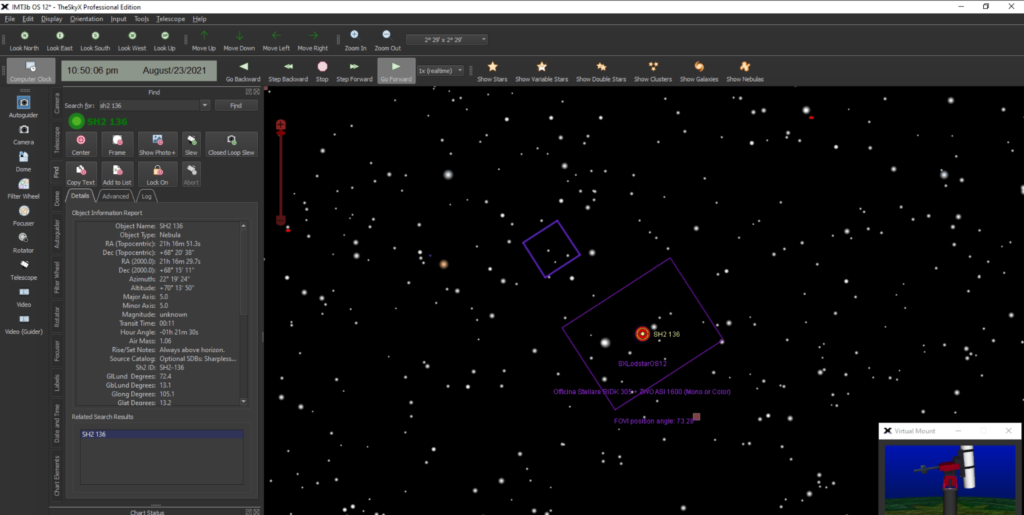
With a near on full Moon, the choices for deep sky were limited so I set about looking for Sharpless emission nebula. First on my list was SH2 136 in Cepheus. I slewed, aligned, selected the Ha filter, rotated the camera to find a guide star, tried to run autofocus which failed (I set the focus point to 18500 for Ha manually) and then imaged a few subs at 600s, which is when I realised the problem.
FoV from TSX for SH2 136
Nothing but stars….. I googled around and it transpires that some fo the Sharpless catalogue is emission and the rest is reflection! Now I know this useful fact I will double check each image I go after.
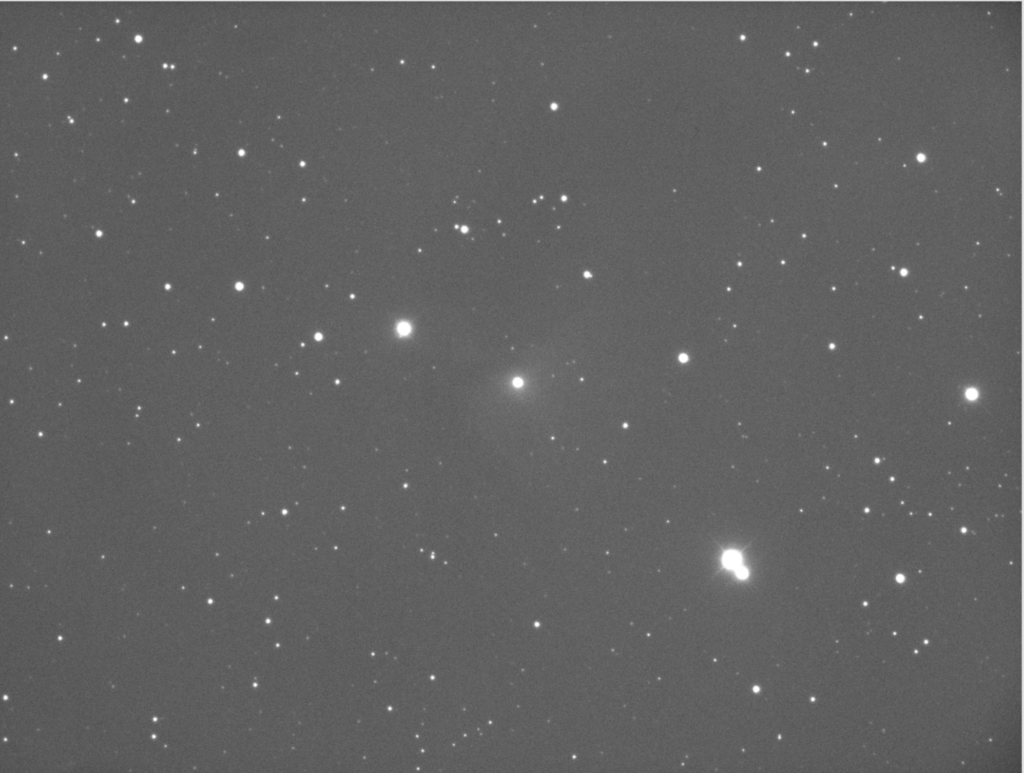
SH2 136 Emission nebula in Cepheus 300s Luminance
Before I moved on I took a single 300s luminance frame just to see if I could see anything at all. The answer was not a lot, so I moved on. This time I choose an emission nebula, much larger than my FoV but still it should be a pleasing object, SH2 132, an emission nebula also in Cepheus.
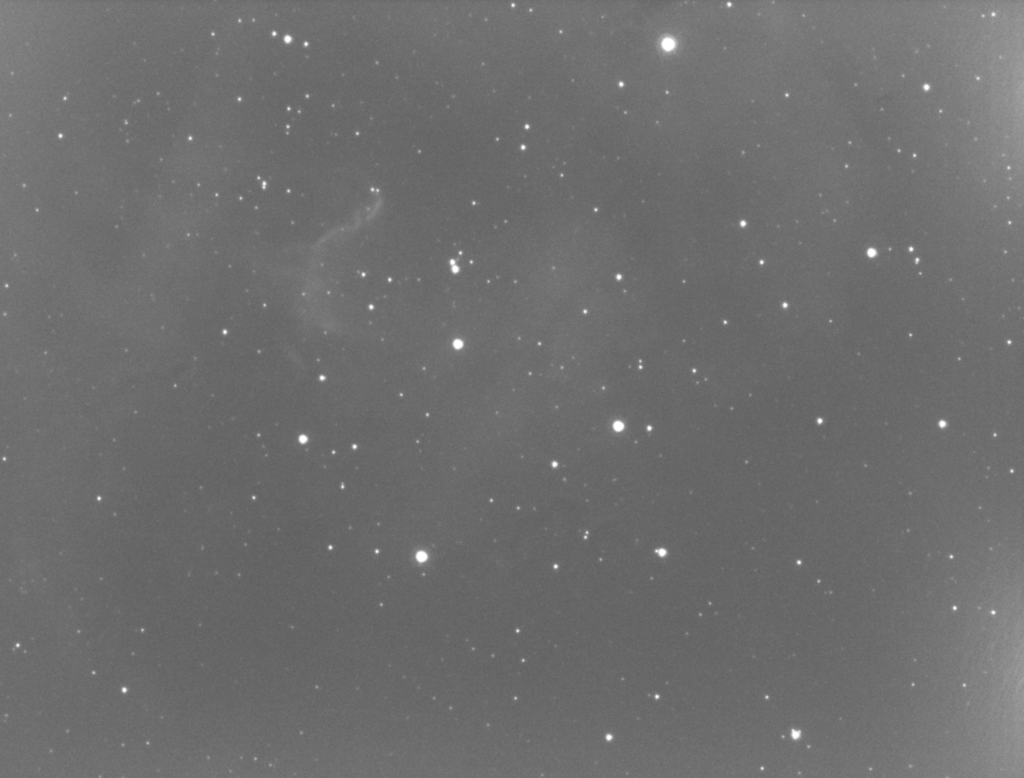
SH2 132 Emission nebula in Cepheus 600s Ha
I set about imaging 14 x 600s in Ha and then went to bed at 23:48 leaving the system running for another 2 hours before hitting the meridian, as I have not setup the scope to flip yet.
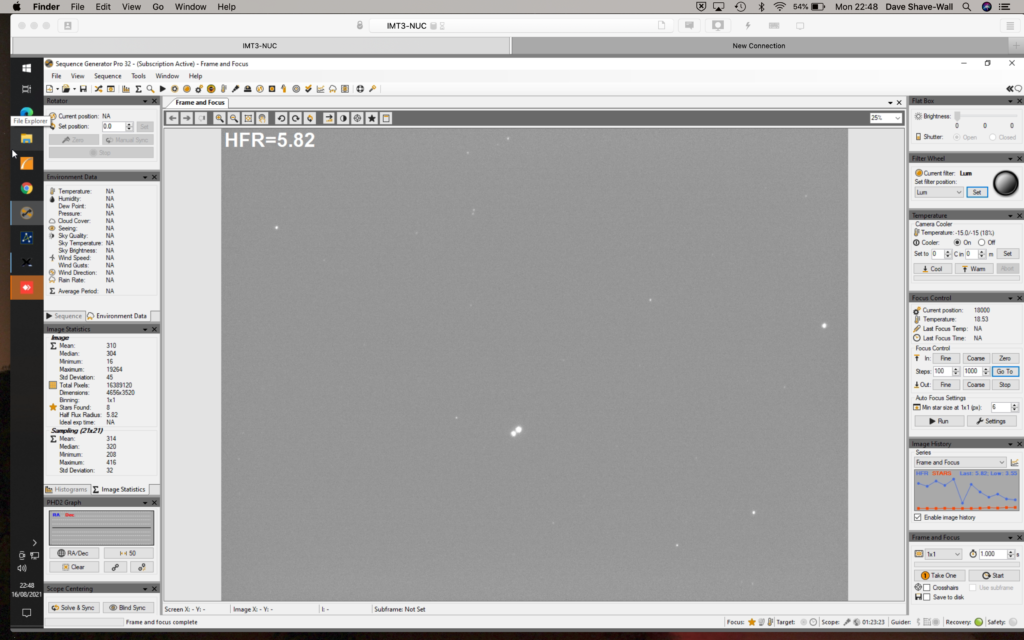
It’s been a while again due to work and the weather. A quick look around the sky this evening and make sure I still know how too use the telescope. So after getting focus
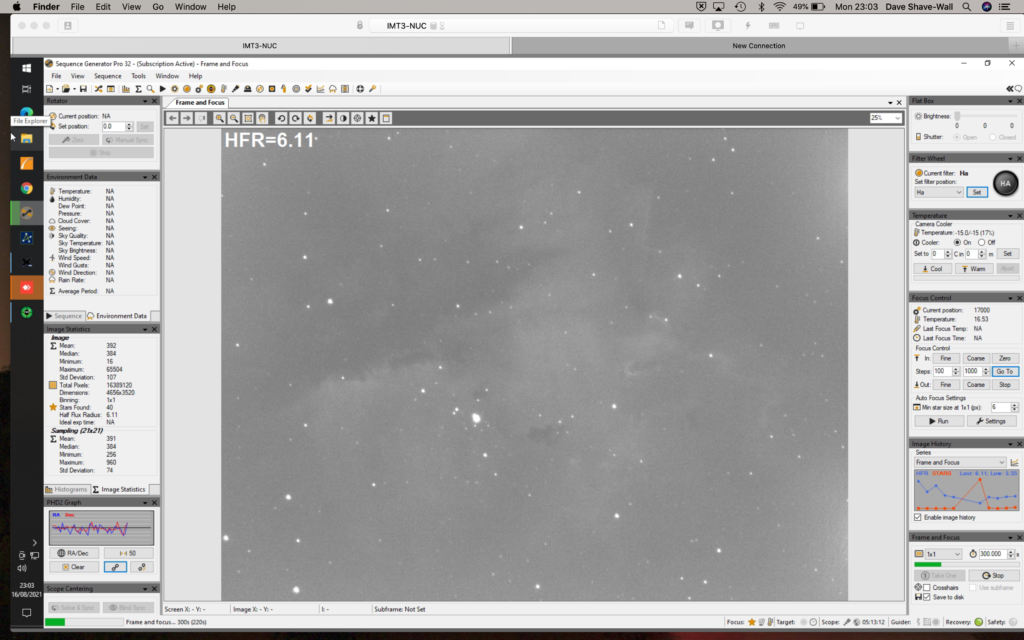
Focus achieved at 17,000 (18,000 here was incorrect)
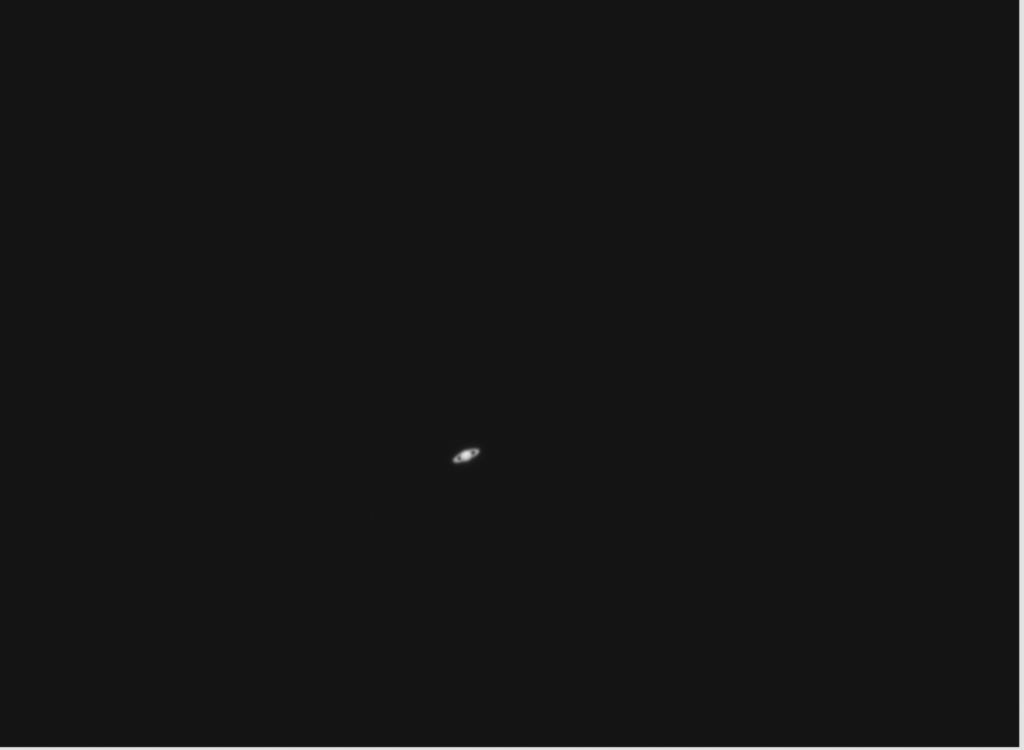
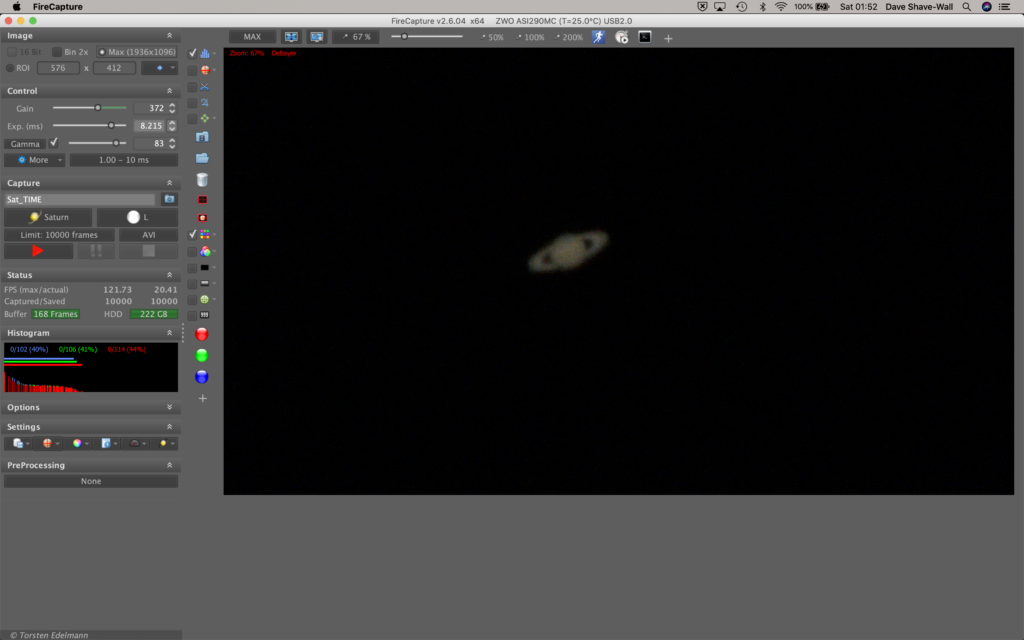
I slewed to Saturn as it was up and as expected it was very small.
Small Saturn
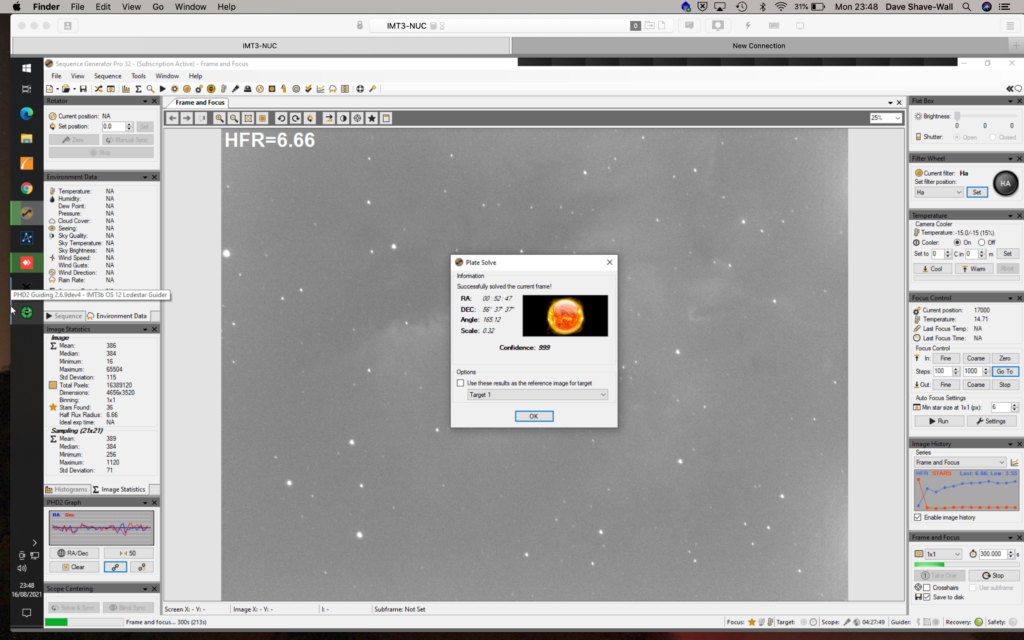
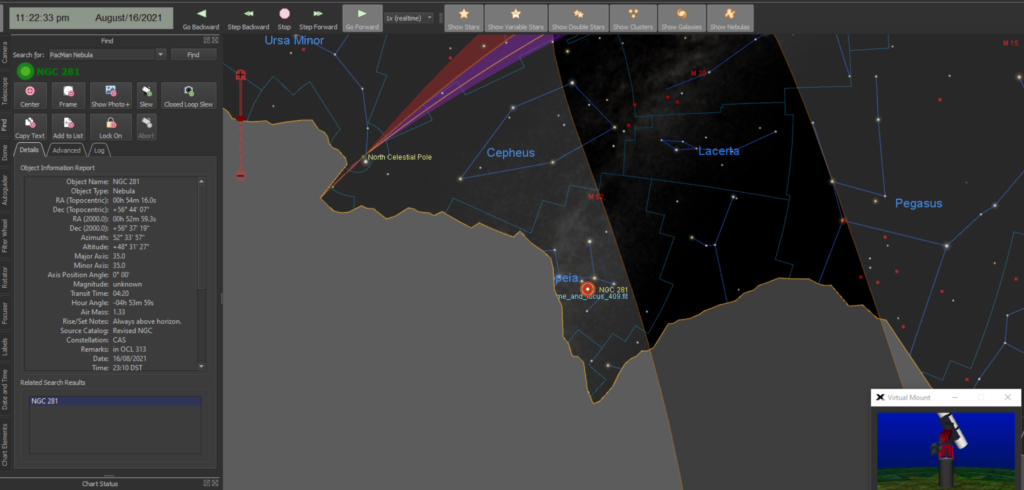
I then slewed to the Pacman nebula, NGC 284 also known as Sharpless SH2-128. I switched to narrow band and the Ha filter. I plate solved, centred
Solved
and then proceeded to take 300s shots.
NGC 284
The camera was called to -15℃, the outside temp was 16.2℃. The focus position was at 18,000. The camera itself was set to Gain 139 and Offset 10, the rotator at 345.560°.
TSX
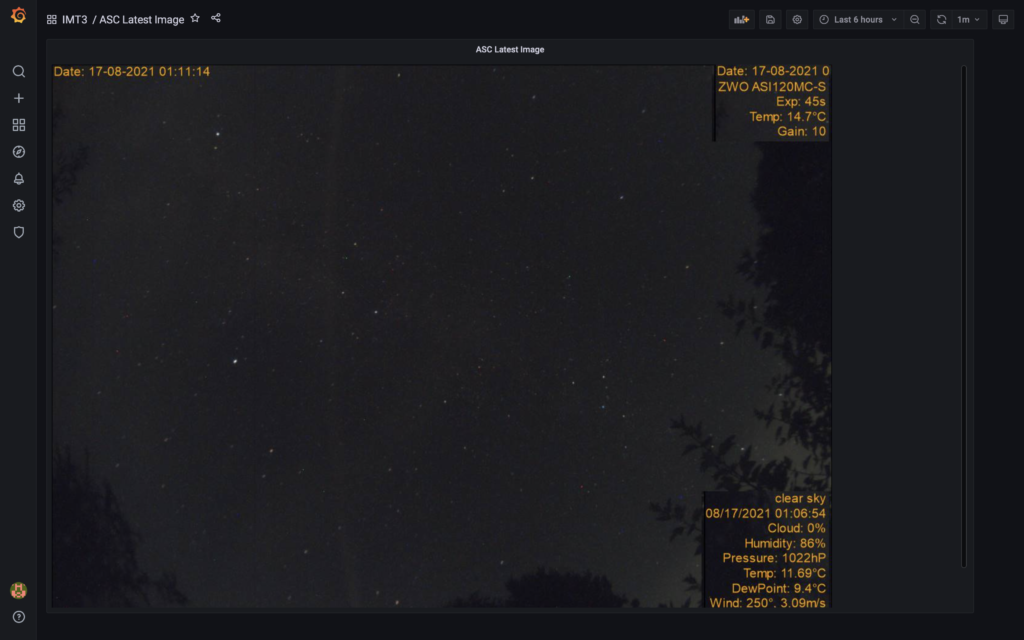
I took 75 x 300s images until I closed the dome, by which time it was very light. I went to bed in-between the start and end of the imaging run, but then realised the dome safety does not work due to the cable from the ASC being severed due to a Stanley blade incident with weed matting.
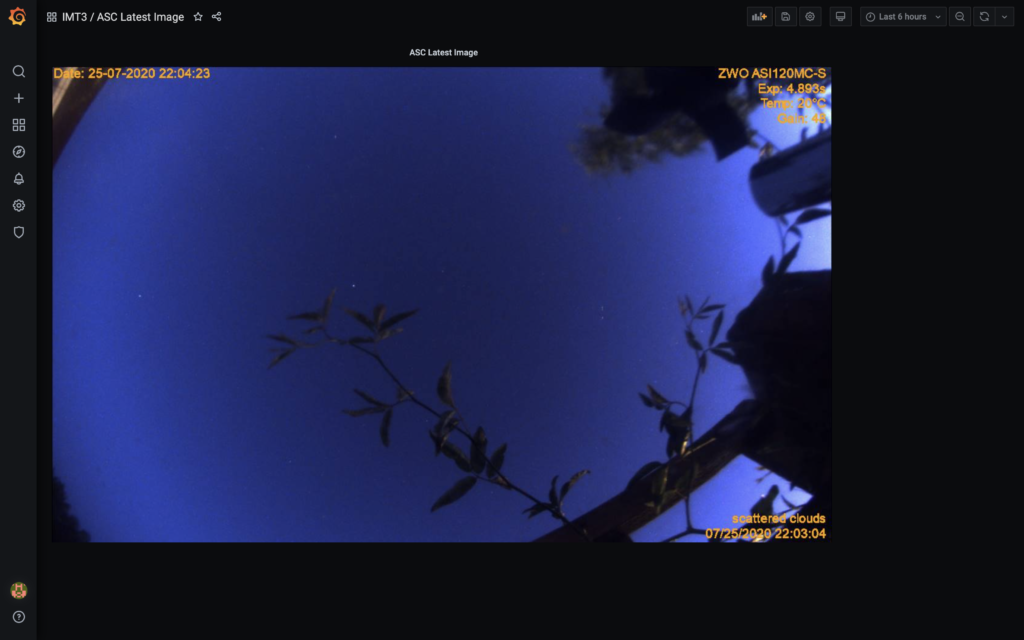
The good thing is GingerGeek and I managed to focus the ASC during the day on some trees in the forest across the valley and we managed to get it in focus.
Focused ASC
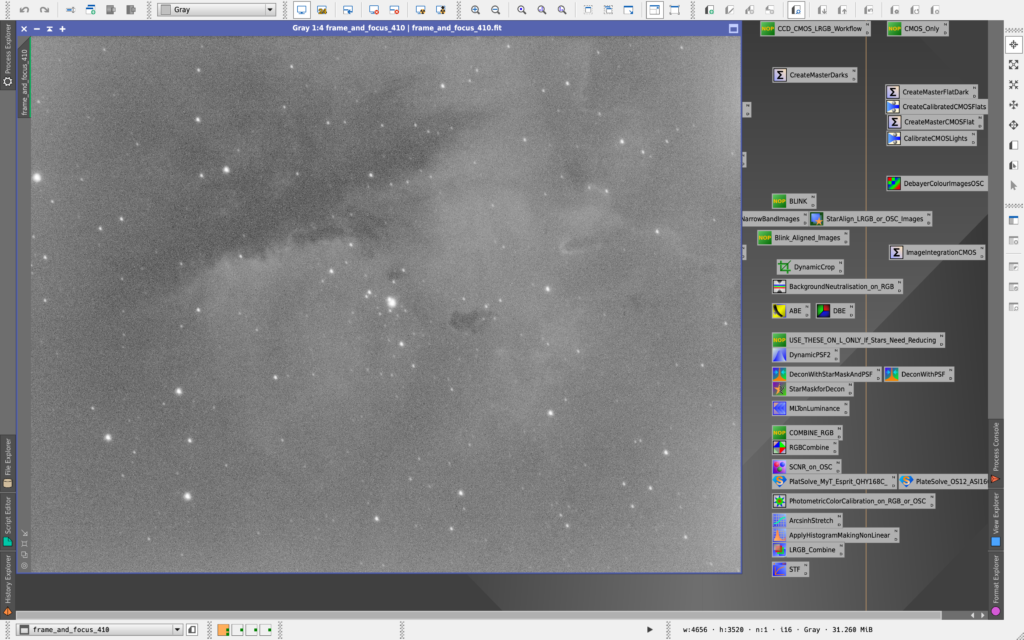
I will process the data last some point and see what it looks like.
GingerGeek, Alan and Bob came over. GingerGeek brought over his 4″ dob and set it up on the patio slab tower. Alan Lorrain then went about aligning it on the Moon.
Alan finds the Moon with Bob watchingTarget acquiredMoon through Dob
So with the Moon successfully acquired and whilst GingerGeek started looking at other targets through the scope, I opened the dome and slewed the 12″ to the Moon too.
Moon through 12″
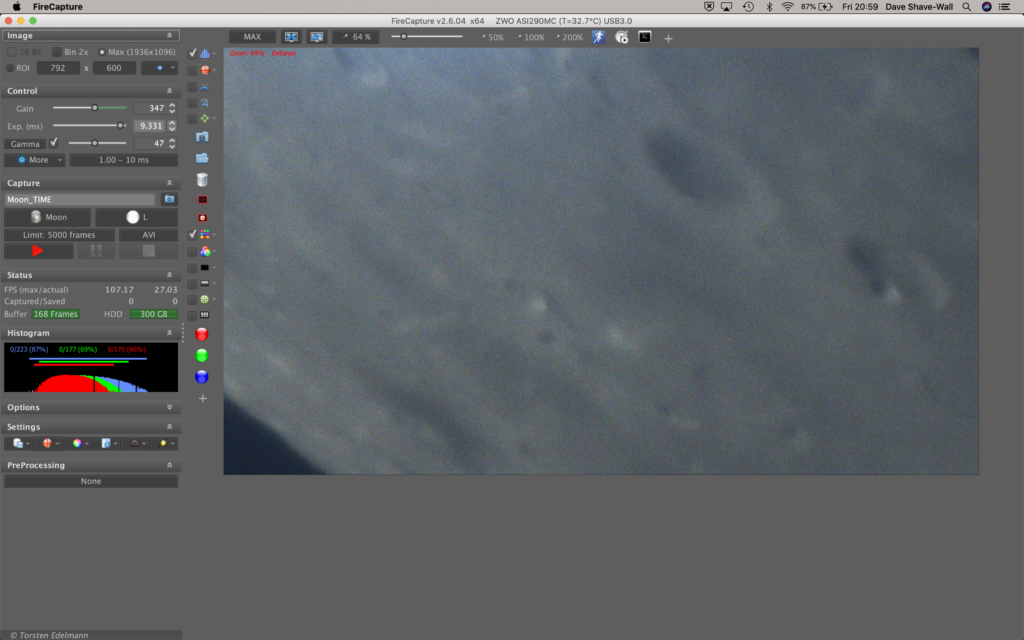
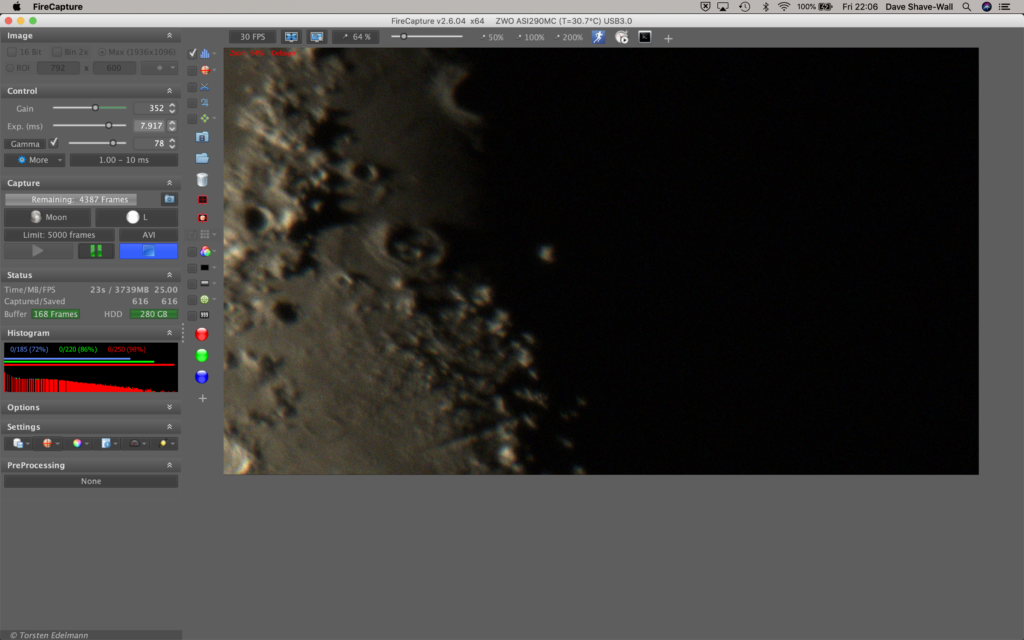
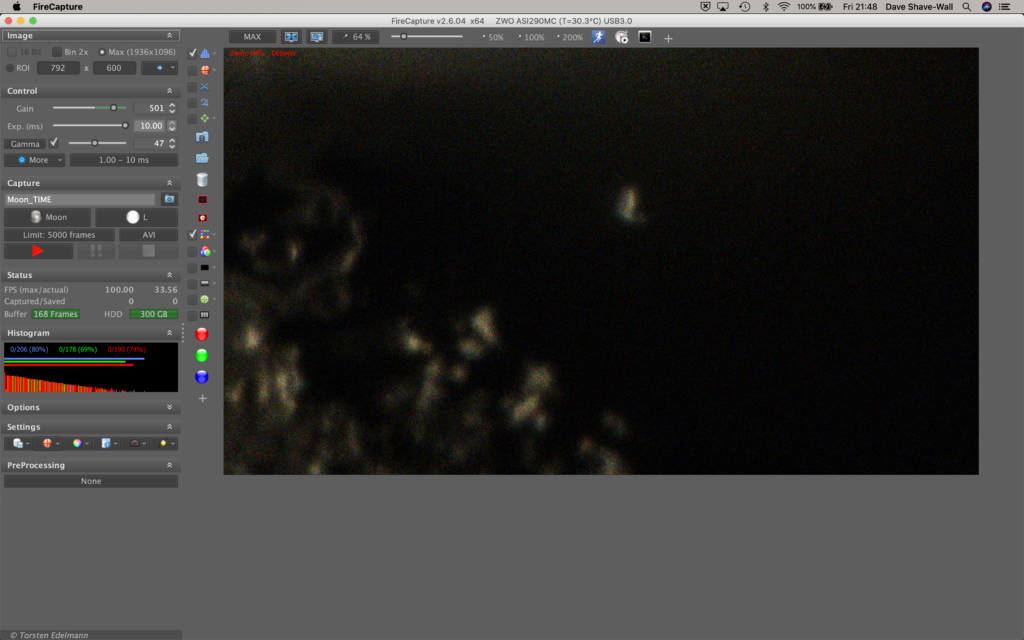
Alan, Bob and GingerGeek found a small bright mountain inside the terminator. We decided to try and find it through the 12″. When we did find it we then tried to work out what it was.
Mountain inside the terminatorIt looks like the island of La Palma!
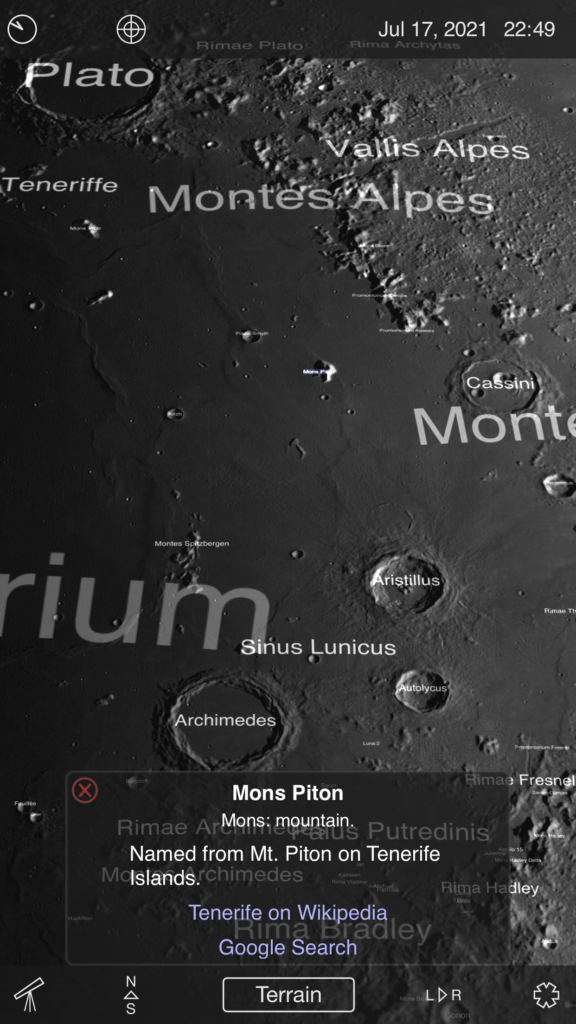
It transpired to be Mons Piton, named after the top of mount Teide on the island of Tenerife. We would need to view it the news night to see it in full daylight.
Sky Safari
Next up was a quick look at the Ring Nebula M57.
M57
We then wanted to seed if we could make out the central white dwarf.
M57 Red
However through the Red and Blue filters and the Luminance filter we could not see it. Finally through the Green filter it stood out very well.
M57 Green
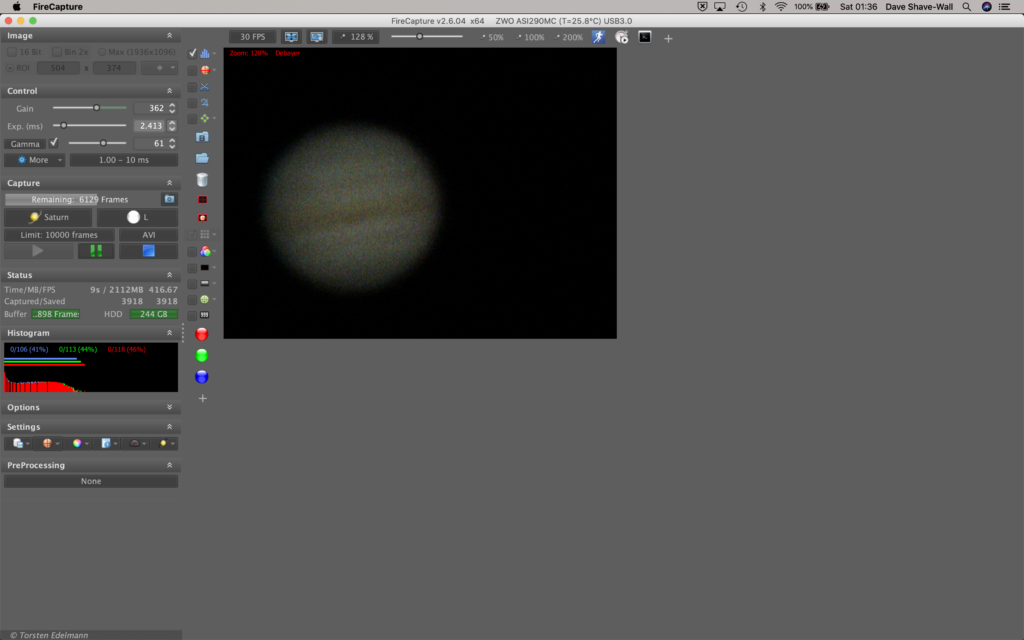
Whilst slewing around with the 12″ in the dome, I had also setup the travel scope with the Mak 180 on top. I wanted to grab some data on Jupiter in particular and Saturn just as it was nearby,.
Jupiter being imaged with Mak 180Saturn through Mak 180
I took a whole bunch of data for the next hour or so which I will process at a later time.
Slight clear spell and no work tomorrow 🙂 so I am opening dome to see if my scope is now repeatable, so can I open, get object in FoV and then image whilst guiding.
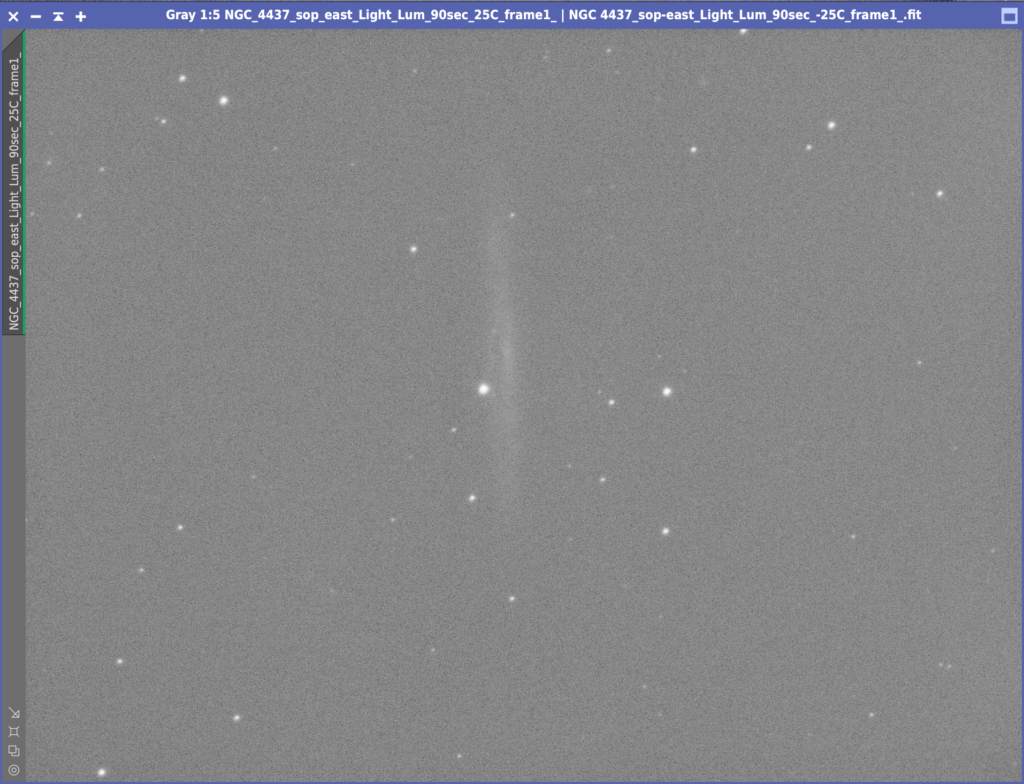
Of course as soon as I opened up the dome it became cloudy. Fortunately not for long, so I waited it out then noticed next to the Home position a galaxy, so I went to image that, NGC 4437, which is a pencil thin galaxy in Virgo.
NGC 4437
Unfortunately there was no decent guide star, even with the rotator I could not find one. So instead I took a bunch of 90s images, just short enough not to trail. I actually took 20 x 90s Lum and then 10 x 60s RGB all at Gain 10 Offset 10 and -25℃.
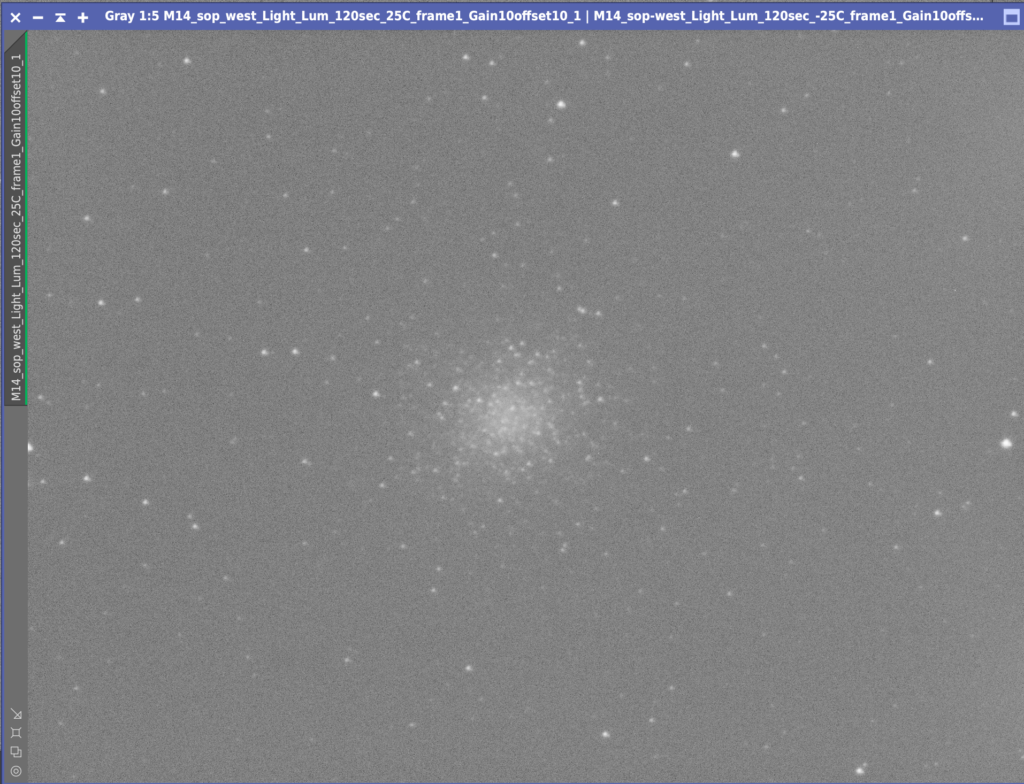
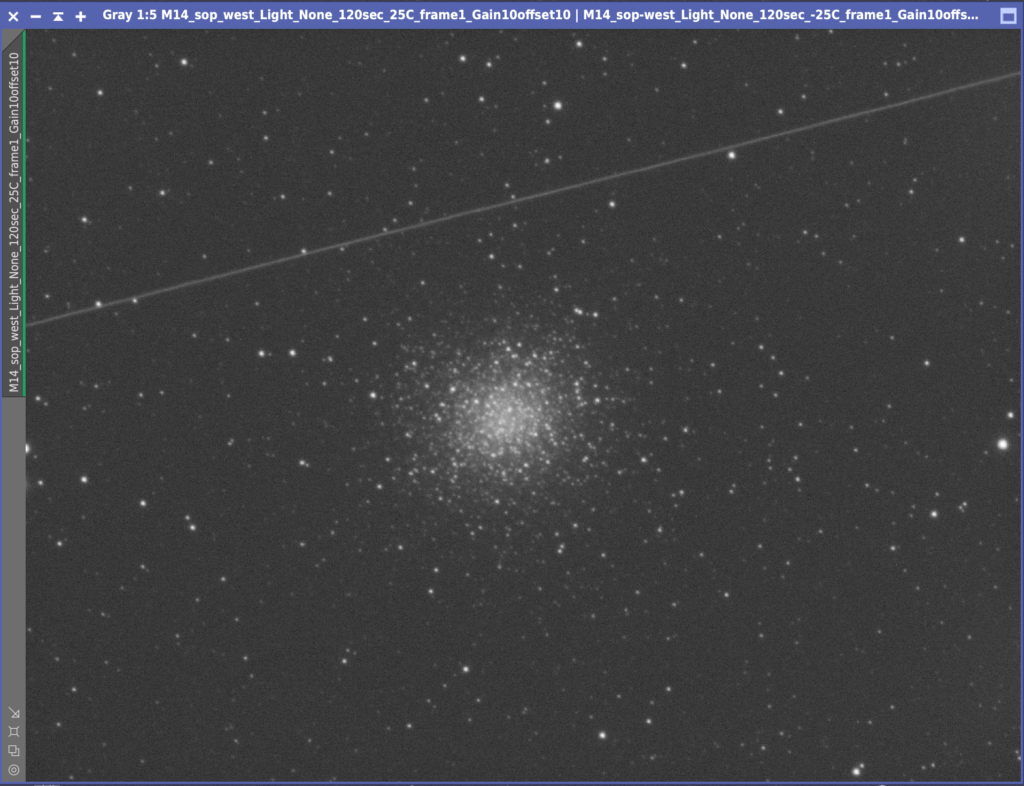
I then turned my attention back to M14, slewed and set the imaging running. Unfortunately I was only 1 frame in when I had to stop at 1:18am as the clouds had returned, so this time I packed up for the night.
M14
Learning tonight was don’t forget to focus and take some darks for the off axis guider.
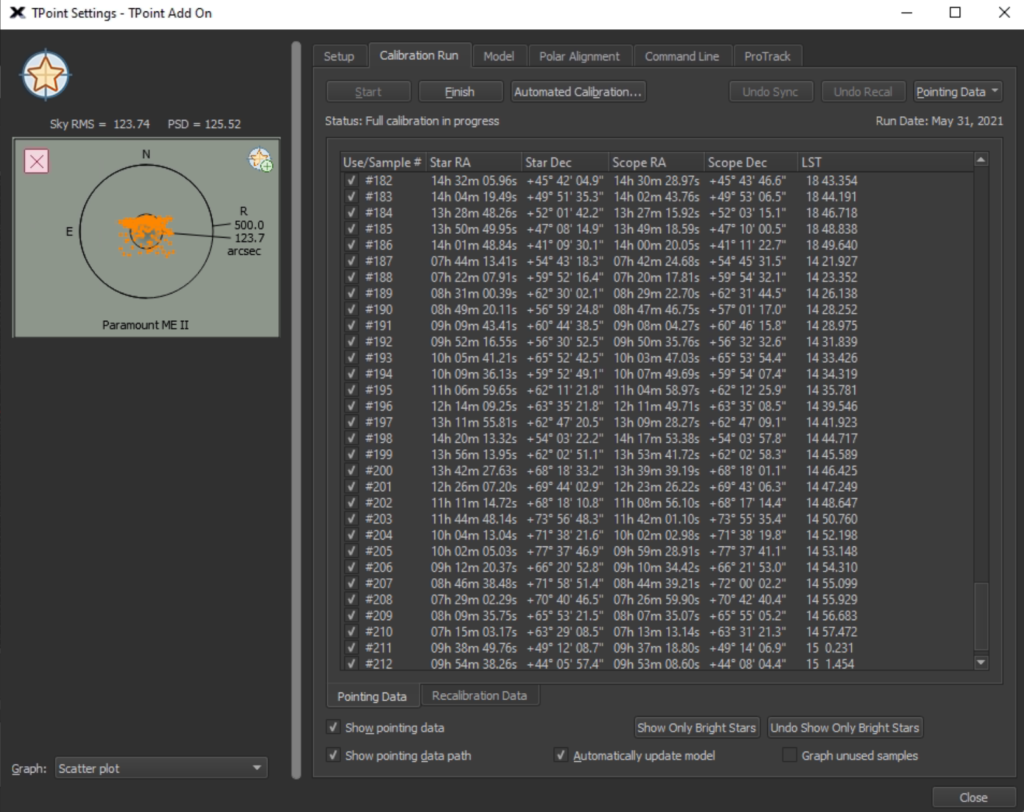
I will start by completing the TPoint run tonight before moving on to calibrate the guider and make sure I can get and image. So by 10:30pm it was just on the border of being dark enough to take and plate solve the first image and continue the TPoint session.
So by 11:30pm I had finished the 212 TPoint model.
212 TPoints
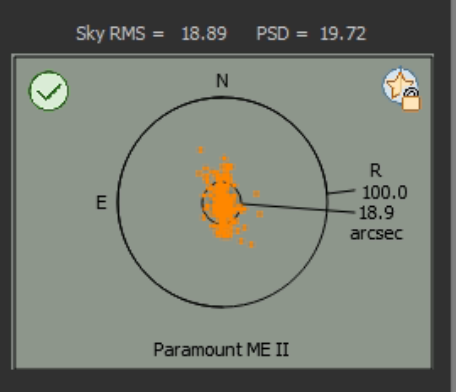
The next thing was to do a Supermodel on the data. This reduced the error pointing from 500 & 23.7 arcsecs to 100 & 19.
Model
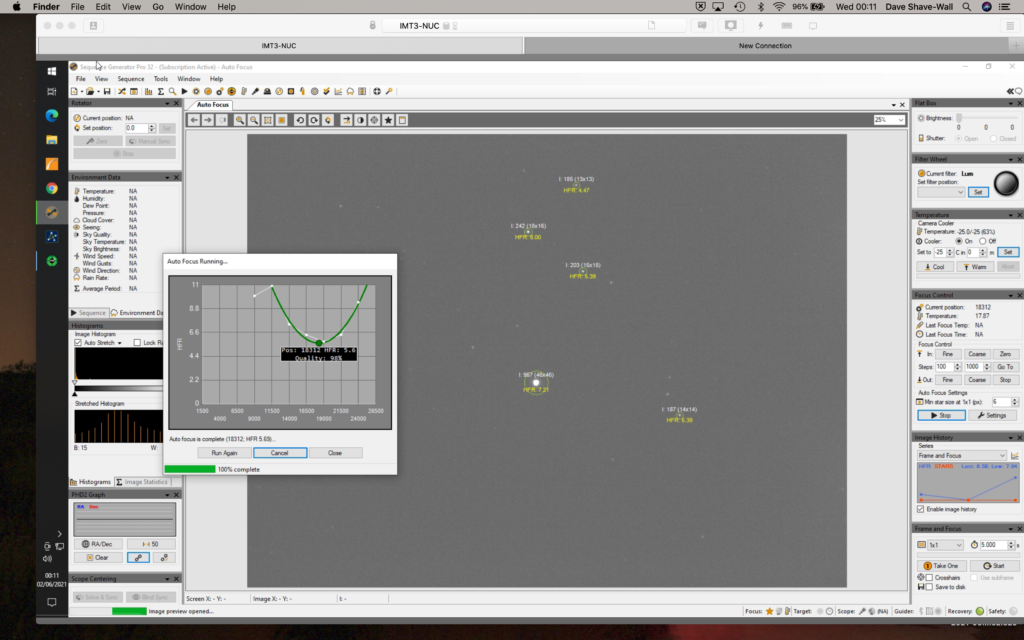
Now connected camera to SGP and running autofocus on a mag 6 star, new focus position for Luminance is 18,312 at 00:13
New focus position
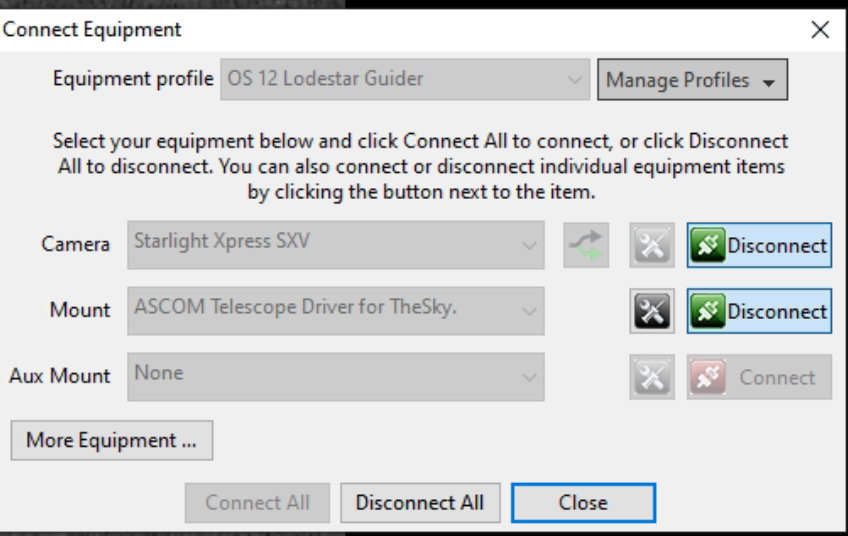
I then setup OpenPHD2 to guide and here I hit a problem. The guider did not move the mount. I have not got a guider cable attached as I do not want to do Pulse Guiding. Instead I always do Direct Guiding. So I looked at the settings in PHD2 and the mount was not set. So I went and searched my blog and I need to select the ASCOM Telescope Driver for TheySky. However it is not in the dropdown list.
ASCOM Telescope Driver for TheSky
Finally after a lot of head scratching I remember GingerGeek removed ASCOM and upgraded when I moved house. He had inadvertently removed the said driver and forgot to reinstall. I went to the ASCOM webpage, found the driver which took me to the Bisque website and downloaded. I then installed, restarted TheSkyX using PHD2 after I had restarted PHD2, I selected the said driver in the Mount dropdown and connected. This then moves the mount when I calibrate and subsequently guide. Fortunately I found all these answers on my blog posts from last year when I had setup the guiding originally.
Finally guiding
Now all of this is working it is rapidly approaching the time when the sky brightens, so it is already after 1am. I slewed to M14 using TSX, performed a Closed Loop Slew with the camera connected to TSX initially. Once I confirmed the object was in the centre of the FoV, I then disconnected the camera from TSX and reconnected to SGP.
M14
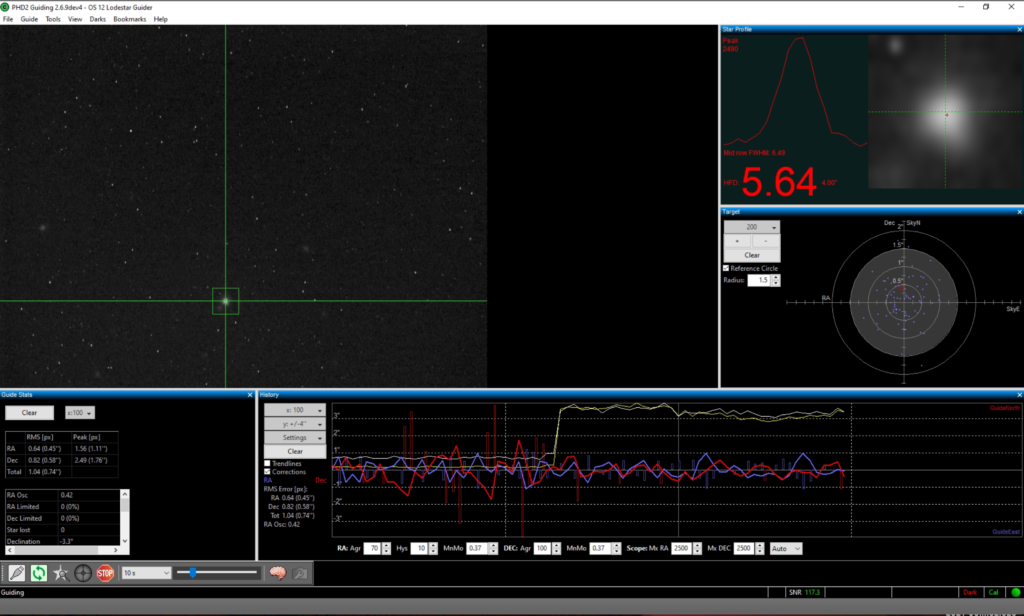
Guiding started, all started to work well. A couple of snags, focus position was wrong in the filter setup so I need to change. Tries to autofocus on start of sequence so I need to change that. I then decided to grab 1, 2 and 5 min subs of LRGB to determine the best exposure. However half way through and some localised cloud rolled in and stopped the session.
Clouds
The good thing its the closed loop slew is working well in TSX.
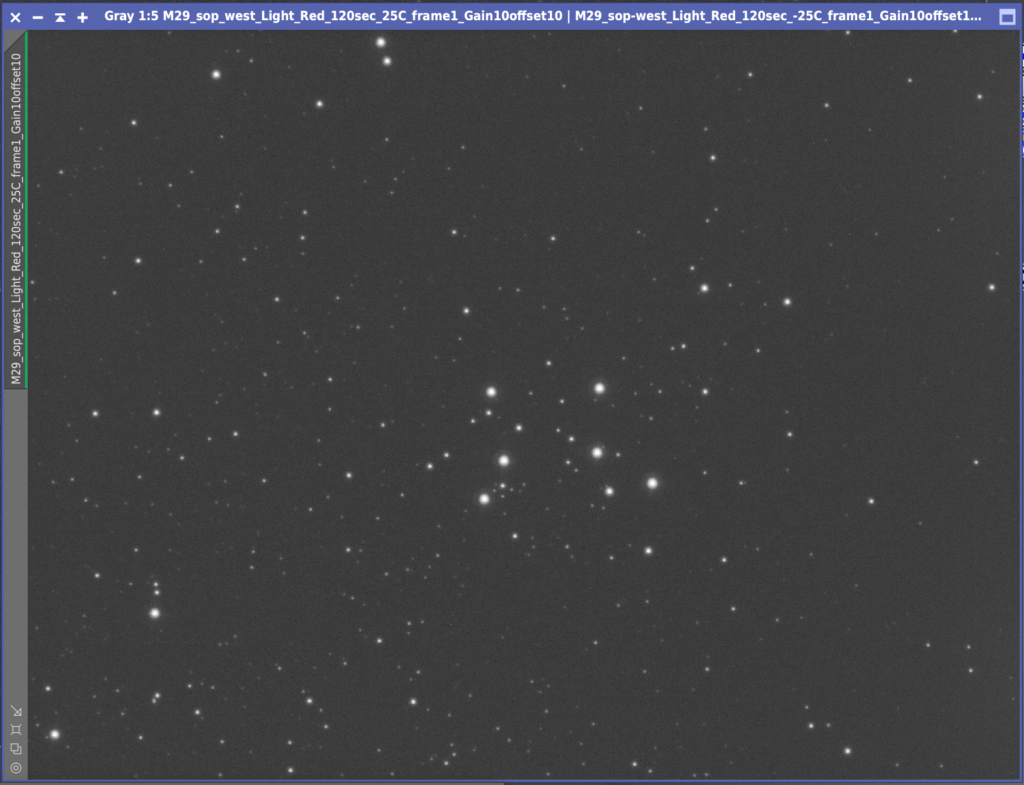
So with the local cloud still causing issues to the South, I slewed North East to another Messier target on my list, M29. Once again I setup 1,2 and 5 min exposures across LRGB to see which would be best. All the imaging tonight for Globular Clusters and Open Clusters was done at Gain 10 Offset 10.
M29 test 2mins Red
I manage to get frames and then I was afflicted by the same cloud. So instead I packed up and called it a night.
Holiday time! Well at least a week off work. It’s been a cold and cloudy Winter so far. So a night where I can get out the travel telescope and setup in the vegetable patch, the construction site of IMT3b is a good thing. The challenge I have is my ribs still hurt somewhat from being broken after an unfortunate accident 4 weeks ago. So I will go careful.
Earlier in the day I had Luke help me setup the equipment in the garden. First the binos to have a good look round.
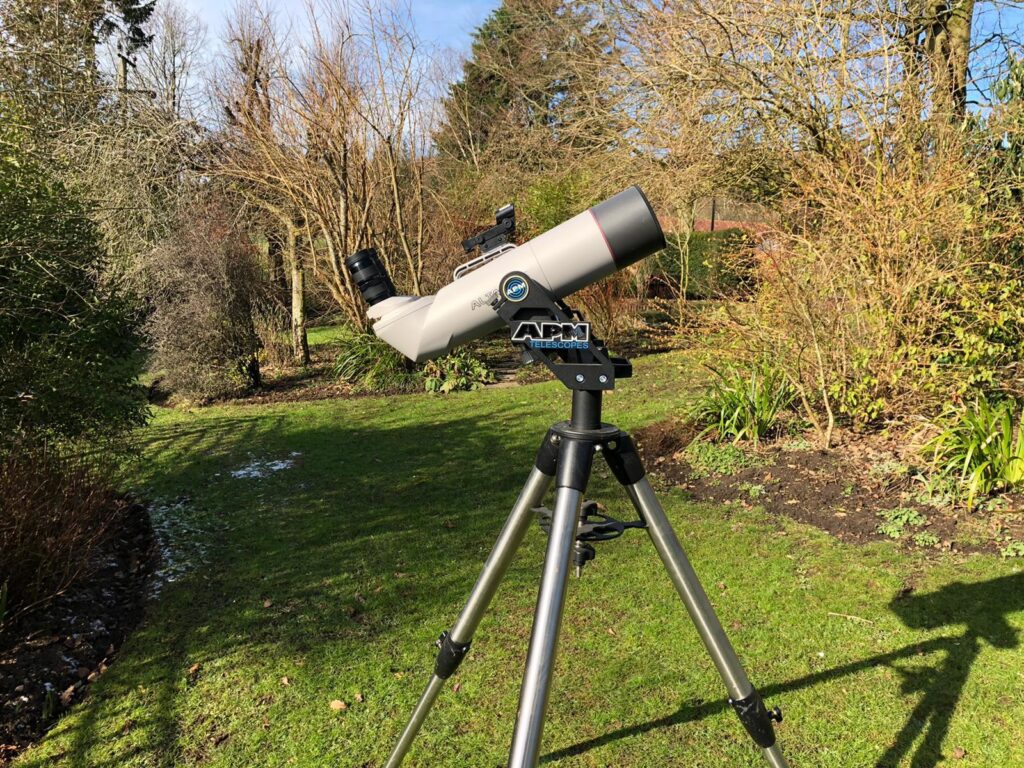
Altair Astro 100mm Binoculars and APM Mount
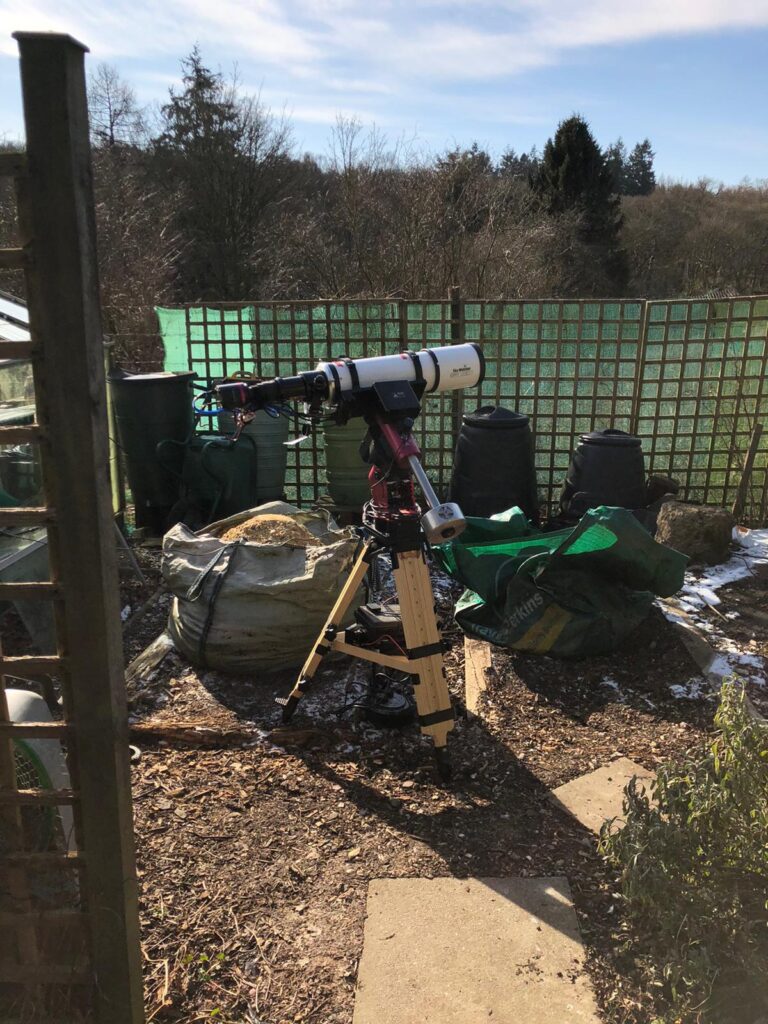
Then we setup the Skywatcher Esprit 120 ED on the Paramount MyT.
Travel scope with QHY168C camera
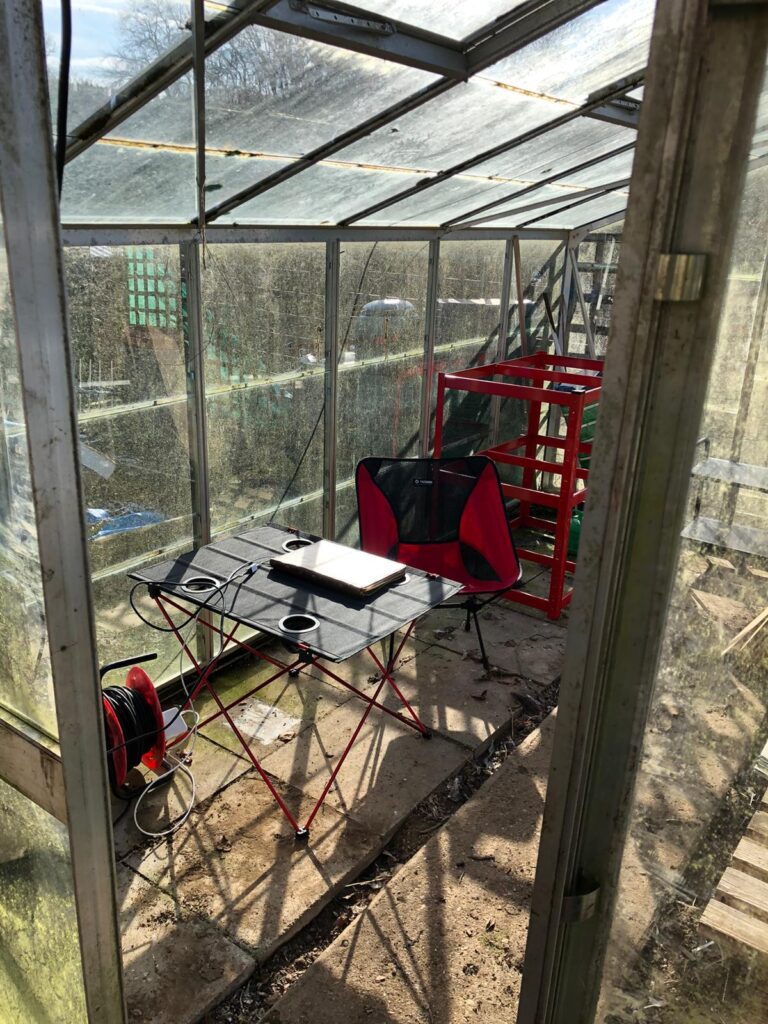
Lastly we setup a “warm room” temporary in nature and fairly cold I would later find out 🥶 in the greenhouse.
Lovely new table with my cool astronomy chair and MacBook Pro
So the night came and after Pizza with my wife I set off out to the garden to start imaging.
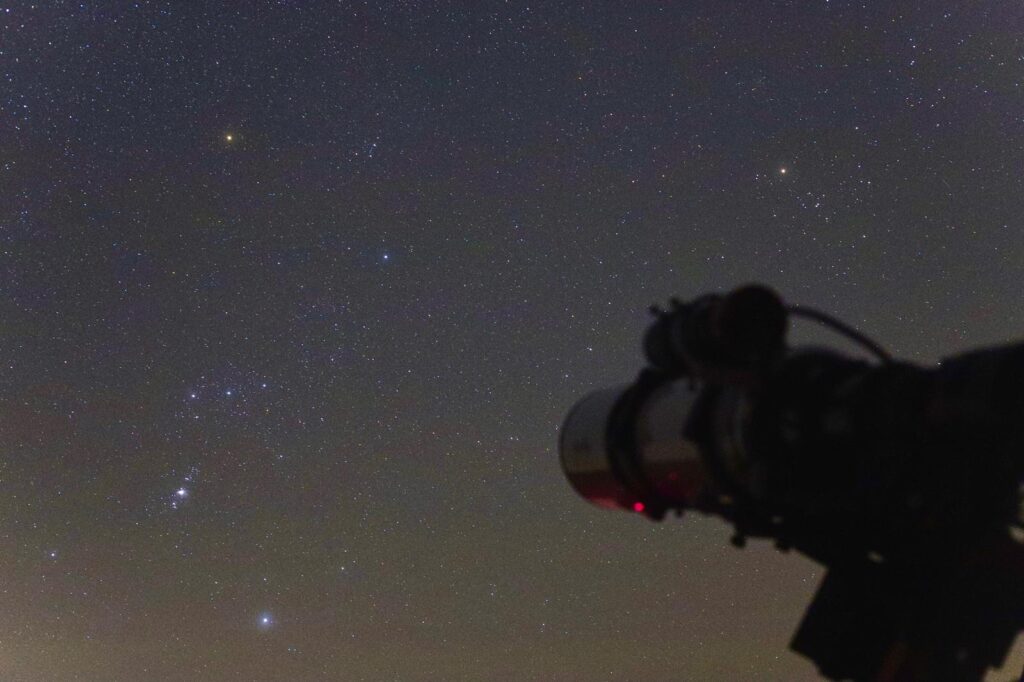
Imaging M42 Orion Nebula
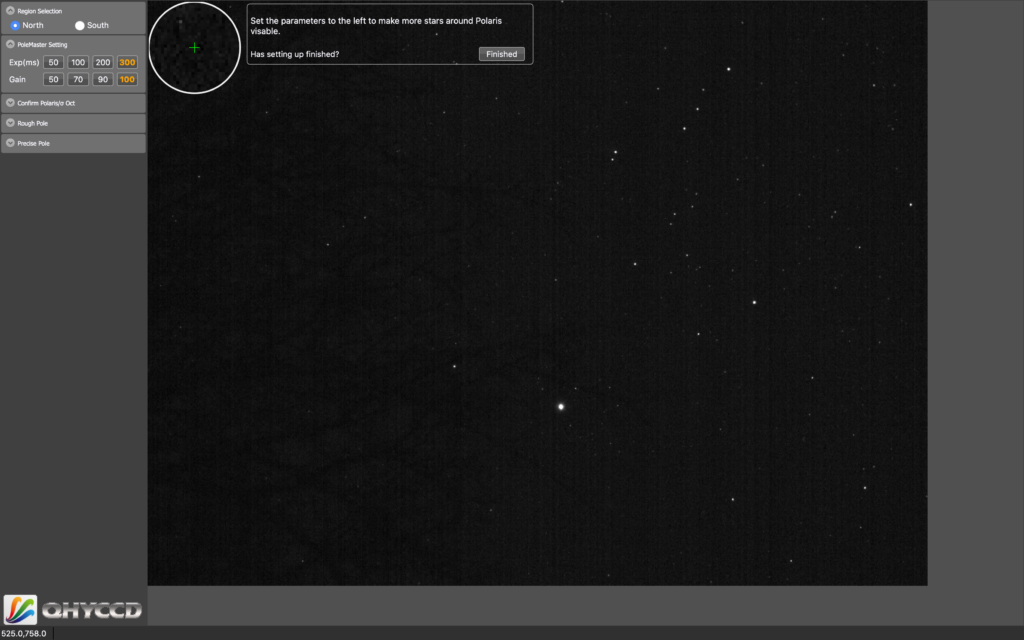
I connected the Polestar camera first to see what my alignment was like after placing the tripod down in a fashion I though condusive to being polar aligned.
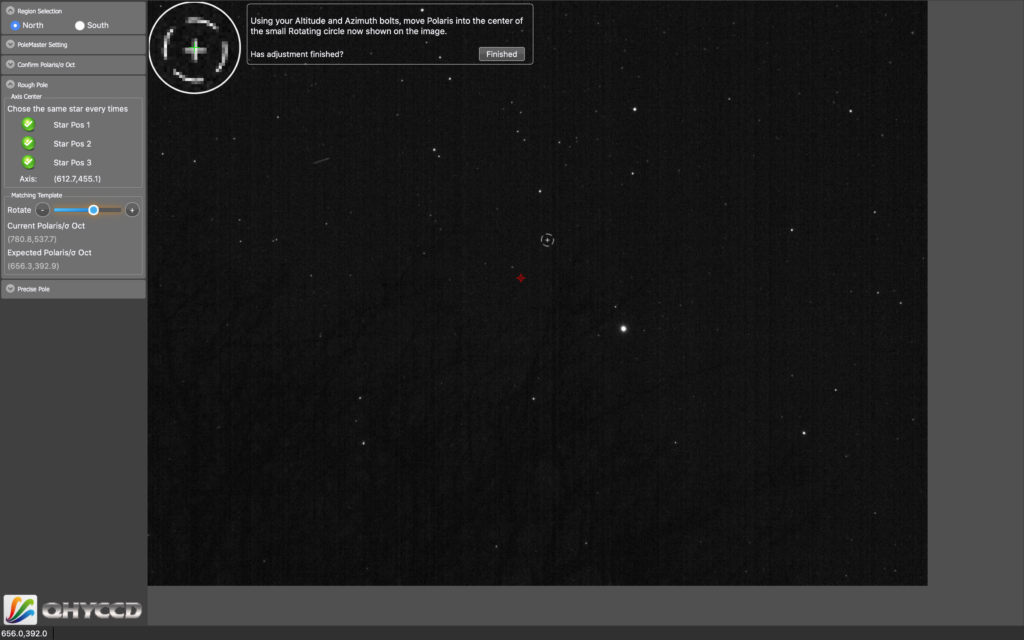
This is where polaris landed up which is not bad.
I then set about measuring the difference in Polaris to determine how much I would need to move the scope to align it.
White cross is where it needs to be
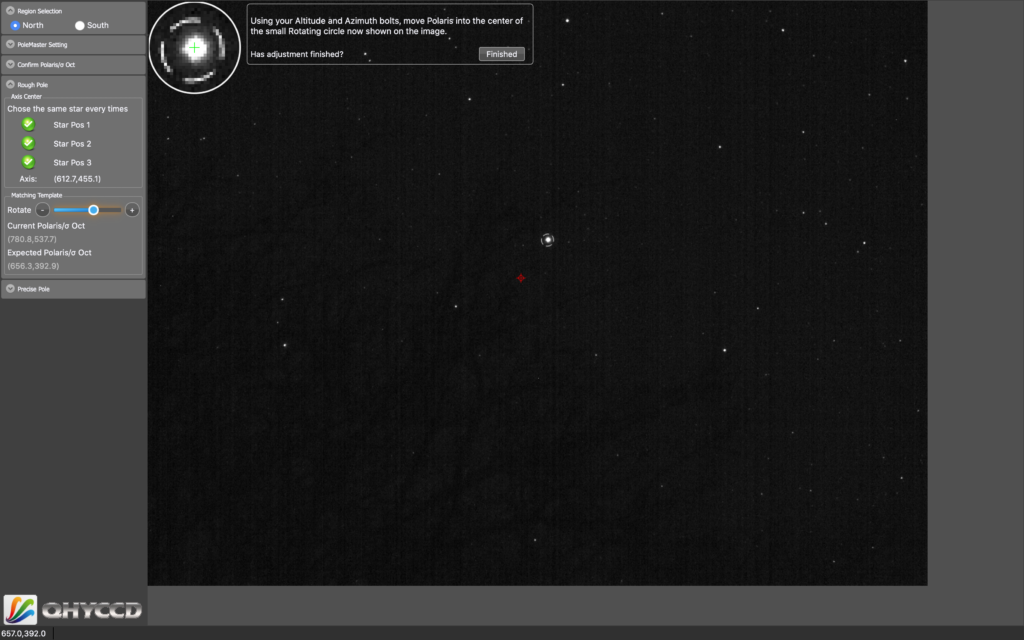
I then fiddled with the altitude and azimuth knobs to align the scope.
Perfect alignment
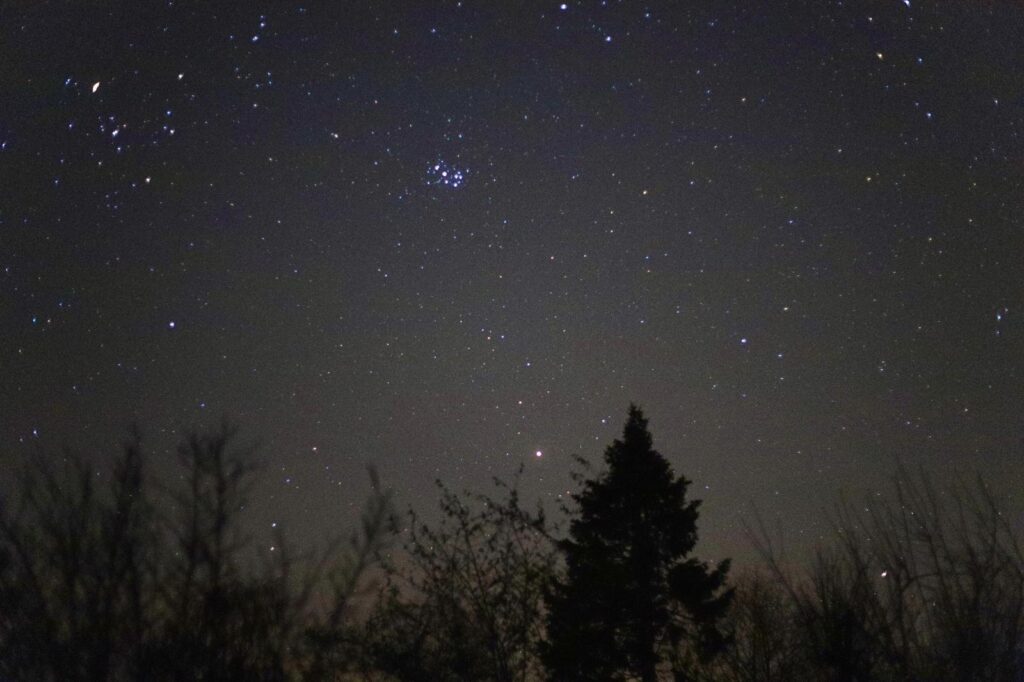
Next I slewed to the first object for the evening which was M45, the Pleiades, the Seven Sisters. I started EZCap and look at the focus which was not far off from the last time I was out a few weeks and it is good enough.
EZCap focus control
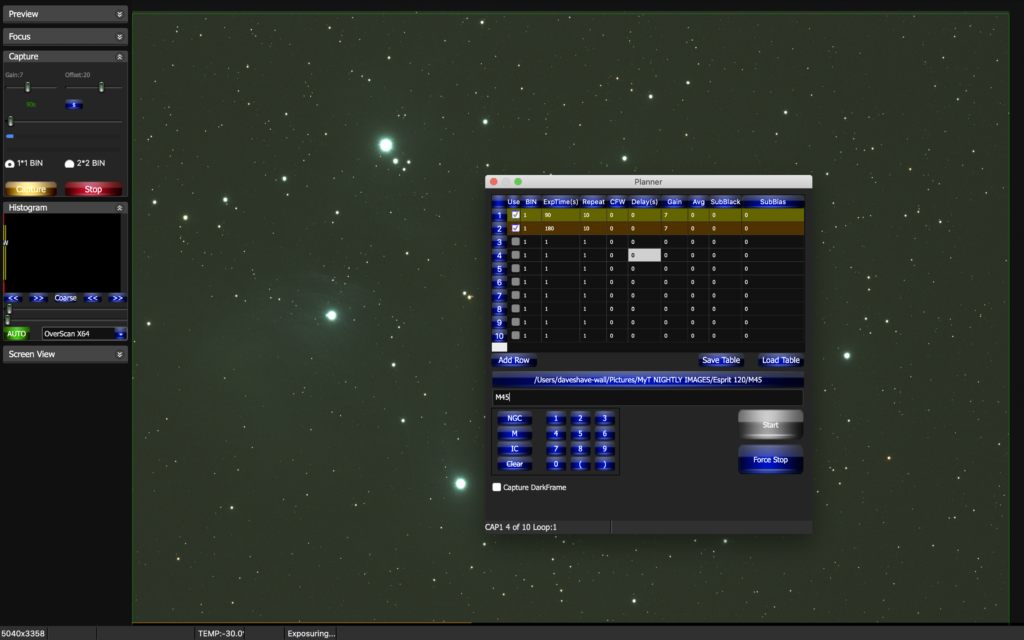
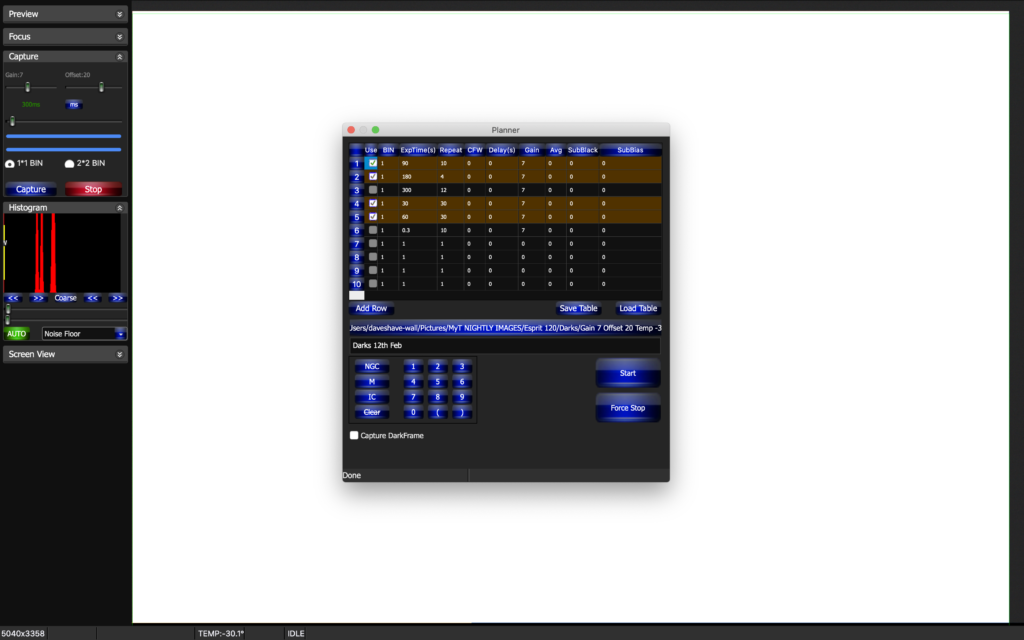
I then took an image of M45 to make sure it was in the field of view. I also setup the Planner in EZCap to with the sequence for capturing the data. I set the camera to Gain 7 and Offset 20 with a temperature of -30℃.
EZCap Planner
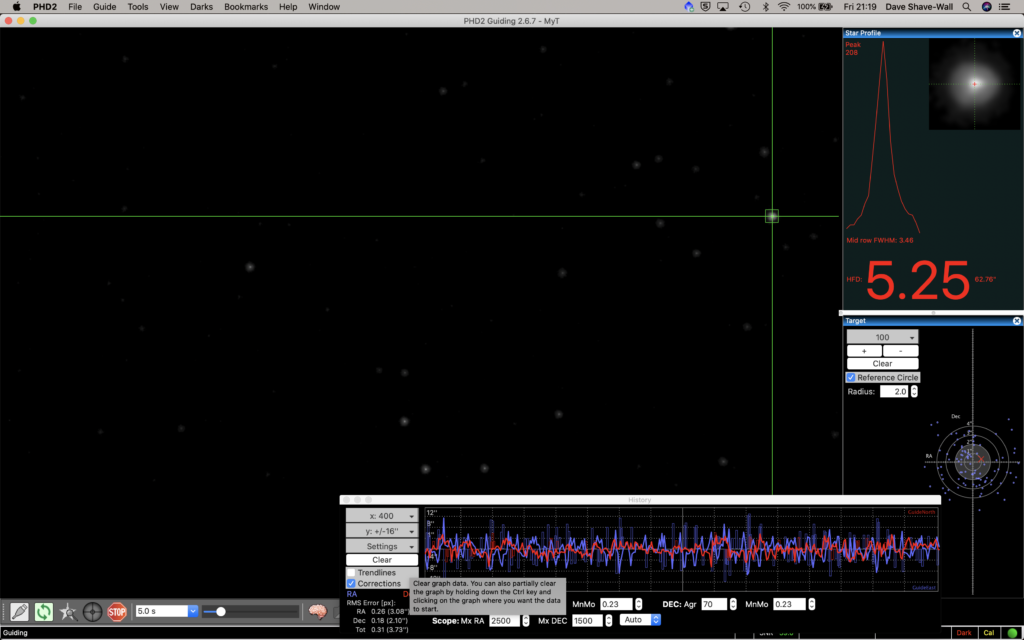
I set PHD running and that was when I hit a problem. To cut a long story short, I had forgotten to plug in the ST4 guider cable into the ZWOASI290 camera and then into the Versa plate of the Paramount MyT. Without this there is no successful calibration within PHD. It took me 1 hour to work out I needed a cable and a further 45mins to find it since the move of house. Your IQ really does drop when it is dark and cold!
Guiding started, but gusts of wind!
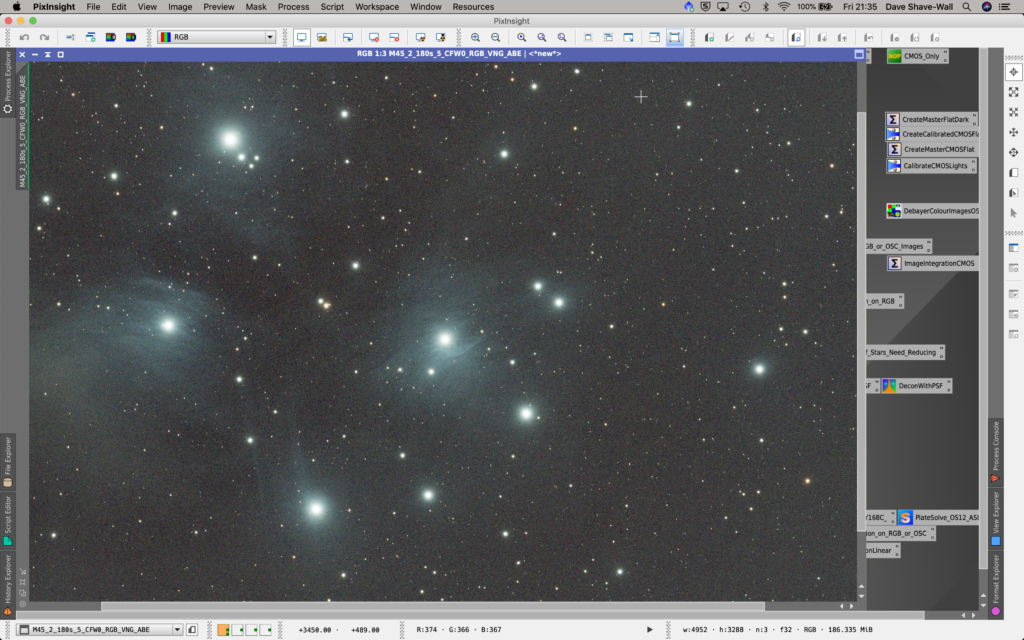
Eventually the calibration completed once the cable was fitted and I could start to see the gusts of wind in the data. I set a sequence running for M45 and was impressed with the results. I took 10 x 90s and 10 x 180s.
M45
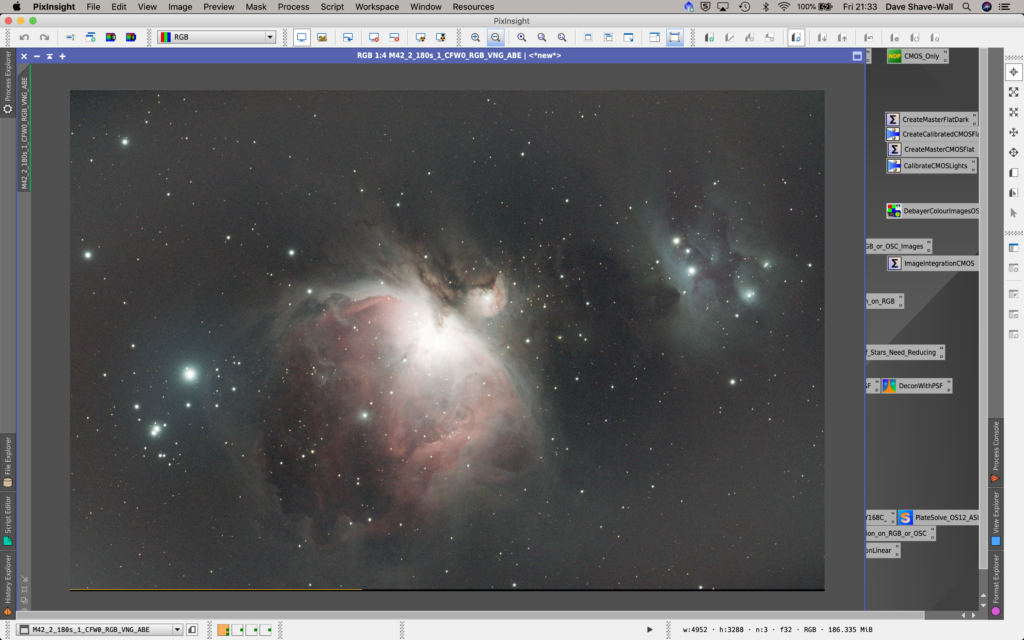
I then switched targets and headed over to M42 and M43 along with the Running Man nebula, also known as SH2-279 and NGC 1977. I took 30 x 60s, 30 x 30s and 10 x 180s.
M42
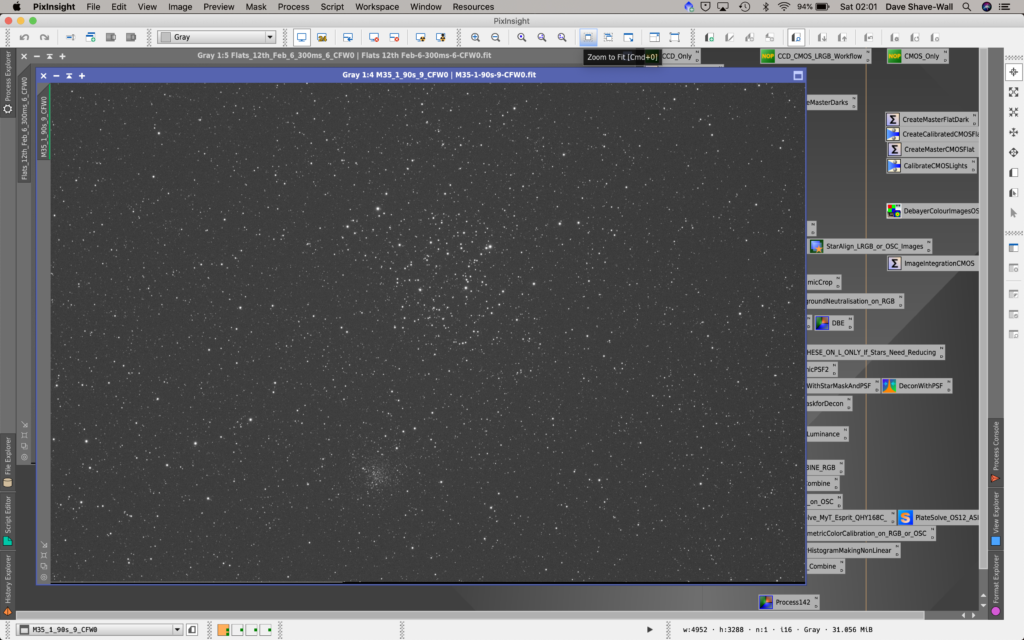
Next and what would be last on my list tonight was M35 along with NGC 2158. I took 10 x 90s and 10 x 60s starting around 23:45.
M35
Now the clouds at a high level started to roll in. So I decided to take some Flats and then take the darks tomorrow morning.
Flats
So I packed up and had one last look up at the night sky.
Decided to have a quick look out before moving house, given it was supposed to be cloudy and there is a bit of a clear spell. I have decided to just take a look at a few objects. First up is the Cheeseburger Nebula NGC 7026.
Next up is IC63 which is a ghost nebula that Tim imaged the other night, I want to see what it looks like in my 12″ vs his 10″. The first thing I noticed was in the guider window that the reflection of the bright star Gamma Cas caused an interesting image.
Guiding reflectionGamma CasIC 63 Ghost Nebula 10min Ha
Next I am going to go after M110.
M110 5 minutes Luminance
I have now slewed to M32 just below.
M32 5 minutes Luminance
The last object of tonight and then off to bed so I can be up to help Bob concrete IMT4 tomorrow is NGC 508.
Bob, Dave and GingerGeek playing with the Tak 102 this evening and just image for 2 minutes on various targets.
Slewed to the Double Cluster first.
Focus position was 564 from the last time we used it a long time, it is now 578.
Took a 2 minute exposure
Double Cluster
Slewed to M75 the Little Dumbell. Needed to take a 5 min exposure to see
M76 Little Dumbell
Slewed to M34 Open Cluster.
M34 Open Cluster
Slewed to NGC 1023 a barred spiral galaxy. Took 5mins exposure at 22:12.
NGC 1023 Galaxy
GingerGeek went off to bed whilst Dave and Bob continued.
Slewed to NGC 1260 a lenticular galaxy in Perseus.
NGC 1260 Galaxy
Slewed to NGC 1545 an open cluster but it was behind the house.
Slewed to IC 1848 the Soul nebula.
IC 1848 Soul Nebula
Slewed to Heart nebula.
IC 1805 Heart Nebula
Slewed to IC 1831 an HII cloud.
IC 1831 Nebula
Slewed to IC 1795 nebula.
IC 1795 Nebula
We found at this point that some of the images were trailing at 2 minutes in the East so we started to use guiding.
Slewed to NGC 1245 open cluster. [not imaged]
Slewed to NGC 1220 open cluster. [not imaged]
Slewed to NGC 1528 open cluster at 23:37
NGC 1528
Dave went off to bed whilst Bob continued.
Slewed to IC 1795 Nebula.
IC 1795 Nebula
Slewed to IC 1831 Nebula.
IC 1831 Nebula
Bob then slewed back to a number of the objects as they had trailed including, IC 1805 Heart Nebula, IC1848 Soul Nebula, IC 1260, NGC 1023 barred spiral, M34, M76, Double Cluster
GingerGeek and I were out imaging tonight. The sky unexpectedly cleared and we thought given the impending move of IMT3 to another site that we would try to gather some more data on M57, specifically LRGB and some additional Ha on the 12″.
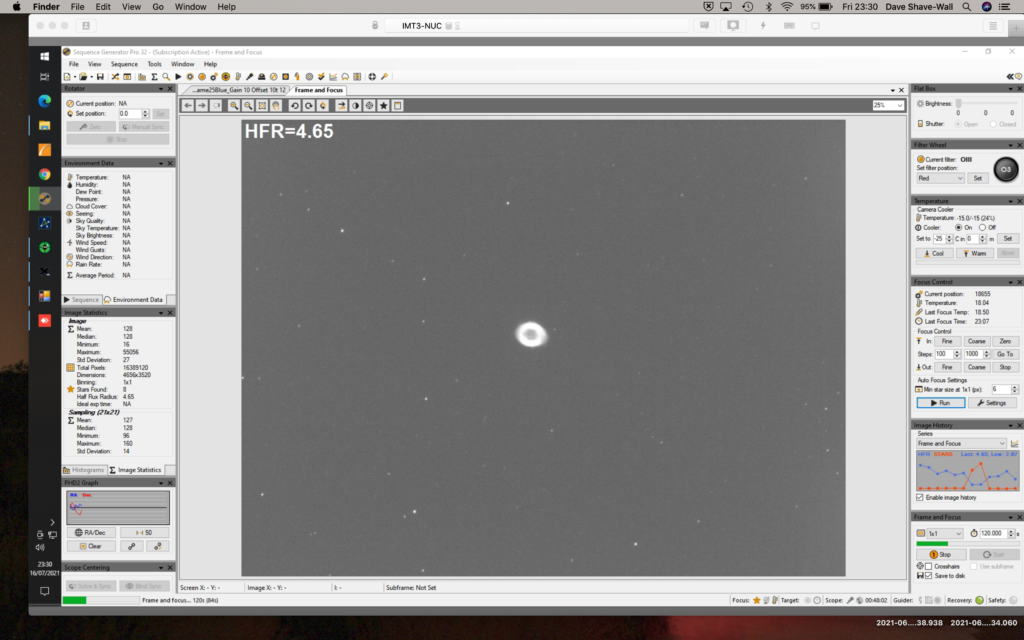
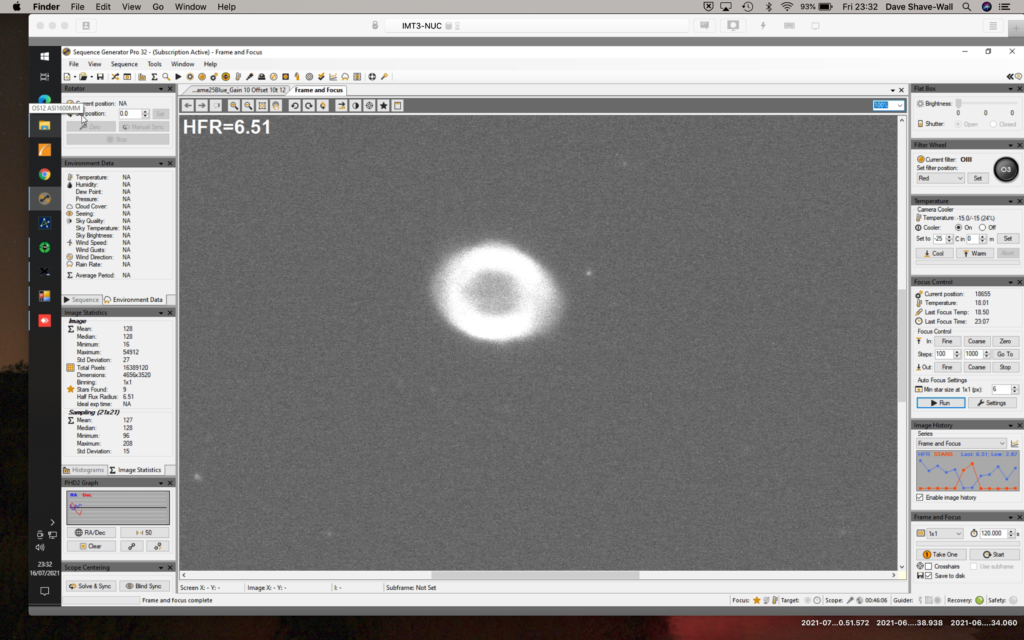
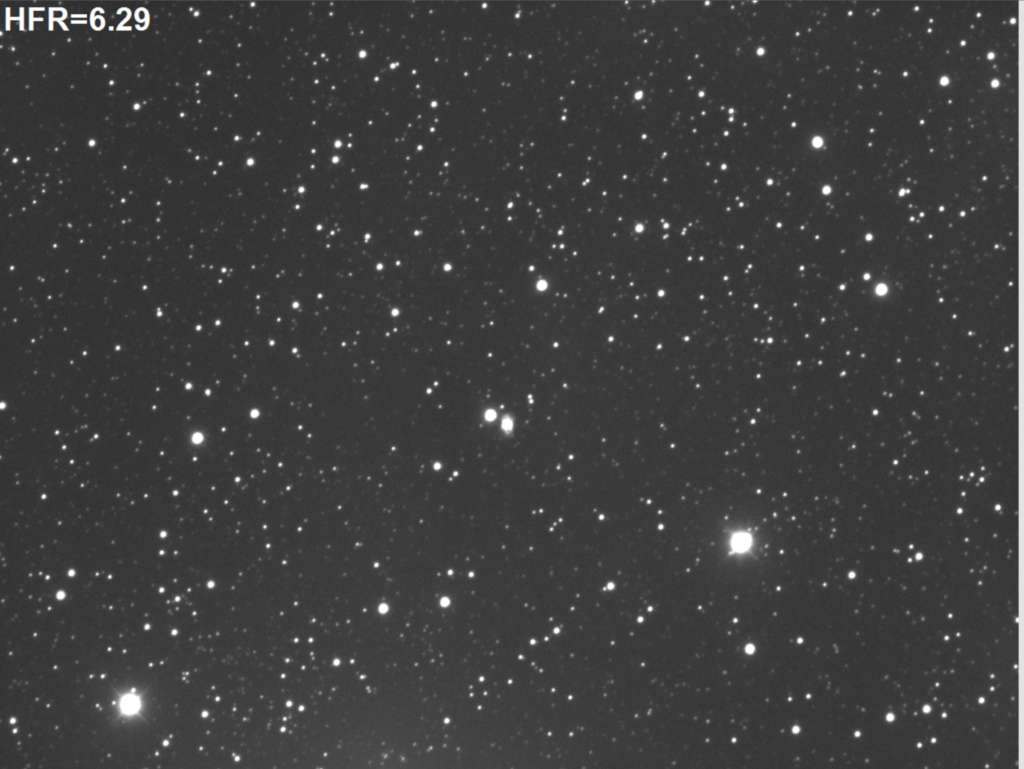
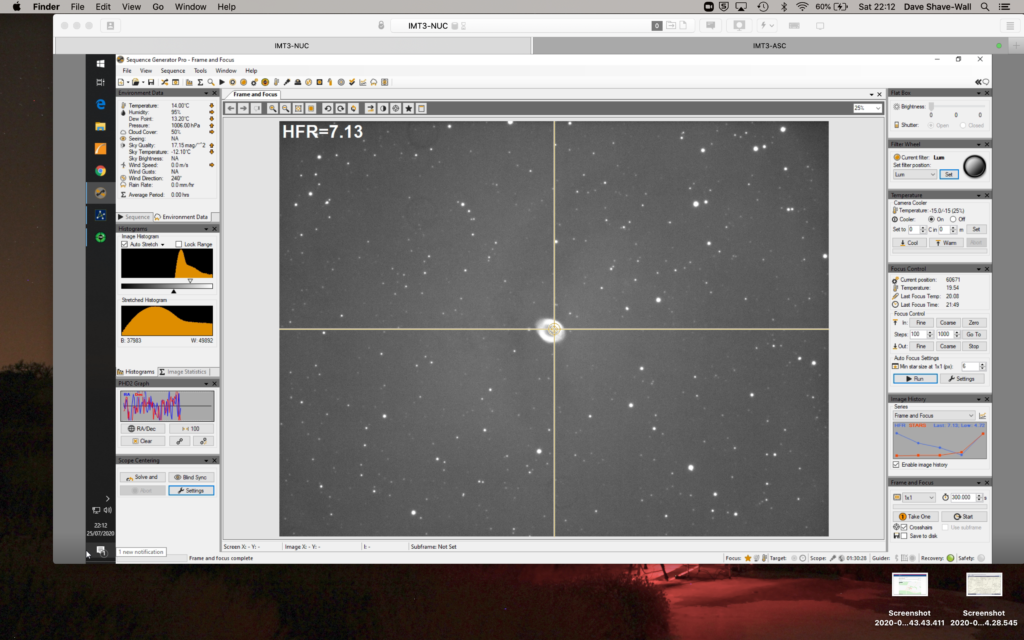
We ran Autofocus on Luminance which gave 60,671 at 20.64℃ and HFR 6.5. We then started to image and after a few frames the temperature started to drop. In the main this is because we opened the dome last minute rather than a minimum of 2 hours before we used it so the dome was warm and now cooling down the optical train shifts.
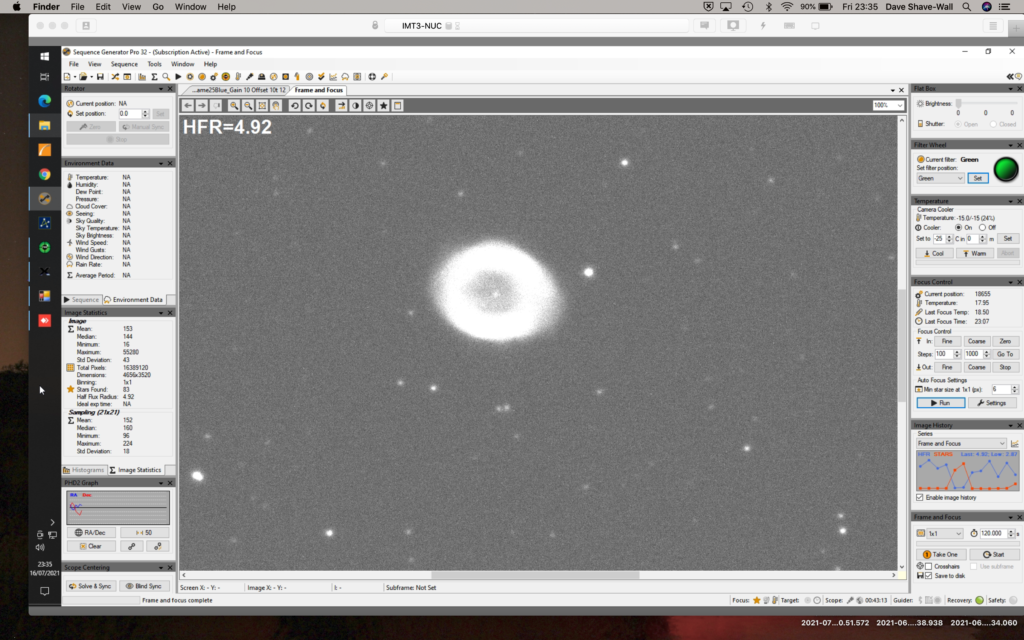
M57 quick frame and focus
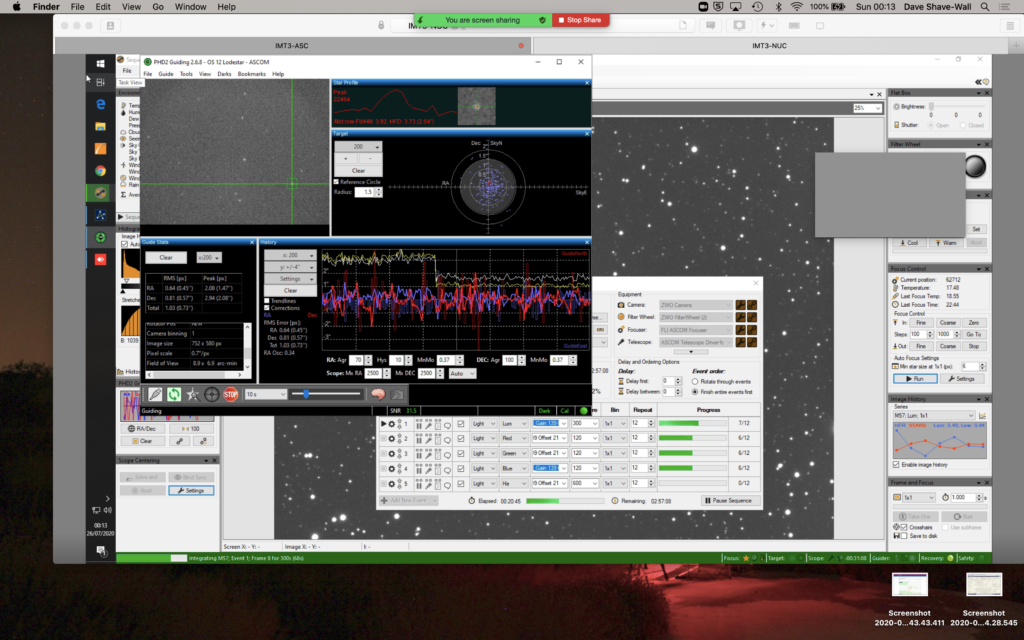
We refocused to 62,712 on luminance at 19.10 with an of HFR 5.15. We then ran the image acquisition and below is a screenshot of the guiding, which looked like it was going to cause an issue but it was ok. If it had then it would have been the local fog rather than anything on the mount. At midnight we performed a Meridian flip nice and early which afforded us to leave the observatory running and go to bed. Notice the graph below, the yellow line drops as we performed the meridian flip, this is due to the dome now shielding against next doors light !!!!!!!
Guiding ok, notice the drop in the graph
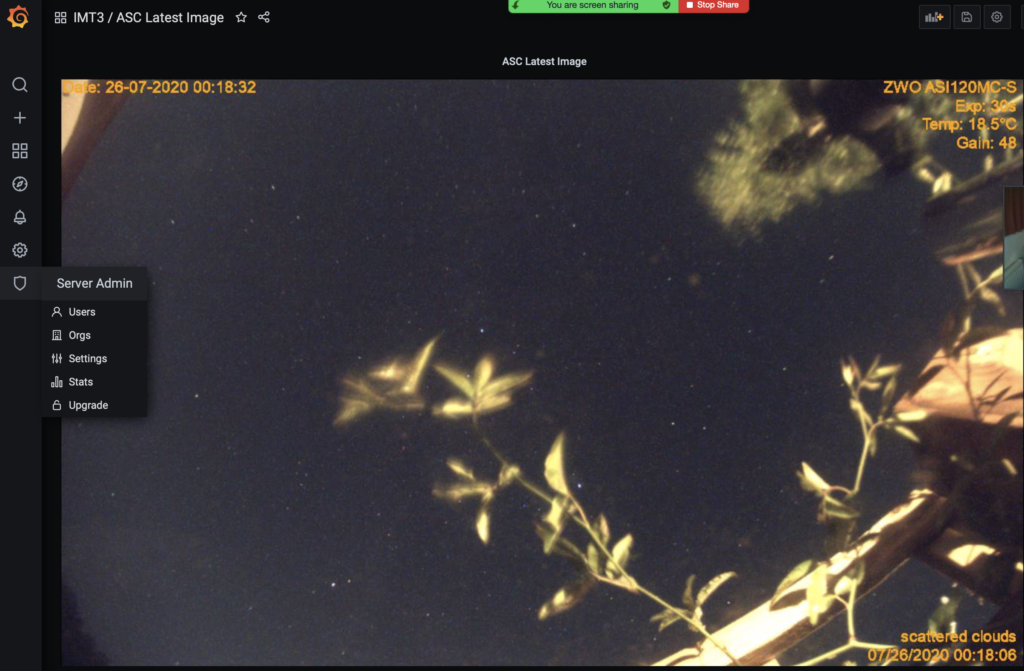
The neighbours light continue to be a pain as can be seen here, I really cannot wait to move the observatory to it’s new dark site.
LIGHT!!!!!
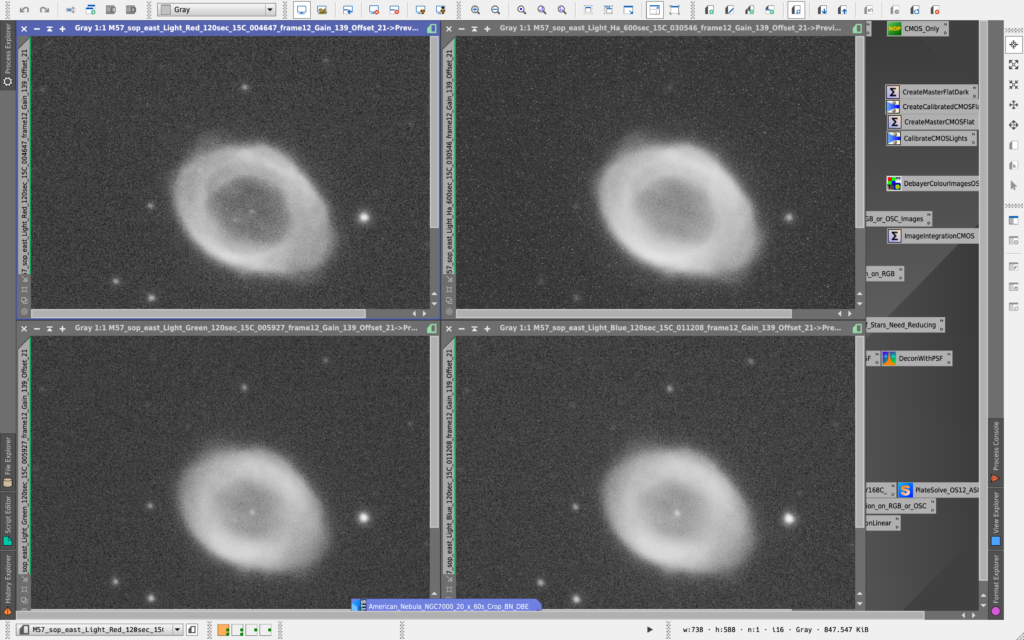
Finally managed to capture LRGB and Ha, below the RGB and Ha frames can be seen in PI. Note the central star is not visible in the Ha frame,
RGB and Ha raw frames
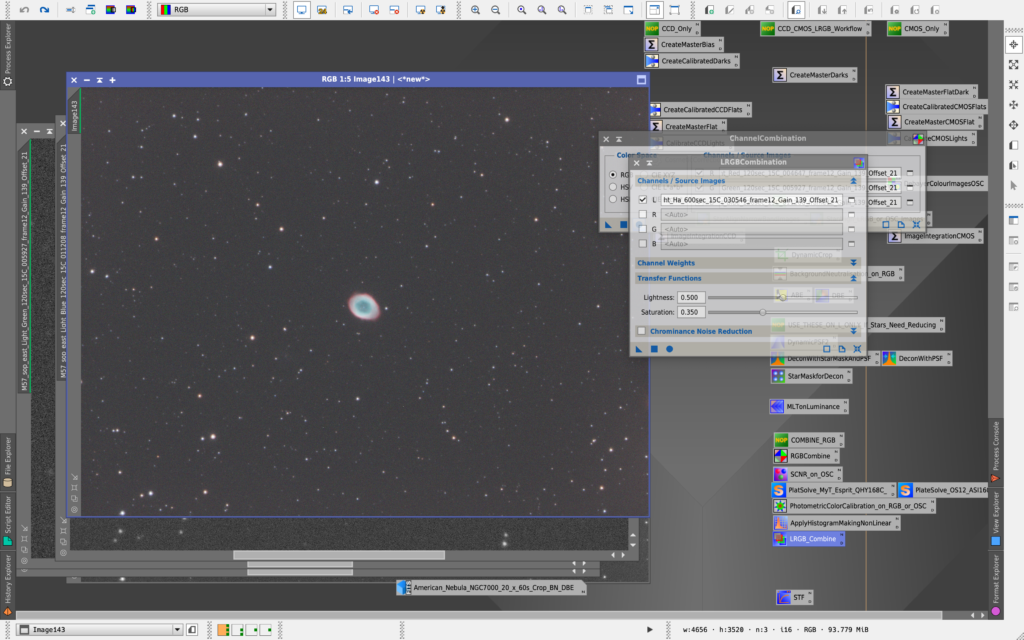
Finally I stacked 1 of each colour without calibration to see what it would look like.
RGB quick single stack no calibration
So we left the observatory imaging, I had a quick peek outside around 12:30am and there was water running off the dome and the outside windows of the orangery! The Observatory ran until the dome shut at 3:58am (it woke me up) when the light levels started to rise.